Translate

Showing posts with label Ring of Kerry. Show all posts

Thursday, February 28, 2019

Dingle Peninsula VS Ring of Kerry

Cow in the green pastures of county Kerry, Ireland

Are you struggling to decide between driving Ireland's uber-famous Ring of Kerry and the lesser known Dingle Peninsula?  Then this is the blog post for YOU!  I have some pros and cons for each drive, to help you choose what will work better for your perfect Ireland road trip itinerary.


Sunset over the Dingle Peninsula county Kerry, Ireland
Sunset Views of the Dingle Peninsula 
I was fortunate enough to spend a week renting a thatch-roofed cottage on the actual ring of Kerry between Cahairsiveen and Killorglin, allowing me to drive around both the Ring of Kerry on the Iveragh Peninsula and the Slea Head Loop on the Dingle Peninsula.  Many folks have asked me which scenic drive I would recommend to them because they have limited time on the West Coast.  If you are getting around by public transport, then your choices are minimal, especially if you are travelling in the shoulder or off-season.   Tour buses leave from Killarney to drive around the Ring of Kerry making this a much busier road to drive than the Dingle's Slea Head Drive.  So if you want to avoid crowds, head to Dingle. If driving in Ireland makes you nervous, and you don't want to rent a car then the Ring of Kerry would be your choice, because there are very few tours offered for the Dingle Peninsula.  This article is geared towards travels who have access to a vehicle.


Views

Both the Ring of Kerry and the Slea Head drive offer stunning ocean views.  The Slea Head road is closer to the sea, whereas The Ring of Kerry has some beautiful cliff-top vistas overlooking the Atlantic Ocean.  You can also take a side road off of the Ring of Kerry and drive the 32 kilometres Skellig Ring Road to see the beautiful Cliffs of Kerry and Skellig Islands off in the distance.  
My vote for better views goes to the Dingle Peninsula because you are driving next to the ocean more than on the Ring of Kerry.

The green cliffs of Kerry near Portmagee, Ring of Kerry, county Kerry, Ireland
The Cliffs Of Kerry
Road at Slea Head , Dingle Peninsula, County Kerry Ireland
Slea Head


Historical Points of Interest

There are many archaeological points of interest on both scenic drives, yet each loop holds different and unique sites. 


Dingle Peninsula's famous early Christian church Gallarus Oratory
Gallarus Oratory, Dingle Peninsula


Slea Head has beehive huts that were used by early inhabitants and later by Christian Monks.  Gallarus Oratory is a very early Christian church that was made by hand corbeled stone in a stunning setting.  Kilmalkedar Church with its Celtic cross graveyard and ancient Ogham stone is picturesque and evocative. DUNBEG RINGFORT IS CLOSED.   If you want to see a stone ringfort, you will have to see it on the Ring of Kerry. 


Staigue stone ringfort located in the rolling hills along the Ring of Kerry
Staigue Ringfort, Ring of Kerry


Ring of Kerry has three bronze age stone ring forts; two at Cahirsiveen and a huge one at Staigue Ring Fort. The cute town of Kenmare has a  prehistoric pagan stone circle in the middle of the city, and Killarney National Park on the Ring of Kerry has a ruined castle and a few deserted abbeys to explore.

My vote is tied between these two drives; each has completely different types of historical monuments.


Attractions


Jaunting car parked on lawn of Muckross House in Killarney National Park, Ring of Kerry, County Kerry, Ireland
Jaunting Car At Muckross House


With Killarney National Park being situated on the Ring of Kerry, the town of Killarney is much better set up for tourist activities than Dingle.  Killarney Park has Muckross House and Traditional Farms which is a grand Victorian House, and it's working open-air museum farm, Ross Castle and Muckross Abbey.  You can hike many of the gorgeous trails in Killarney park, rent a bike and explore the park, rent a boat, take a boat tour or hire a jaunting car through the Gap of Dunloe. 

Mysterious Beehive shaped huts on the Island of Skellig Michael, Kerry Coast, Ireland
Mysterious Beehive Huts On Skellig Michael


Another famous tourist attraction that is along the Ring of Kerry is the Skellig Islands.  Skellig Michael is a remote island 12 miles off the Kerry coast that is one of two of Ireland's  UNESCO world heritage sites.  The islands have become very popular in the last few years because of the filming of the Star Wars movies, and you must READ THIS BEFORE GOING TO SKELLIG MICHAEL!

Honourable mention for attractions on the Ring of Kerry is Derrynane (rhymes with Mary Ann) House, which was the home of Daniel O'Connell who gained equality for Catholics in Ireland back in the 1800s.


The town of Dingle has an aquarium called Oceanworld that is very popular with children. See www.dingle-oceanworld.ie for more information.  Another favourite activity in Dingle is a boat cruise around the harbour to spot Fungie the dolphin, Dingle's wild "mascot."  Or * NEW FOR 2019* you can take a cruise from Dingle to the Skellig Islands (this is not a landing tour, just a boat trip.  Check out Dingle Bay Charters for their cruise schedule.  If you want a taste of "real Ireland" visit the Blasket Islands just off the coast of Dunquin. Dingle Bay Charters in Dingle harbour has a ferry service daily to the remote Gaelic speaking Islands.  If you don't want to make the trip all the way out to Great Blasket Island, you can stop in at the Blasket Islands Visitor Center in Dunquin.  

My vote: Offering so many more attractions and activities, I would have to say the winner for the best attractions is Ring of Kerry.

Beaches

Both the Ring of Kerry and the Dingle Peninsula have gorgeous sandy beaches, some are popular swimming areas full of frolicking children, and some are a bit more isolated and remote feeling.  For two of the most popular swimming beaches here my picks:


View of Ballinskellig Castle on Ballinskellig Beach, Skellig Ring Road, County Kerry, Ireland
Ballinskellig Beach photo by Patrick Cotter

Ballinskellig Beach (also known as Ladies Beach) along the Skellig Ring Road has a 1-kilometre long sandy strand, lifeguards on duty in July and August, and the ruins of a 16th-century castle to explore.  Most of the beaches along the ring of Kerry are located around the village of Sneem or around Ballinskellig on the Skellig Ring Road.  This is a popular beach with locals and holiday cottage renters in the summer, so finding parking can be a bit difficult.


Sandy beach of Inch Strand near Dingle on Dingle Peninsula, County Kerry, Ireland
Inch Strand Near Dingle

Inch Beach or Ínse (in Irish meaning Sea Meadow) is a sandy spit that juts out four miles into Dingle Bay making it the biggest beach in County Kerry.  This beach is perfect for swimming, beachcombing, horseback riding and surfing.  You can also drive up along the sand at Inch Beach!  There are several surf schools located on Inch Beach that offer lessons from May through September and surfing is great year round.

This was a tough decision!  My vote for the best beach would have to be Inch Strand, on the Dingle Peninsula.  


Towns


Busy shopping street of Kenmare, Ring of Kerry, County Kerry, Ireland
Downtown Kenmare

While Killarney is a large town on the ring of Kerry, for me it lacks charm and authenticity.  It seems like Killarney is all just strip malls and chain hotels with a lot of forgettable pubs and restaurants.  While there are many other charming towns on the Iveragh Peninsula like Killorglin, Waterville, Sneem and Kenmare which is my favourite on the Ring of Kerry.  Kenmare is an ancient market town that is very easy to walk with lots of shops, restaurants and pubs.  There is also a stone "Druid's Circle" in the city that dates back over 3,000 years!

Busy main road lined with colourful shops in Dingle, County Kerry, Ireland
Dingle's Colourful Main Street


The Dingle Peninsula's namesake town of Dingle, however, is one of the most charming places on the West Coast of Ireland.  Nestled on the water's edge, Dingle is a fishing port before a tourist town.  Colourfully painted little shops and restaurants line Dingle's streets and keep tourists happy.  Dingle's real charm comes out at night when locals and tourists alike head into the pubs for a pint and a session.  A "session" you may know is an evening of Irish Traditional Music, and in the evening out of almost every pub spills the sound of drums, fiddles and lots of laughter.  Dingle is rather well known in Ireland for its music scene, and it is worth spending an overnight, other than Dingle there are no other towns that I would say you must stop to visit.

The vote here would be for Dingle on the Dingle Peninsula for quality over quantity. Dingle is a super little town!

There you have it, folks!  If you have limited time on Ireland's West Coast, I would head over to Killarney National Park, then overnight in Dingle and drive the Slea Head Loop trail.  If you do have the luxury of time to do both drives I would highly recommend it, as each peninsula is unique with a unique vibe on each.

Have you been to County Kerry?  What was your favourite drive?

Follow me on FACEBOOKINSTAGRAM  and  BLOGLOVIN'  for daily photos and updates! #slowtravel🐌 #dulgomall

Sunday, December 9, 2018

How To Hire A Jaunting Car In Killarney National Park


Ahhhh, Ireland!  The feel of the sea breeze on your face, the sound of the horse's hooves on the gravel, the rhythmic sway of the cart, and the smell of a turf fire lingering in the air.  What could be a more romantic and elemental experience than a jaunting car ride?


What is a jaunting car?

An "outside" jaunting car

One sees jaunting cars all over Killarney National Park.  A jaunting car is a horse-drawn two-wheeled cart that was the traditional transportation at one time in Ireland.  There were three main types of jaunting cars: the "outside car" where the passengers faced outside sitting on top of the wheel well and the "inside car" where the passengers sat inside the car facing each other and their backs to the sides of the cart.  The third type of jaunting car is the "covered car" which is an inside car with a canvas cloth roof overhead to protect the riders from the elements. 

The driver of a jaunting car is called a "jarvey," and they are world renowned as being great storytellers of Irish myths and legends and excellent local historians.  Many people are turned off jaunting cars because they feel it is too touristy.  But I beg to differ... 


Why take a jaunting car?


Gerry The Horse and His Jarvey
I know many people claim the jaunting cars are rip-offs and hate the jarveys "hassling" the tourists, just like some folks hate the Gondola drivers in Venice.  While locals don't take jaunting cars anymore like Venetians don't take gondolas, it still is an authentic Irish cultural experience.  Here's why:
1) Jaunting cars are the traditional vehicle locals used to get around in Ireland (just like a Gondola in Venice).  2) Jaunting cars offer a unique perspective of your surroundings by being off the roads (just like a gondola in Venice).  3) Travel on a jaunting cart is quicker than walking (just like Venice).  4) jaunting cars (and the horses) are expensive to maintain therefore a jaunting ride is not cheap (just like on the Gondolas in Venice).  

Lastly, the jarvey is your built-in tour guide that has so much knowledge of the historical sites in Killarney park (just like the gondolier in Venice).  


Where do you hire a jaunting car?


The Jaunting Cars and available tours are located at the below locations in Killarney Park:

Entering The Muckross Estate
  • The Killarney Town Centre – From here you can tour The National Park, Ross Castle, and Kenmare Estate.
  • The First Entrance Gates to Muckross (car park on the left-hand side) on the main road to Muckross. From here you can tour the beautiful Muckross House & Gardens – other routes are also available to lengthen your journey if you wish.
  • Muckross House & Gardens – From here you can tour Muckross Abbey, Muckross House, and the glorious Torc Waterfall.
  • Torc Waterfall – From here the jaunting car will take you around Muckross Gardens and Lakes to Muckross Abbey if you wish.
  • The Gap of Dunloe – If you are doing the gap of Dunloe tour, the Jaunting Car will bring you from the base of the Gap to the top and down the other side, residing at Kate Kearney’s Cottage (or vice versa).


Muckross House


There are also several jaunting car tour operators that have websites where you can book tours ahead.  This is good if you are travelling with a family or a larger group and you want to organize your time in the park.  For instance, a Gap of Dunloe tour can take 5 hours, so you want to make sure you have a whole afternoon scheduled in Killarney National Park.
killarneyhorseandcarriagetours.com and killarneyjauntingcars.ie are two examples of longtime tour operators in Killarney.


Approaching Muckross Abbey
We hired our horse Gerry and his jarvey with his traditional "inside car" at Torc Waterfall.  I saw a lot of wagons full of people around Killarney town center, and I wanted to make sure I was taking an actual "real-deal/two-wheeled" jaunting car tour.  Unfortunately, we did not have much time to take a longer tour, so we negotiated with Gerry's jarvey to take us on a 45-60 minute tour around the grounds of Muckross House and Muckross Farm to the abandoned Medieval Muckross Abbey.  We spent 15 minutes exploring Muckross Abbey while Gerry had a snack, and then we headed back to Torc waterfall car park.  A one-hour jaunting car tour around Muckross costs about €40-45 and a 2-hour tour €60 in peak season (you can bargain a little in the offseason when it's slower).  Depending on the size of the car, you can usually have up to 4 or 5 people in the vehicle plus the driver.  

The Gap Of Dunloe


An Experience To Remember!
The Gap of Dunloe is a bit different.  Here the jarveys are lined up at Kate Kearney's Cottage on the North end of The Gap and Lord Brandon's Cottage on Upper Lake at the South end of The Gap.  The jarveys want €80 to take you through the Gap of Dunloe, for up to four people in their jaunting car.  If you only have two or three people in your group, it will still cost you €80 IN HIGH SEASON.  In shoulder season you can negotiate to €20 per person, but remember this is only ONE WAY you still have to get back.  There are standard prices set for The Gap of Dunloe tours, and jarveys are very firm that they are paid fairly. Another thing to be aware of is that there are two steep inclines on the route that the jarvey will ask it's passengers get out and walk because it is too much for the horse to pull up the hill.  If you are planning to take a jaunting car one way through the Gap of Dunloe and walk back, it takes about two and a half hours to walk the 11 km (7 miles) through the Gap.


In the end, to hire a jaunting car you just find a jarvey that you connect with and whose accent you can understand (good luck with that, my friends), agree to a route and negotiate a fair price.  Then just hop aboard your car and enjoy the magic of this unique Irish experience!


Follow me on FACEBOOKINSTAGRAM  and  BLOGLOVIN'  for daily photos and updates! #slowtravel🐌 #dulgomall


Sunday, December 2, 2018

Killarney National Park

Lough Leane with the Macgillicuddy's Reeks Mountains in Killarney, Ireland National Park


Ireland's first National Park is a household name to many North American tourists. Killarney National Park is full of natural beauty and historical landmarks, putting it on the "big tour bus" itinerary.  Killarney Park may be crowded in certain places, but to get off the beaten here, is spending time in a lush green paradise.


Map of Killarney National Park, Killarney, Ireland
Map of Killarney National Park


Killarney National Park is sometimes overlooked by travellers who get put off by it's over-tourism, but the Park has so much to offer.  As the starting point for the famous Ring of Kerry, the town of Killarney is a bustling tourist hub with the regional train and bus station, big chain hotels, tourist restaurants and shopping "outlet malls."  Don't let the tourist trap vibe fool you-Killarney National Park is a scenic slice of wild Ireland and a hike can find you all alone in a peaceful old-growth forest.   I recommend spending at least a whole day exploring Killarney Park.  Most travellers spend just a few hours in the Park as they travel through on the N-71; this road is known as The Ring of Kerry  


Moss-covered old-growth Oak trees in the forest of Killarney National Park, Ireland
Old Growth Forests
Yew trees in the forest of Killarney National Park, Ireland
Yew Trees
Killarney National Park was established in 1932 when the 25,000 acres Muckross Estate was donated to the Irish Republic by the Vincent family.  The government ran the park like a working farm for decades and then in 1981 UNESCO designated the park a biosphere reserve.  The park conserves the last native forest in Ireland full of Oak and Yew trees and protects the only herd of Red Tail deer left in Ireland.
There are three lakes in Killarney National Park; Upper Lake, Muckross Lake and Lough Leane and they are all interconnected, but each has their own eco-systems.  There are boat tours, water taxis, rowboat rentals and organized kayak tours available on Lough Leane that all depart from the pier at  Ross Castle.  There are several excellent and walking hiking trails for every level of fitness in Killarney Park.  The Park has a website with all the various hiking trail information www.killarneypark.ie


Torc Waterfall in Killarney National Park, Killarney, Ireland
Torc Waterfall

Torc Waterfall


If you have only a limited amount of time in Killarney Park, I would recommend a quick walk up to Torc Waterfall.  The parking lot for Torc Waterfall is two miles South of Muckross House on the N-71 (Ring of Kerry).  From the car park, it's only a ten-minute leisurely stroll along a trail. You are passing through Friar's Glen flanked by moss-covered tree trunks of old-growth Oak, Yew Alder and Rhododendrons.  This is what most of Ireland looked like before people arrived 8,000 years ago; a lush green rainforest.  The Owengarriff River gently cascades down the mountain to create Torc Falls and is usually swamped with kids clambering up the rocks on either side.  If you wish to do some more serious hiking continue along the path, several trails lead up to Torc mountain above the Waterfall.


Rent A Jaunting Cart


A great way to get yourself around Killarney National Park is to rent a bicycle from one of the many rental companies by the train station or near Muckross House: Cycling Killarney, Lyne's Rent A Bike, and O'Sullivan's Cycles are just a few of the companies offering bike rentals and tours.  Rates are €15/day for adults and €12.50 for kids (and rear panniers are free so bring along that picnic).  Or you can rent an E-bike for €35/day-vroom!


Traditional Jaunting car pulled by Gerry the horse in Killarney National Park, Killarney, Ireland
Gerry Pulling Our Jaunting Car
Another option is to hire a "jaunting car."  A jaunting car is a horse-drawn two-wheeled cart that was the traditional transportation at one time in Ireland.  We hired our horse Gerry who kindly allowed his "jarvey" or driver to take us around the grounds of Muckross House, Muckross Farm and the abandoned Medieval Muckross Abbey.  A 45-minute to  1-hour jaunting car tour costs about €40-45 and a 2-hour tour €60 in the peak season (you can bargain a little in offseason).  Depending on the size of the cart you can usually have up to 4 or 5 people in the vehicle plus a driver.  The jarveys are all over Killarney park, lined up and hustling for business.  I know some jarveys are very persistent, so just find a jarvey who's accent is not so thick (good luck with that, my friends), agree to a route and negotiate a fair price.  This is an experience to remember!


Muckross House & Traditional Farm


Muckross House in Killarney National Park, Killarney Ireland
Muckross House 
No trip to Killarney National park would be complete without a tour of Muckross House and Traditional Farm.  This stately Victorian Mansion built in 1843 was lived in until 1932 when the Park was created.  Situated overlooking Muckross Lake, the house is adjacent to Muckross Farms which is an open-air museum designed to give visitors a taste of what life in Ireland was like at the turn of the last century.  You can not see the interior of the mansion without the 45-minute guided tour that comes with the €9 Euro entry price.  It is also €9 to tour Muckross Farm, or there is a combo ticket for €15.  If you visit one grand house in Ireland-make it THIS one.  Touring the magnificent gardens of the Estate is free.  Visit the *stunning* Muckross website at www.muckross-house.ie for more details.


Muckross Abbey


Ruins of ancient Muckross Abbey in Killarney National Park, Killarney, Ireland


Muckross Abbey is a beautiful ruined Franciscan abbey that sits on a chestnut tree-lined lane on the Muckross Estate.  The monastery was built in 1448 and has been damaged and rebuilt many times until Cromwell's army finally destroyed it in the mid-1600s. The abbey has no roof but is very well preserved and is a photographer's dream.  The ancient Yew tree in the centre of the cloister is a sight to behold!  You can climb around inside the abbey and even get up to the second floor and wander around the building.


Tombs inside ruins of Muckross Abbey, Killarney National Park, Killarney, Ireland
One thousand year old Yew tree in cloister of ruined Muckross Abbey, Killarney National Park, Killarney, Ireland


Ross Castle


Ruins of Ross Castle in Killarney National Park, Killarney, Ireland
Ross Castle

Ross Castle is situated on the shores of lovely Lough Leane, the largest lake in Killarney Park.  Built in the late 15th century, Ross castle was the head of the O'Donoghue Clan.  The tower house is in good shape and 40 minute guided tours are offered with the price of admission €5.  The castle is open from March until November and is a bustling attraction.  For hours of operation click HERE or search www.heritageireland.ie.  You can get to Ross castle by taking Ross Road off the N-71 (Ring of Kerry) and parking your car or by coming through Killarney Park on foot, bike or jaunting car.  If you have time to wander around the castle grounds, there are some beautiful walking trails around Library Point.    Ross Castle is also where you can rent boats, kayaks or take a waterbus to Innisfallen Island where a mysterious old monastery sits...


Innisfallen Island


Ruins of Innisfallen Abbey on the island in Lough Leane, Killarney National Park, Ireland
Innisfallen Abbey
Inniffallen Abbey was said to be founded around the year 640 by the leper St. Finian.  There is much evidence that this island in Lough Leane was inhabited since the Bronze Age because of all the copper mines in the Ross Castle area.  St. Finian was a disciple of St. Columba in Scotland and was said to be a very strict abbot who ran a (vegetarian!) monastery here. This monastery lasted for 950 years until Queen Elizabeth I dispossessed it in 1594.  The monks who lived here wrote a chronicle of Early Irish history in the year 1092 called the Annals of Innisfallen which are in Oxford's Bodleian library, England. This was how Lough Leane got its name; for in Irish the lake is called Loch Léin which means "lake of learning."  All of the ruins you see on Innisfallen are from the 12th century, the original buildings were repurposed to build a more prominent Romanesque style church as the abbey flourished.   There are no facilities on Innisfallen Island so make sure you bring everything you need with you when you leave Ross Castle.


The Gap of Dunloe


Jaunting cars in the Gap of Dunloe, Killarney National Park, IrelandIf you have more than a day in the Park, a trip to The Gap of Dunloe is a picturesque way to spend an afternoon.  The Gap of Dunloe is a mountain pass on the Loe River between the Purple Mountains and MacGillycuddy's Reeks.  At the North end of The Gap, you will find the tiny village of Beaufort with it's beautiful Ogham Stones that are a National Monument, 2 castle ruins nearby, and the ruins of two ancient churches!  The narrow road of the Gap of Dunloe is about 11km (7 miles) long between Kate Kearney's Cottage which is a 150-year-old bar, restaurant and craft shop and Lord Brandon's Cottage which is nestled on the shores of Upper Lake.  Motor vehicles through the gap are not permitted unless you are a local (there are old homesteads along the road) so you will have to park at Kate Kearney's Cottage and walk to take a jaunting car the rest of the way.   

My suggestion would be to pack a picnic lunch and hire a jaunting car from Ross Castle to take you through Killarney park to the Gap of Dunloe and then take the boat back to Ross Castle in the afternoon.  There are many tour operators offering unique itineraries that you can book ahead like Killarney Horse and Carriage Tours.   Or just pop into the Killarney Visitor Centre on Scott Street for tourist information on all the tours available to the Gap of Dunloe. 


Killarney National Park is a treasure on the West Coast of Ireland that should not be missed.  Even if your visit to the park is brief, I have every confidence that it will be memorable.  What was your favourite experience in Killarney Park?


Follow me on FACEBOOKINSTAGRAM  and  BLOGLOVIN'  for daily photos and updates! #slowtravel🐌 #dulgomall 

Sunday, November 25, 2018

Driving Ireland's Ring Of Kerry


Views of the Ocean from the Cilffs of Kerry along the Ring of Kerry, Killarney, Ireland


The Ring of Kerry is famous as the quintessential slice of West Coast Ireland.  It is 179 km of breathtaking views of ocean cliffs, castles, ring forts, charming villages and Killarney National Park containing picturesque lakes and the highest mountain in Ireland.


Map of the Ring of Kerry drive with all the tourist attractions, Killarney, Ireland
Ring of Kerry Drive
The ring of Kerry is the N-70 Road that circumnavigates the Iveragh Peninsula and is one of the most popular tourist attractions in Ireland.  Giant tour buses circle the Ring of Kerry each day leaving Killarney and travel in a counterclockwise direction, clogging up the narrow roads.  If you wish to explore the Ring of Kerry you have three options:  rent a car, take an organized coach tour, or take the Bus Éireann public bus.  Killarney is the biggest town on the Ring of Kerry and has the bus and train station.  The bus station and the Tourist Info centre is where all the big tour coach operators leave from and if you wish to take the Bus Éireann public bus you are a bit limited.  The public bus departs daily at 12:45 (July-Sept) and returns you to Killarney at 5:45. While the cost is only €23, the bus only stops to drop off/pick up passengers except for an hour stop in the cute little seaside town of Sneem.  You would be better off taking a minivan tour from Kenmare for €30 with Finnegan's Tours.  Check the schedule: www.kenmarecoachandcab.com  If you decide to drive the Ring of Kerry yourself, factor in about 4.5 hours without any stops.  A  good Ordnance Survey Road Atlas is an essential tool and sold in most tourist info centres for about €13.


Black Kerry Dairy Cows in a grassy green field along the Ring of Kerry drive, Killarney, Ireland
Kerry Cows

When driving the Ring of Kerry, most people advise you to set out in the same direction as the tour buses; counter-clockwise.  Since we were staying at an Airbnb on the Ring of Kerry (aka N-70) near the tiny village of Kells, we started off in the morning driving in a counter-clockwise direction and luckily missed most of the tour buses; venturing off the beaten path by cutting over to Valentia Island or veering off the N-70 to drive the Skellig Ring Loop (R-565).  Also, taking a small detour such as Staigue Ring Fort can bypass much of the mega-bus traffic.  Since most people will be leaving from Killarney, we will start there and travel towards Killorglin.


Killorglin


The famoust festival "The Puck Fair" of Killorglin, Ireland
Killorglin's Puck Fair
The first major town you will come across is Killorglin; a sweet little market town that happened to be all decorated for the world-famous Puck Fair.   The Puck Fair happens every year on August 10-12 and is one of Irelands oldest fair.  A "Puck" is a wild male goat that is caught in the nearby mountains and brought back to Killorglin.  The Puck is crowned "King" for the fair by "The Queen of Puck" which is a local schoolgirl voted Queen for the year.  The Puck is then put in a cage on a high platform to watch the entire fair and later released into the mountains once again after it is all over; thinking "WTF just happened to me?!?"  This fair is a pre-Christian festival that falls near the Pagan Sabbat of Lughnasa which symbolizes the beginning of the Harvest season.  The goat is a Pagan fertility symbol, and during The Puck Fair women were encouraged to ask the men out for a date.  It's a grand time with musicians, carnival rides, food vendors and a midway. Also, all the pubs stay open until 3 am!  Check it out at www.puckfair.ie

Skellig Ring Road


View of Skellig Michael from the cliffs of Kerry along the Skellig Ring Road, Cahersiveen, Ireland
View of Skellig Michael 

Leaving Killorglin towards Cahersiveen, you travel along the water overlooking the Dingle Peninsula and Dingle Bay. At Cahersiveen there are two iron age Ring Forts; Cahergal and Leacanabuaile.  These two Ring Forts of Cahersiveen are easier to get to then Staigue Fort which is further along on the Ring of Kerry.  Just past Cahersiveen is Valencia Island and a few kilometres down the road is the turnoff to The Skellig Ring Road (R-565) towards Portmagee and the jumping-off point for Skellig Michael.  If you are planning to see Skellig Michael while driving the Ring of Kerry, I would recommend spending two days driving around the Ring and spend a night on the Skellig Coast.  Try Airbnb.com or bnbireland.com for bed and breakfast booking information.


Eightercua Stone Row


Pre-historic Eightercua Stone allignment along the Ring of Kerry, Killarney, Ireland
Stone  Row With Bull Keeping Watch
There are traces of ancient Ireland everywhere on the Ring of Kerry.  Just outside of Waterville there is a megalithic stone alignment called Eightercua.  Dated back to 1700 BCE, these four giant stones are on the East side of the N-70 on private property...which has a big old bull on it.  You can see Eightercua from the road, or you can always drive up to the farmhouse and ask permission to walk the land to the Stone Row.  Since I was wearing a bright red raincoat, I thought it would be best to skip Eightercua in case the bull got any ideas!


The mysterious Eightercua stone allignment in the farm fields, Ring of Kerry, Killarney, Ireland
Close Up Of Eightercua


We decided instead to take a small side trip to Staigue Ring Fort. The turnoff to Staigue Fort is at Castle Cove where you will find a delightful pub and cafe along the way.  Grab a "cuppa" (tea) here before you explore the stone ring fort set upon a windy hill.  The 4km road leading to Staigue Ring Fort is so small that it often resembles a small alleyway.  Go slow and prepare to reverse at least a dozen times to a small pullout to let oncoming cars pass.  From the parking lot, there is a short path flanked with wild fuchsias leading over a bridge to a livestock gate and an honour system pay box asking for €1 to enter the stone ring fort.  


Staigue Ring Fort


Ancient Staigue Ring Fort in the hills of Kerry, Killarney, Ireland
The Path To Staigue Ring Fort
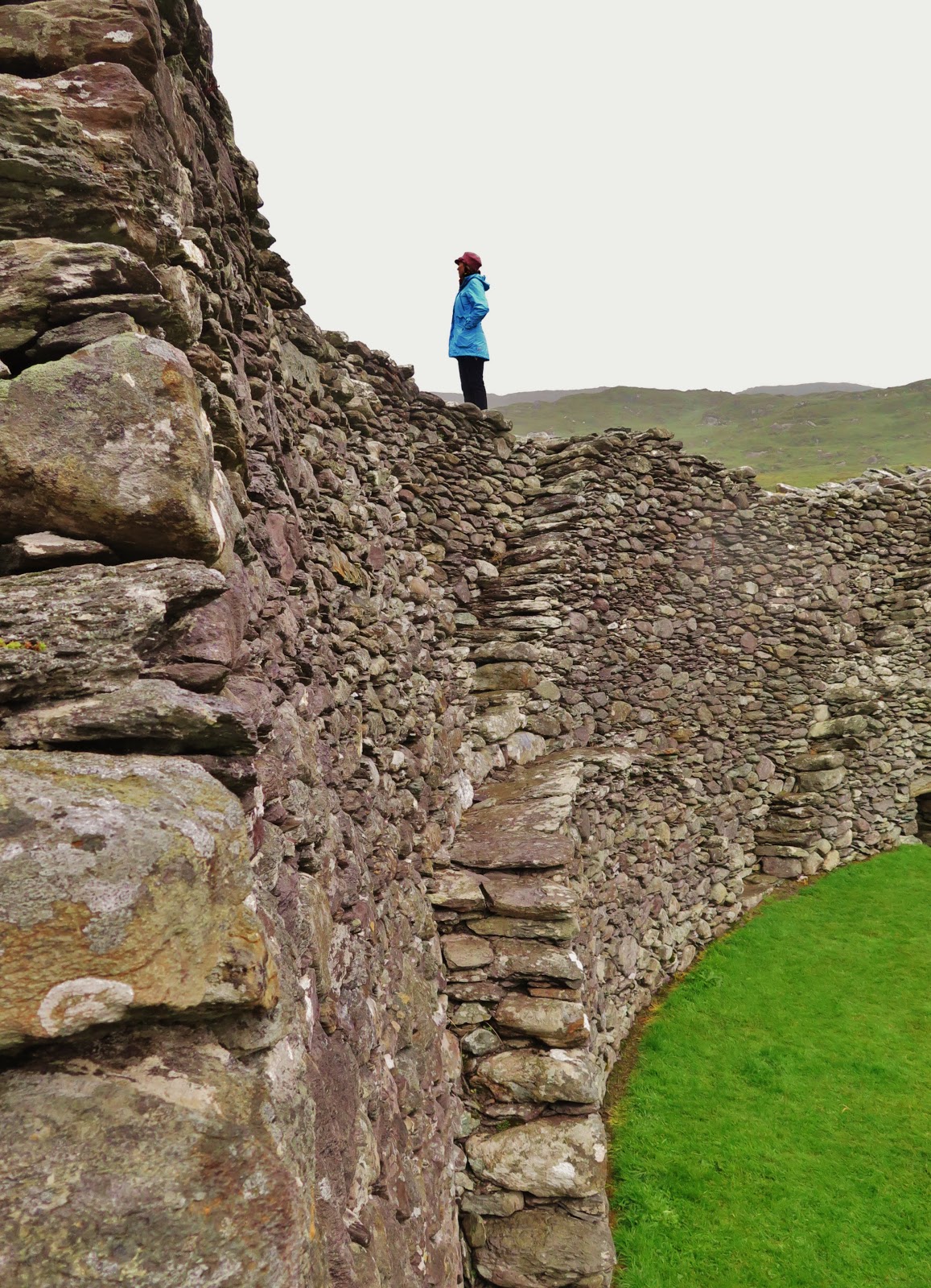
Situated overlooking Kenmare Bay, Staigue Fort is one of the grandest ring forts in Ireland.  There is conflicting information on when it was built, Bronze Age or Iron Age and whether it was made for defence purposes or religious.  In any case, the plaque on sight stated that Staigue Fort was constructed between 500 b.c.e and 300 c.e.   Chieftans would have the need to protect their clans and their valuable cattle herds from rustlers and invaders coming up the coast.  There is an ancient ditch dug around Staigue Fort which archeologists suggest is for defensive purposes. There are a lot of copper deposits in South West Ireland where the prehistoric sights are so plentiful.  You can't have the Bronze Age (3000-1500 b.c.e) without mixing copper with tin to make the bronze weapons; so I reckon the Stone Fort is around that old-but I'm not Indiana Jones...  


The Staigue Ring Fort in the green fields of Kerry, Killarney, Ireland

Walking on the ancient fortified walls of the Staigue ring fort along the Ring of Kerry, IrelandThe coolest thing about Staigue Fort is the walls.  They are massive; 18 feet high and 13 feet thick with ten X shape flights of stairs leading to the ramparts which you can climb up on and walk the circumference of the ancient ring fort.  AND Staigue ring fort is made by dry-wall stone technique-not an ounce of mortar was used in building the 90-foot ring!!!  


Kenmare


Pub sign in the town of Kenmare along the Ring of Kerry, Kenmare, Ireland

The small town of Kenmare is cute and colourful.  In Gaelic, Kenmare is called Neidín which means "little nest" and sits at the head of Kenmare Bay.  Kenmare is a great place to stop and have some lunch, with many choices of great pubs serving lunch.  The steamed muscles caught fresh from the Bay of Kenmare is the local specialty and is worth making a stop for!  There is also some great shopping in Kenmare with traditional woollen wear and Kenmare's exquisite lacemaking tradition that put Kenmare on the map for Irish lace.  If you fancy a walk in Kenmare, try walking to the end of Market Street where there is a 3000-year-old stone circle that is one of the largest stone circles in South West Ireland.  


Ancient druid stone circle in Kenmare on the Ring Of Kerry, Kenmare, Ireland
Kenmare Stone Circle


This 15 stone ring has a dolmen centrepiece that is thought to be a burial monument.  The circle is a celestial calendar that determines the two Solstices in June and December, marking the year's longest and shortest days of the year.  The monument is open all the time, and there is a €2 honour box at the entry hut where there is more information about the circle.


Killarney National Park


Old-growth Oak trees in the forests of Killarney National Park on the Ring of Kerry, Killarney, Ireland
Old Growth Forest In Killarney Park
Killarney National Park is just south of the town of Killarney.  The N-70 you have been following changes to the N-71 just past Kenmare as it heads into the most mountainous stretch of The Ring of Kerry.  On the way from Kenmare to Killarney Park, you will drive through Moll's Gap where there is a pull-out to view Carrauntoohil, Ireland's tallest mountain.  This is a hiker's paradise!  Beyond this, you will arrive in Irelands oldest National Park, established in 1932 when Muckross Estate was donated to the state. 
Hiking up to Torc waterfall in Killarney National Park, Killarney, Ireland
Torc Waterfall, Killarney Park

A nice little walk in the lush Killarney forest is Torc Waterfall.  Look for the parking lot (or more likely, find a spot on the side of the road) and the trailhead. A hiking trail leads you gently upward through old growth Oak, Yew, Alder and Rhododendron trees.  Torc waterfall is only a 10-minute uphill walk from the parking lot, but you can go beyond the waterfall for more strenuous 60 and 90-minute loop walks.

Another fun activity is to hire a jaunting car and tour around Muckross House and Abbey.  A jaunting car is a horse-drawn two-wheeled cart that was the traditional transportation at one time in Ireland.  We hired our horse Gerry who kindly allowed his "jarvey" or driver to take us around the grounds of Muckross House, Muckross Farm and the abandoned medieval Muckross Abbey.  A 45-minute jaunting car tour costs about €40-45 and a 2-hour tour €60 in the peak season (you can bargain a little in offseason).  Depending on the size of the cart you can usually have up to 4 or 5 people in the vehicle plus a driver. 


Traditional jaunting car in front of Muckross house in Killarney National Park, Killarney Ireland
Jaunting Cart At Muckross House


Another cheaper option to a jaunting car tour in Killarney park is to rent bicycles in Killarney to tour the grounds of the Muckross Estate.  I recommend spending your time exploring the natural beauty of Killarney Park rather than the town of Killarney which felt to me like one big tourist trap full of chain hotels and strip malls.
Once past the town of Killarney, the N-71 road becomes the N-72 that takes you back to the village of Killorglin, and your Ring of Kerry drive is over.


I hope you enjoy your tour around Ireland's iconic Ring of Kerry!  Let me know in the comments below what your favourite stop on the Ring was!


Follow me on FACEBOOKINSTAGRAM  and  BLOGLOVIN'  for daily photos and updates! #slowtravel🐌 #dulgomall