Translate

Friday, June 13, 2025

Off The Beaten Path Umbria: Civita di Bagnoregio


Civita di Bagnoregio, Lazio, Italy


Somewhere between Ghost Town and Fairy Tale Village floats Civita di Bagnoregio.  Referred to as "the Dying Town," Civita di Bagnoregio is a medieval wonderland lost in time...


Civita di Bagnoregio over the Valle dei Calanchi, Lazio, Italy
Central Italy has no shortage of off-the-beaten-path hill towns to discover.  The Provinces of Tuscany, Umbria and Lazio meet at the Valle dei Calanchi or Valley Of The Badlands and is home to one of Italy's most beautiful villages, Civita di Bagnoregio.  Civita is situated about 24 km to Orvieto in Umbria, making it a perfect day trip.  Full of Medieval architecture, smack in the middle of a stunning canyon and Civita di Bagnoregio is completely car-free. 

Italian Poet Fillipo Paparazzi once wrote that Civita di Bagnoregio was "an island bravely poised in the middle of the air, on the top of a truncated cone, above the immense abyss..."
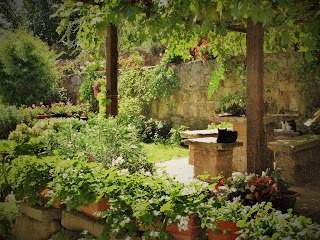
Maria's Garden, Civita di Bagnoregio, Lazio, Italy
Maria's Garden

Built upon a foundation of tufa upon clay that is slowly eroding with every passing year, Civita di Bagnoregio was founded by The Etruscans over 2,500 years ago. Like the town of Pitigliano, the Romans took over in 265 BCE and renamed the settlement Bagnoregium.  Much of the town has already slid into the canyon below after a massive earthquake, and the residents moved across the ravine to the modern city of Bagnoregio.  There are less than 20 permanent residents living in Civita di Bagnoregio today. Most of the well-cared-for homes in the village are weekend escapes for city folks.  There are more cats than inhabitants lounging in the shady gardens.  

Map of parking lot for Civita di Bagnoregio, Lazio, Italy

Getting to Civita di Bagnoregio which lies two hours north of Rome, is simple.  The closest large town to Civita is Orvieto in Umbria.  There are busses leaving from Orvieto to the Bagnoregio bus station several times a day, and then it's a 20-minute walk to the bridge that crosses the canyon to Civita.  Alternately, there is a shuttle bus during tourist season that leaves the Bagnoregio bus station and drops you at the bridge crossing.  If you arrive by car, drive through Bagnoregio's main street following the yellow street signs to Civita di Banoregio's metered parking lot.  There is a booth where you can pay to cross the footbridge (in 2026, it is €5),


Pedestrian footbridge to Civita di Bagnoregio, Lazio, Italy

Porta Santa Maria the entrance to Civita di Bagnoregio, Lazio, Italy


A pedestrian footbridge stretches across the vast canyon, leading upward to the Roman archway, which is the village's entrance.  Stepping through the Porta Santa Maria arch, you walk along the Etruscan road that was carved 2,500 years ago.  These ancient cobbled roads had led to Rome before Rome WAS Rome!


Civita di Bagnoregio is a delightful place to spend an afternoon-WITH NO AGENDA.  

Remains of Etruscan carvings on the side of a building in Civita di Bagnoregio, Lazio, Italy

There are no main sights to see in Civita di Bagnorgio. The delight is to stroll the hamlet, take a million pictures, have lunch & a coffee and perhaps stop to pet the many, many cats here.  The village is tiny, so it doesn't take long to wander around it.  Enjoy the Etruscan carvings, the medieval layout of the town, the remains of the renaissance palace. Find the outdoor laundry sinks, where the locals have been meeting for decades.

Church of San Donato on the main piazza of Civita di Bagnoregio, Lazio, Italy


On the main piazza, check out th
e church of San Donato.  You will notice round columns in front of the church. These were once the foundation of an Etruscan temple, then a Roman temple and finally a Christian cathedral.  Take a moment to peek inside the church to admire the beautiful and haunting 15th-century crucifix carved out of pear wood.  


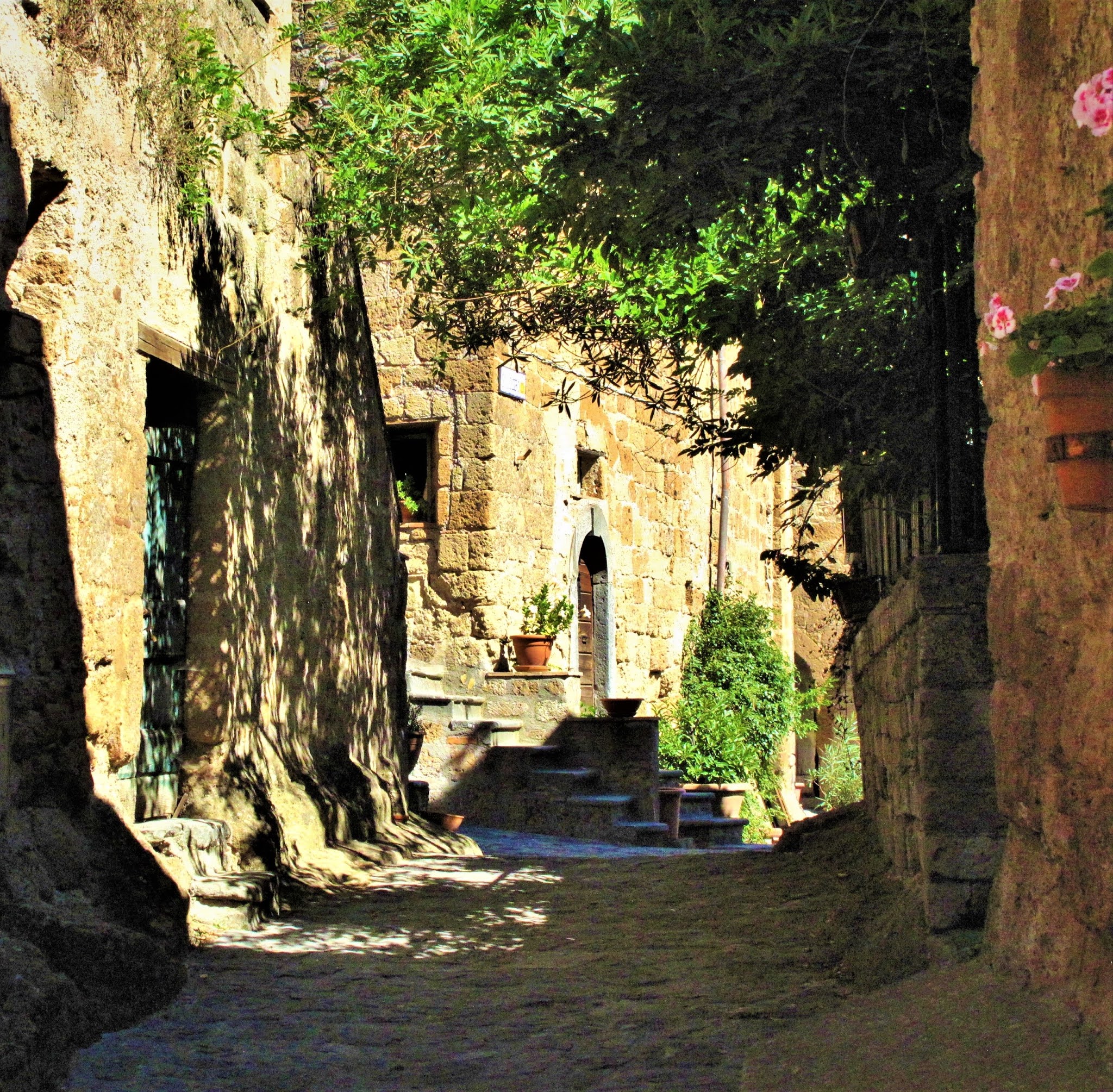
Ancient alleyways of Civita di Bagnoregio, Lazio, Italy


As you stroll the village and take in the views, wander the small alleyways, admire the display of flowers that explode from every window box and staircase.


Etruscan caves in Civita di Bagnoregio, Lazio, Italy


At the end of the town, the main street begins to slowly wind downhill. The road eventually turns into a trail that villagers used to travel to attend their farms on the valley floor.  If you descend along the pathway, you begin to see caves carved out by the Etruscans 2,500 years ago!  These caves were used as wine cellars and storage for farm equipment until just a few decades ago. 


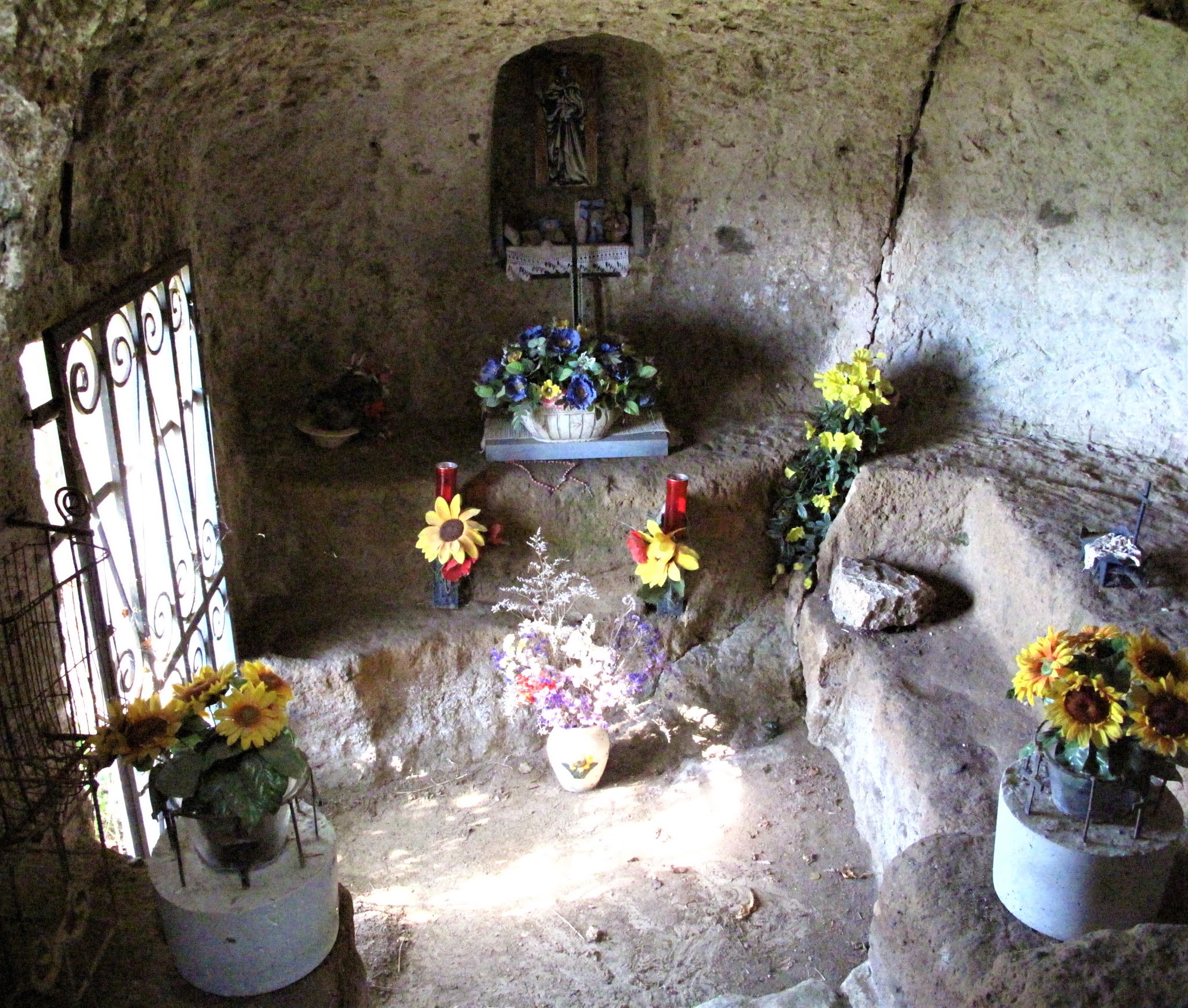
Cappella del Carcere, Chapel of the Incarcerated, Civita di Bagnoregio, Lazio, Italy

One cave has a gate in front of it, sealing it off, but you can peer inside.  This is the Cappella del 
Carcere or The Chapel of The Incarcerated.  This was most likely an Etruscan tomb, but in Medieval times it was used as the city's jail.  This humble "chapel" is a special place of worship for the few remaining Civita residents and is the town's starting point for religious processions.  Now that you have worked up an appetite exploring Civita, it's time for a meal!


Having lunch outdoors with street cats in Civita di Bagnoregio, Lazio, Italy

There are many choices for food in Civita.  I decided to stop for a delicious lunch at a small Osteria off the main piazza called La Cantina di Arianna. Delicious "bruschetta" (toasted bread with local olive oil) and homemade salumi, and of course, the local Orvieto Classico white wine is the best!  Check out my blog post for more information on Wines to Try in Umbria.  My son had so much fun feeding the cats and their little kittens that gathered under our table during lunch.  It seems like outdoor dining in hill towns often means you will have little furry guests joining you for your meal.


Potted plants at a home in Civita di Bagnoregio, Lazio, Italy


Civita di Bagnoregio had soared in popularity since I first visited it in 2013 when it was just a sleepy little ghost town on the Tuscan-Umbrian border.  I recommend planning your visit to Civita earlier in the day or later in the evening, catching the sunset, to avoid the mass tour-bus crowds.  Just remember to slow down your pace and enjoy sauntering around this unique place on earth.

Have you been to Civita?  What was your impression; a tourist trap or a slice of heaven?  Let me know in the comments below!


Follow me on FACEBOOKINSTAGRAM  and  BLOGLOVIN'  for daily photos and updates! #slowtravel🐌

Friday, May 30, 2025

Montepulciano, Tuscany~Vistas & Vino!

View of Montepulciano and the Valdichiana in Tuscany, Italy


Stradling, a ridge between the Chiana and Orcia Valleys, the Tuscan hill town of Montepulciano, offers visitors sweeping vistas, rustic Tuscan food and world-class wine...it's all vino & vistas


The Renaissance church of San Biagio as seen from the top of Montepulciano, Tuscany, Italy
Sitting on a 2,000-foot limestone ridge near the Umbrian border, Montepulciano was said to have been founded by an Etruscan king in the 4th century BCE.  The city grew in Roman times increasing in importance and has been ruled alternately by Siena and Florence over the centuries, with each ruling city leaving their distinct marks on Montepulciano.   The Middle Ages saw constant fighting amongst Montepulciano's noble families until the Del Pecora family, who had ties to Santa Margherita of Cortona, became the rulers in 1390. 

The beautiful streets of Montepulciano, Tuscany, Italy

Today Montepulciano doesn't offer travelers a list of must-see sights to tick off their list; instead, an 
authentic experience of  Tuscan food, wine and relaxed wandering.

Montepulciano is around 70 km south of Siena, 124 km south of Florence, 186 km north of Rome, but just a half-hour drive from my VBRO rental villa in Cortona. In fact,  I can see the lights of Montepulciano each night from the terraced yard that overlooks the beautiful Val di Chiana.  Montepulciano is easy to navigate, the newer part of town is at the bottom of the hill full of gift shops, gelaterias and restaurants gearing towards the tourist hoards.  The real treasure of Montepulciano is at the top of the hill where the historical center hides a fortress, the Duomo and palazzos for days...


Ancient city walls surrounding the hilltown of Montepulciano, Tuscany, Italy

Driving in Montepulciano is not advised.  Most of the historical centre is restricted to local traffic only or zona traffic limitation.  There are several easily accessible day parking lots around the edges of the town.  Signs to the parking lots are well marked and numbered 1-8.  If you are looking for free parking near the historical centre, try lot #8 near the Fortezza.


The inviting castle is the very top of town.  Constructed in the 1200s on top of Roman ruins, the Fortezza is Montepulciano's art and cultural centre, hosting all sorts of exhibits and events for locals and tourists alike. 


Palazzo Comunale in Piazza Grande the main square of Montepulciano, Tuscany, Italy

Entering the main square, Piazza Grande, one can't help but notice this Piazza feels somehow familiar.
This central square is dominated by the Palazzo Comunale, which looks very similar to the Palazzo Vecchio in Florence.  Florence ruled this hill town in the middle ages, and Piazza Grande is covered with the Medici coat of arms showing that Montepulciano was aligned with Florence's power & wealth. The town is absolutely gorgeous, with endless views of the Tuscan countryside. I can see why Montepulciano was the Renaissance stomping grounds for the Florentine elite.


Medieval well or pozzo in Montepulciano's Piazza Grande, Tuscany, Italy
Look for the Pozzo or well in Piazza Grande.  Beneath it is a giant cistern that held water for all the surrounding palaces.   Above the well are two lions, the symbol of the powerful Medici family of Florence.  The lions hold up the Medici coat of arms, kind of like a paid political advertisement of the Middle Ages~ "This clean water brought to you by The Medici Family...you're welcome."

Lion symbol of the Medicci family, Montepulciano, Tuscany, Italy

The crenellated tower of Palazzo Comunale in Montepulciano, Tuscany, Italy

For 360 degree views of the Tuscan countryside, a trip up the tower of Palazzo Comunale is a must.  To climb the tower, head into the palazzo and up the stairs on the left.  On the second floor is the cashier office (open 10am-6pm) and it a €5 entrance fee.  From the top of the tower, Montepulciano flows down the hill like a silk veil into the lush Tuscan farmland- so breathtakingly beautiful.   You also get views of the square below with Palazzo de' Nobili-Tarugi in its arcaded Renaissance splendor, the Duomo with its unfinished facade, Palazzo Contucci. The Contucci palace was built by del Pecora family whose son hid Saint Margherita of Cortona away as his mistress, and is surrounded by many other stunning Renaissance palaces in the Piazza. 

The Renaissance church of San Biagio below Montepulciano, Tuscany, Italy
Photo of San Biagio by Klaus Stebani

From your perch on the top of the tower, you can see the domed church on San Biagio below.  This domed masterpiece was the work of Renaissance artist Antonio da Sangallo who also designed Palazzo Tarugi.  Both of these elegant buildings are built out of locally quarried travertine marble. Bramante, the master architect, spent time in Montepulciano, and the dome of San Biagio influenced his design of St. Peter's dome at the Vatican.  A walk down to San Biagio along Via di San Biagio from San Francesco church is a delightful stroll.


Cathedral of Santa Maria Assunta on Piazza Grande in Montepulciano, Tuscany, ItalyA quick peeked into the Duomo on the Piazza Grande for a look at the art is worth the stop.  The church was supposed to be covered by Travertine marble, but the town was cut off from funds when Siena was overpowered by Florence.  To the left, when you enter the Duomo, is the Early Renaissance work by Sienese master Andrea Della Robbia.  The "Alter of Lilies" in the baptismal font is a gorgeous glazed terracotta piece that is all golden & gothic.    

Golden alter retable in Santa Maria Assunta, Montepulciano, Tuscany, Italy

Behind the altar of the church is a three-panel retable by Sienese early Renaissance artist Taddeo di Bartolo. Painted in 1401, this altarpiece includes a self-portrait of the artist as one of the apostles.  This panel was painted in-situ, which means this work of art is displayed in the place that it was intended to for-not a museum.  It's my favourite way to appreciate the art the way the artist intended it to be experienced.
Other treasures in Montepulciano must be experienced, but not of the visual sense...


Via di Gracciano or Corso of Montepulciano, Tuscany, Italy
Corso of Montepulciano
Montepulciano is known for a few food specialties like honey, a thick hand-rolled pasta called pinci that looks like fat spaghetti and, of course, its wine: Vino Nobile di Montepulciano.  Vino Nobile is the other heavyweight wine of Tuscany alongside Chianti and Brunello.  Not to be confused with Montepulciano d'Abruzzo wine, which made from a grape variety called Montepulciano, or Rosso di Montepulciano a lighter version of Vino Nobile.  The DOCG regulated Vino Nobile is made from mostly Sangiovese grapes, some Canaiolo Nero and a splash of Mammolo grapes and aged 2 years, with half that time in oak barrels.  Spend some time in a wine cellar like the one in the Contucci Palace tasting the Vino Nobile.  The Contucci family has been living in this Palace for almost 1,000 years, and there is nothing like sampling wines in a cellar dating back to the 13th century.   www.contucci.it    


Clocktower and bell on Palazzo Bucelli Montepulciano, Tuscany, ItalyNext, I headed downhill and ran a gauntlet of wine stores, passing many delightful artisan shops and found a quiet little "trattoria."  Sitting outside a tiny piazza overlooked by a whimsical clocktower on top of Palazzo Bucelli, I had a very memorable lunch.  It was a hot afternoon in the mid-September sun, so I ordered  "Panzanella" which is a type of Tuscan traditional dish of bread salad with tomatoes and olive oil.  Along with the salad, I had a "mezzo" litre or half-litre of local white wine, Montepulciano Bianco.  This local wine is the colour of pale straw; light, sweet and crisp-perfect for a summer lunch one a patio.  I wish I had picked up a bottle to bring home.


Sweeping view of Valdichiana and San Biagio from Montepulciano, Tuscany, ItalyIf you can stay in Montepulciano into the evening, or better yet, overnight, you will find the town makes an almost audible sigh of relief as the day-trippers return to the big cities.  As the sun sinks below the sun-drenched Tuscan hills, the shops close, and locals relax and full restaurants spill out into the piazzas.  This is the time of day when you forget Montepulciano's history and the sights and just enjoy the vibe of the town and being in the moment. 


Whether you are a wine connoisseur, an architecture devotee or just like beautiful scenery, Montepulciano has it all!   


Follow me on FACEBOOKINSTAGRAM  and  BLOGLOVIN'  for daily photos and updates! #slowtravel🐌


Wednesday, March 12, 2025

ORVIETO~Classic Umbrian Hilltown


Orvieto Umbria; Classic Umbrian Hill Town

Set amidst a rolling landscape and surrounded by vineyards, Orvieto perches regally atop a rock outcrop 1000 feet above the valley floor...


Orvieto fortifications
Founded by the Etruscans around 500 BCE, Orvieto is thought by many archeologists to be the mysterious city of Velzna, a huge Etruscan city destroyed by the Romans. Later, when the Romans annexed the Etruscans, Orvieto became a major Roman stronghold because of its virtually impenetrable verticle cliffs. Orvieto became a refuge for the Pope and a castle during the Middle Ages. Many grand palaces and churches were built.

Today Orvieto, with its close proximity to the A1 Autostrada connecting Rome with Florence, has become quite the weekend destination for those escaping the big cities and a day-trip destination for foreign tourists.   While this gorgeously preserved Medieval hilltop town can be explored in one day, the real magic of Orvieto occurs at sunset when the crowds disperse, and the residents unwind.


Piazza in Orvieto
To reach Orvietos Historical Center at the top of the cliffs, you can park at the funicular (near the train station) at the east end of town. There is also public parking on the west side of the cliffs, and you can take the elevator or escalator up to the top. Unless you have accommodation in the Centro Storico with complimentary parking, it is best to leave your car below, avoiding expensive parking fees and driving the very narrow one-way streets. If you decide to drive up to the centro storico, the most convenient parking lots are in the Piazza Cahen and Piazza del Duomo.

Green Umbrian Hills
If you ride the funicular up to the old center, you are deposited at Piazza Cahen. There is an info centre here at the funicular station where you can get an Orvieto map and find information on various tours of the Orvieto Underground. T
he ruins of Rocca Albornoziana, a fortress from the mid-12th century, are to the left of Piazza Cahen. The view from here of the Umbrian countryside is outstanding. To your right are a public park, and beyond it, the remains of an ancient Etruscan Temple on the edge of the bluffs with more breathtaking views.  


St. Patricks Well

St. Patricks Well
Towards the belvedere of the Etruscan temple remains is one of the most impressive feats of engineering in 16th century Italy; St. Patricks well. The Pozo di San Patrizio was built in 1527 by pope Clement while he stayed in Orvieto during the sack of Rome. The Pope knew the cliff walls of Orvieto would keep invaders at bay, but if they wanted to outlast an extended siege, the city would need an ample water supply. The well took only ten years to build and has a central shaft reaching down 53 metres (175 feet), and two separate paths spiral around the well. One path leads downwards, and the other spiral upwards so that mules carrying water only had one-way traffic to deal with. It's a fun workout to descend the 250 steps down, and the 70 windows offer those with slight claustrophobia some relief. The cost is €5, and the well is open 9-8. The audio guide is worth the €2 rental; bring a sweater-it's cold at the bottom!

Orvieto Cathedral

Orvieto Cathedral

Orvieto is the perfect size town to manage by walking. The streets are flat and easy to stroll with the car-free Via Cavour or "the
Corso" being the main route. Follow the Corso and listen for the Renaissance-era bells of Orvieto's Duomo or Cathedral. Glistening in gold and brightly coloured mosaics, the Duomo's facade is a feast for the eyes! Resembling Siena's Cathedral with its black & white striped marble, Orvieto's Duomo is also magnificent on the inside. Featuring frescoed ceilings started by Fra'Angelico and finished fifty years later by Luca Signorelli from the nearby Tuscan hill town of Cortona. Signorelli's masterpiece and not to be missed piece of art in Orvieto is the Chapel of San Brizio, featuring beautifully lit frescoed scenes of the Apocalypse. The entrance price for seeing the Cathedral, including the San
 Brizio Chapel, is €5.


Orvieto Underground

The Well of The Cave in Orvieto
If you want more subterranean tours, The Well of The Cave (Pozzo della Cava) is a vast network of underground caverns, tunnels and wells dating back to the Roman and Etruscan civilizations of Orvieto. The tunnels provide an excellent exploring adventure for kids but are not for the claustrophobic! Self-guided tours are €4/€2.50 for children. For more information, visit pozzodellacava.it


Etruscan Tombs

Orvietos Necropolis
There are two Etruscan burial sites at the base of Orvieto's cliff. Called a Necropolis, these are literally cities of the dead where the burial tombs look like miniature stone houses laid out in a city grid plan.  On the Southside of Orvieto is the Necropolis of Cannicella, and to the North of  the town is the Necropoli Etrusca del Crocifisso del Tufo.  This is the one I chose to visit because it had a large free parking lot and a small museum holding some of the archeological findings from the area. You can wander freely amongst the tombs that date back to the 5th century BCE and even go inside some of them. You can even see the Etruscan family name carved in stone above the tomb entrance. Tickets 
€3; closed Mondays & Tuesdays.


Orvieto Wine & Wine Tasting

Orvieto Wines
Orvieto is known for its delicious white wines, appropriately named Orvieto Classico. A blend of 40% Grechetto, 20-40% Trebbiano (locally called Procanico) and up to 40% of other white grape blends such as Verdello and Malvasia Bianco. Orvieto Classico is a DOC wine is a pale straw colour that is light and crisp, with a delicate floral taste. There are many enoteca 0r wine bars to try different local wine varieties, including Orvieto "secco" or dry white. Another fun thing to do is tour a local vineyard and have a wine tasting. You can arrange this with the local Tourist Information Centre near the funicular station in Piazza Cahen or visit the tourist office online at orvietoviva.com to plan your tour. For more on discovering wines of Umbria, don't miss my popular blog post 7 Wines To Try In Umbria


Civita di Bagnoregio

Civita di Bagnoregio
A short 20km from Orvieto is the well-preserved Medieval village of Civita di Bagnoregio.  Considered a ghost town, Civita di Bagnoregio is nicknamed "The Dying Town" because of the gradual slide of its' perch atop a clay pillar into the steep valley below. Civita is connected by a 1 km pedestrian toll bridge crossing the canyon. It costs €5 to cross the bridge to Civita, which pays for the shoring up of the village's hillside. Stepping through the city gates is like stepping back through the mists of time; Renaissance, Medieval, Roman and Etruscan architecture blend together, becoming a fun scavenger hunt. The leisurely pace of life in Civita de Bagnoregio reminds one to slow down and enjoy the moment. Busses from Orvieto to Civita de Bagnoregio leave several times a day; check the orvietoviva.com site for the seasonal schedule. Also, check out my blog post on Civita di Bagnoregio for more information on what to see and do.


Palazzo in Orvieto

Orvieto becomes even more enchanting at night with all the day tourists from Rome gone and the historic buildings, palaces and churches delicately lit up. Stroll the Medieval city ramparts or sip a glass of wine and marvel at the Duomo. My favourite place to stay in Orvieto is
La Casa di Tufo B&B right in the historic centre. I feel like I am staying with family at this charming B&B!

Orvieto Charm


Orvieto is a place I stop to visit again and again. What is your favourite memory of Orvieto? The food, the wine, the architecture?


Follow me on FACEBOOKINSTAGRAM  and  BLOGLOVIN'  for daily photos and updates! #slowtravel🐌