Translate

Showing posts with label Ireland. Show all posts

Saturday, January 4, 2020

How To Have Ireland's Famous Glendalough All To Yourself


High Crosses and Round Towers of Glendalough, Wicklow Mountains, Ireland


Glendalough is becoming one of South-Eastern Ireland's busiest tourist sights.  Big bus tours and Dublin day-trips keep Glendalough crowded all day long.  Here's how you can experience this mystical place without another tourist within sight...


St Kevin's Kitchen Amid The Graves at Glendalough Monastic Site Wicklow Mountaind Ireland
Peaceful Glendalough

Glendalough (pronounced GLEN-da-lock), is a historical early Christian monastery nestled deep in the Wicklow mountains, just 45 miles south of Ireland's bustling capital city of Dublin.  Glendalough means "Valley of the two lakes" in Irish, and the monastic settlement is situated in a valley next to two lakes.  These picturesque lakes, along with Glendalough, are located in the Southern part of Wicklow Mountains National Park.  The Wicklow Mountains are a popular destination for locals and tourists alike because of it's close proximity to Dublin.  The plentiful walking trails, historical sights and natural beauty offered in the area are particularly busy during July and August.  Click the link to read my blog post on what to do in the Wicklow Mountains.  


Exploring The Round Tower of Glendalough in the Wicklow Mountains, Ireland
Glendalough's Round Tower


The history of Glendalough is fascinating.  It was founded by Ireland's Saint Kevin in the mid-sixth century.  Within 100 years, Glendalough became a large ecclesiastical settlement of over 1,000 people, a "city," for those times.  Check out my blog post for more information on the history of Glendalough.  Today we can stroll peacefully through green meadows to the remains of centuries-old stone churches and Celtic crosses and an impressive round tower...without another soul in sight! 

The trick to having Glendalough to yourself is to arrive early in the morning before the visitor centre opens.  Glendalough is part of the Irish Office of Public Works' historic properties, and you can find out more at www.heritageireland.ie/en/.  There is a state-of-the-art visitor centre at Glendalough, which opens from 9:30-6:00, BUT you can explore the site anytime since it is free and always open.  Evening exploring can work well too, but there are usually still plenty of people milling about after the Visitor Centre closes.


Walking the Road To Glendalough Historic Site From Glendalough International Hostel, Wicklow Mountains, Ireland
The Two-Lane Road to Glendalough
Now, if you don't fancy getting up before the crack of dawn to drive one and half hours south of Dublin through narrow dark mountain passes, I do not blame you!  It's not a smart idea, especially if you are not accustomed to driving on the left side of the road.  Many tour operators offer guided tours to Glendalough, and the big tour coaches start arriving between 10:00-11:00. The public bus service to the Wicklow mountains from Dublin is limited, but there is a daily service with St. Kevin's Bus Service that takes you round trip to Dublin to Glendalough for €20 or €13 one way.  Or you can also try Bus Éireann to the town of Laragh, which is about 2 kilometres from the Glendalough visitor centre.  Either way, the busses don't arrive in Glendalough until the early afternoon when the site is packed with tourists.  
Unless you stay overnight...


St. Kevins Kitchen Stone Church at Glendalough Historic Monastery, Wicklow Mountains, Ireland
St. Kevin's Kitchen
Another recommendation is to stay overnight in either the Glendalough International Hostel or in the Glendalough Hotel.  Both of these places are within a short stroll of the ancient monastic site and offer free breakfast, free wifi and free parking.  I decided to book a private family room at the Glendalough International Hostel.  The room at the hostel slept up to five people and came with an ensuite bathroom, was very clean, quiet, comfortable and such helpful staff.  There was a real mix of guests, families with young kids, backpacking youths, plus hikers from all over Ireland and elsewhere who were trekking the Wicklow Way.  The best part was that we paid less than half of what it would cost at the hotel down the road.  To book the Glendalough International Hostel, you can go to hostelworld.com or to booking.com.


Stone Archway Entrance to Glendalough Monastic Site Wicklow Mountains Ireland
Entrance To Glendalough

Imagine slipping through the timeless stone archway of Glendalough's entrance into a world of crooked mossy gravestones and decorated Celtic High Crosses.  Marvel at the construction of the 110 foot round tower with only the sound of the wind in your ears.  Wander amongst the ruins of stone churches and Cathedrals and ponder what it would have been like to live in Ireland 1500 years ago.   

With just a little planning, you can step back through time and experience Glendalough the way the Irish monks used to. No tourists.  No crowds.  No distractions.
Just you and St. Kevin's legacy.

Stone Celtic High Cross at Glendalough Historic Site Wicklow Mountains Ireland
High Cross at Glendalough


Follow me on FACEBOOKINSTAGRAM  and  BLOGLOVIN'  for daily photos and updates! #slowtravel🐌

Saturday, July 27, 2019

Saint Brigid's Holy Well in Kildare, Ireland

Saint Brigid's slippers at Tobar Bride in Kildare, Ireland


Long before Brigid was the Patron saint of Ireland, there was a Goddess Bríde who was venerated all over the Celtic world.  At St. Brigid's well, you feel Ireland's ancient past wrapped around you like a mantle...


Saint Brigid's ancient well and stone cross in Kildare, Ireland
Holy wells in Ireland are plentiful. Over 3,000 wells and springs dot the countryside; more than any other country in the world.  Always dedicated to an Irish Saint, in ancient times these sacred wells, were places of power devoted to Celtic Gods and Goddesses. In myth and folktale, sacred springs are portals to the Otherworld, the realm of the unseen...the realm of the faeries.  The holy wells were visited at the four significant Pre-Christian holy days February 1 (Imbolc), May 1 (Beltaine), August 1 (Lughnasadh) and November 1 (Samhain).  Other times a well would be visited was when someone needed healing, poetic inspiration, or trying to conceive a child.  These wells and sacred pools often had fish in them which were said to have magical powers, for they lived in the waters that have healing and transformative power.

Stone archway, Saint Brigid's slippers and Station Stones mark Saint Brigid's well in Kildare Ireland
St. Brigid's Slippers

Many of the sacred springs and wells in Ireland have elements of pre-Christian ritual sites.  Accompanying the well or natural spring, there was often a standing stone, a natural or man-made hill, and a very ancient tree; oftentimes a Hazelnut or Ash tree.  There was usually a ritual circuit for each sacred site. Often the ritual included circling the well a certain number of times in a clockwise direction, then drinking or bathing in the spring water. The ceremony concluded with leaving an offering for the God, Goddess or Spirit of the well in gratitude.


Tobar Bride sign at the entrance to Saint Brigid's well in Kildare, Ireland
"Tobar Bride" is Irish for Brigid's Well

When Christianity came to Ireland in the 5th century, Christian churches were often built at the pilgrim site of the holy wells, using the water of the well as a baptismal font.  There are even some churches built directly over pagan wells that still have a subterranean spring in its crypt!  


As the new Christian stone churches were being built, gathering at the holy well sights either fell out of popularity or was forbidden.  After the Dissolution of the Monasteries in the mid-1500s, many Roman-Catholics had nowhere to worship once their Church was disbanded or destroyed.  Catholic parishioners then decided to gather once again at the holy well sights on the Parish's Patron Saint's Feast Day.  The word 'Patron' turned into 'Pattern' and visiting Holy Wells on 'Pattern Day' became very popular in Irish culture in the 1700s.


Saint Brigid's holy well, station stones, stone archway and Saint Brigid's Slippers in Kildare, Ireland
The Spring & The Stones Leading to The Well


Map of Dublin to Kildare in County Kildare, Ireland

I visited Kildare's "Tobar Bríde" or Saint Brigid's wellIn Irish, Tobar means well, and Bríde is one of the spellings for the Celtic Goddess Brigid.  Kildare or Cill Dara is Irish for "Church of the Oak," and it is in Kildare that St. Brigid established her monastery in the 5th century.  Check out my blog post on Saint Brigid for more information on this fascinating woman that helped shape the history of Ireland.
GPS directions to Saint Brigid's holy well in Kildare, Ireland


Kildare is about a 45-minute drive from Dublin on the M7 motorway.  While St. Brigid's Cathedral is located in the heart of Kildare, the well is located on the Southside of the M7 in a park-like setting.  From Dublin heading East on the M7 take the Kildare Centre exit and head South on the R415 following the directions to the Irish National Stud.  Take the second left, and you will see a sign to the well on a small laneway to the right.  There is parking for a few cars at the entrance gate to the park.


Sitting aside Saint Brigid's ancient holy well in Kildare, Ireland
Cloutie Tree To The Left of The Well


I had learned about St. Brigid's well from some women in my spiritual community back home in Vancouver, Canada,  In fact, while I was visiting the well in Kildare, an Irish-Canadian woman was gathering water to bring back to her home in Toronto.  The woman was a Catholic, and she explained that she believed the waters from this well helped to heal her from her cancer.

The well is in a small park maintained by the Brigidine Sisters.  The deep well with a stone cross is fed by an underground spring.  The water then travels in an underground stream and path is marked by "station stones"  where one would say prayers at each stone.  Then the flow pops to the surface again at a stone archway leading to a stepped channel.  The two U-shaped stones under the arch are called St. Brigid's Slippers and are flumes to divert the flow when the water is running high.  Tradition has it that this area was used for early Christian baptisms and healing rituals.   


Bronze statue of Saint Brigid by Annette McCormack at St. Brigid's holy well in Kildare, Ireland
St Brigid by Annette McCormack


Behind the well is a traditional clootie tree.  A "clootie" or "cloutie" is a strip of cloth or leather. The cloutie strip is dipped into the well or spring and then used to wash the affected area of the body.  The cloutie is then tied to a sacred tree next to the well, and as the cloth turns to rags and disintegrates, the illness will disappear.  

Another tradition of sacred wells is the spotting of a tiny fish in the well.  Of course, the symbol of the fish was an early symbol for Christianity before the cross.  If you peer into the well at Tobar Bride, you may spot a little fish frolicking in the spring.  A sighting of the fish is supposed to ensure that St. Brigid has answered your prayers.

  
Looking into Saint Brigid's stone holy well at Kildare, Ireland


I am happy to report there was a goldfish sighting in the dark waters of Tobar Bride in August of 2018. Let me tell you my prayers were answered swiftly and directly!  The transformative energy of Brigid was not a slow burn, but a raging inferno that has changed the course of my life forever.  
I hope you have the opportunity to add one of Ireland's magical holy wells to your Irish itinerary.

For another of my blog posts on Ancient Sacred Sites in Ireland click HERE

In Ireland, this world and the next are only separated by a thin veil. Whisper questions into the sacred wells and your answers will appear...


Follow me on FACEBOOKINSTAGRAM  and  BLOGLOVIN'  for daily photos and updates! #slowtravel🐌 

Monday, July 1, 2019

Storytime: Ireland's Brigid-Saint or Goddess?


Statue Of Saint Brigid at Holy Well, Kildare, Ireland

 Ireland has many holy wells dedicated to its patron Saint; St. Brigid.  There is also a Celtic Goddess named Brighid who was worshipped long before Christianity arrived in Ireland.  So what is the difference between these two and the significance of the ancient pilgrim sites dedicated to them?


I have found Ireland's myths, legends and history so enticing and also so confusing, but Brigid is by far the most intriguing for me.  Many similarities between the Celtic Goddess Brighid (who is also Brigit, Bríg, Bride-pronounced breet) and the Christian Saint Brigid have scholars debating whether they are one and the same.  Brigid is sometimes referred to as "Muire na nGael" or "The Mary of The Gaels," and along with Saint Patrick and Saint Colomba, Saint Brigid is Ireland's third official patron Saint.  I am in no way a scholar or academic; just a travel lover, a story lover, & Goddess lover.  This blog post addresses all three.  


The Legend Of Brigid 

According to a book written about the life of St. Brigid in the early 600's, she was born in Faughart (also spelled Fochart) which is close to the town of Drogheda near the modern border of Northern Ireland.  St. Brigid was said to have been born around the year 451 to a beautiful Pictish slave mother named Brocca and a Pagan Chieftain of Leinster named Dubhthach.  Brocca was a converted Christian who was said to have been baptized by Saint Patrick himself.  When Brocca was pregnant with Brigid, Dubhthach's wife, who was jealous of Brocca's beauty and the attention her husband paid to her, sold Brocca to a Druid.  There is no mention of the Druid being a man or a woman since a Druid could be either-but my hunch was the Druid was a female.  This Druid Priestess mid-wifed Brocca and helped to raise Brigid and I suspect the Priestess also had a hand in naming Brigid.  The Druid helped to raise Brigid and let her work alongside her mother in the dairy the Druid owned, probably training her to become a Druid as well.   Young Brigid gained a considerable reputation for healing the sick, feeding the poor from the dairy and performing miracles; one of them being turning water into beer.  That sounds vaguely familiar for some reason 😉


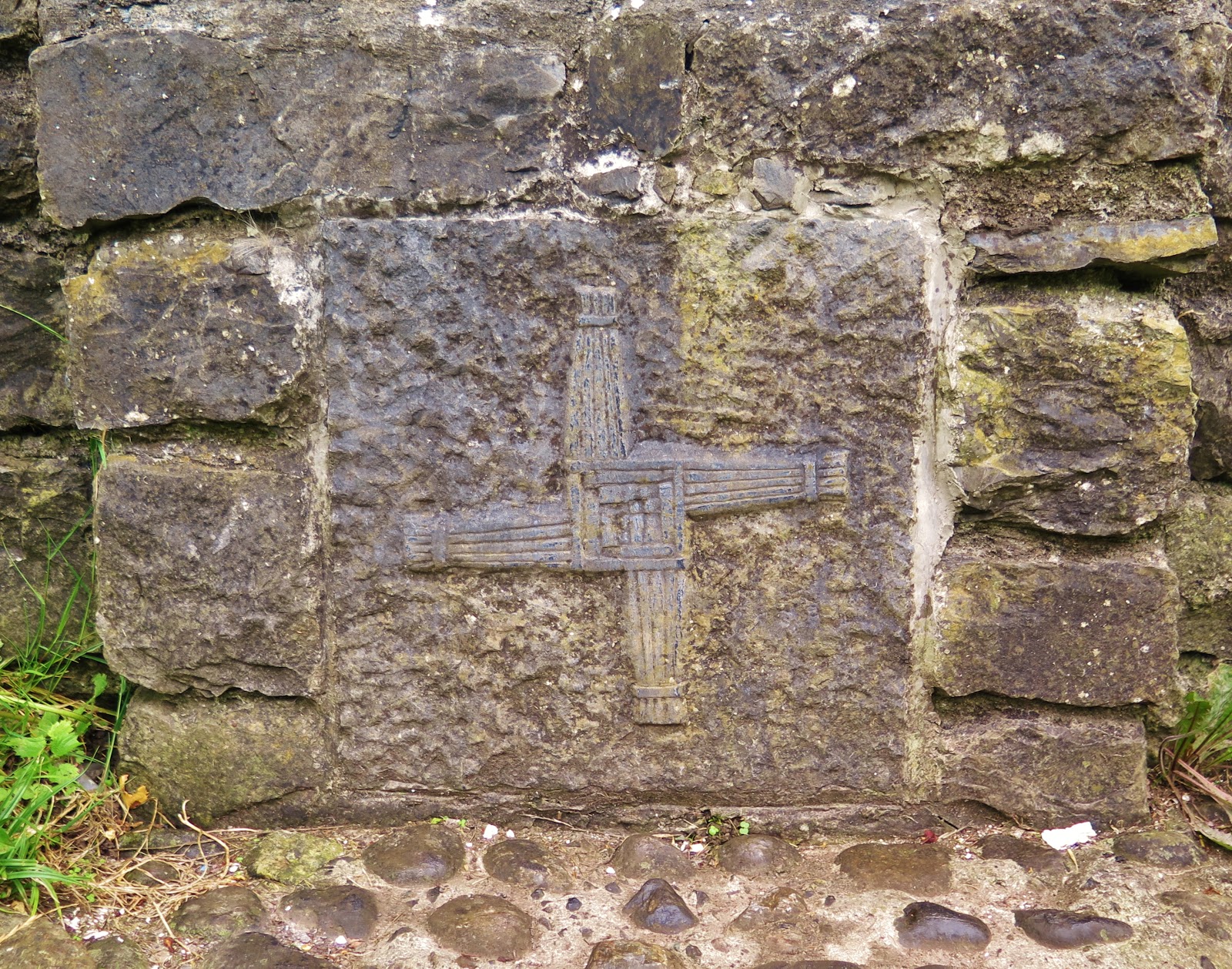
A Bogha Bride or Saint Brigid's Cross at Holy Well in Kildare, Ireland
A "Bogha Bride" or St. Brigid's Cross
Now Brocca was the property of the Druid, but Brigid was still the property of her Cheiftan father.  As the legend has it, when Brigid was 10, she was returned to the household of her father Dubhthatch and raised alongside her half-brothers and sisters.  Brigid soon turned into a lovely young woman like her mother. Approaching close to marrying age, her father wanted to use Brigid's marriage to make alliances with other Pagan Chieftains.  Her father brought Brigid to the court of the King of Leinster to either sell her or to find a suitable husband that would strengthen his political alliances.  At court, Bridgid told the King that she did not wish to marry and become the property of a man again and that she wanted to become a Christian nun.  The King of Leinster at the time was Crimthann mac Énnai a Christian King baptized by Saint Patrick like Brigid's mother. The King had heard of Brigid's miracles and convinced Brigid's father to free her from slavery as long as she promised to take the vow of Christianity.  Dubthatch complied, and Brigid returned to her mother at the dairy and continued to feed the sick and poor and to also keep learning from the Druid, growing into an intelligent and formidable woman.  


Brighid The Goddess
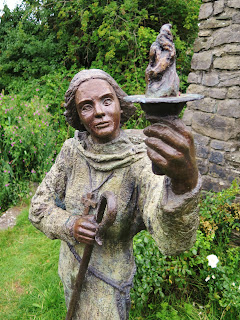

Statue of Saint Brigid with her Crosier and Holy Flame, Kildare, Ireland
St. Brigid's Holy Well, Kildare
At this time, Celtic Christianity was different from Roman Christianity because of the societal structure of the Celts and their intense connection to nature; many people blended the new Christian beliefs with the old Celtic religion.  The Celtic Goddess Brighid was revered all over Ireland as a life-giving Goddess of midwifery, healing, poetry, animal husbandry; especially cows which were scared to the people of Ireland dating all the way back to Neolithic times. Brighid was the virginal keeper of the flame, fire and smithcraft, representing transformation.  She was also the Goddess of the Spring and her sacred day was the Celtic festival of Imbolc, celebrated on February 1st, the official start of Spring for the Celtic people.  

The idea that St. Brigid was trained as a Druid was not uncommon for this time in Ireland, and many "Holy" men & women were versed in ways of the Old Region as well as the new religion of Christianity.  Around the year 468, a 17-year-old Brigid took "the Veil" to become a nun, but was ordained the first Abbess in Ireland. Appointed by St. Patrick's nephew St. Mél of Ardagh who "accidentally" read the wrong ceremony and ordained Brigid as a bishop instead of a nun-whoops!   St. Mél claimed the error was an act of God and did not rectify the mistake, giving St. Brigid substantial power.   Brigid set out with St. Mél and his disciple St. Mac Caille to convert Pagan Cheiftans in central Ireland to Christianity.  Along with St. Mac Caille (sometimes spelled Maccaille) Brigid set up an early Christian monastery at a holy well at Croghan Hill which was an ancient Pagan burial site.  A group of women soon joined her there, and her community proliferated.  


St. Brigid's following was growing so rapidly in fact, she decided to ask her old buddy, the King of Leinster for some land to establish her own abbey.  There is a myth about St. Brigit's Cloak magically expanding to cover all the area where the King would allow Brigid to build her monastery.  What is more likely, is that Brigid wanted to establish her abbey in a specific Pagan spot, later named Cill Dara so that she could carry out her work.  "Cill Dara" in Irish means "Church of the Oak" and where we get the modern Irish name for the town of Kildare.   Oak trees are sacred to Druids, and the site Brigid selected to build her convent was a nemeton or a Druidic sacred Oak Grove.  In this sacred grove, an eternal flame burned in the honour of the Celtic Goddess Brighid and was tended around the clock by Druid priestesses. Remember the King of Leinster was a Christian, so giving Brigid a Druidic place of worship to establish her monastery was definitely a calculated move on his part.


Brigid Of Kildare

St Brigid Flame in Kildare, Ireland
The Abbey that St Brigid established in Kildare was unusual for several reasons.  The abbey was co-ed, housing both monks and nuns which was very uncommon for that time in history.  Brigid also kept the tradition of the sacred flame alive.  Nineteen nuns took turns holding twenty-four-hour vigils tending the flame, and on the 20th day, the Goddess Brighid Herself was said to tend the flame.  The sacred fire on the hill of Kildare was never to be extinguished; keeping the holy traditions of the Druids of Cill Dara. In addition to this, St. Brigid (and the Abbesses who came after her) co-ruled Cill Dara with an Abbott, but the Abbess ranked above the Abbot essentially holding the same privileges as a Bishop, which is why St Brigid is often depicted with a Bishop's crozier.   The power over Kildare Cathedral and Abbey that was given to St. Brigid (and the abbesses that followed) by the Church, lasted until the year 1152 and has never happened again in the history of the Catholic Church.   St. Brigid's community at Cill Dara expanded, and she convinced St. Conleth, a religious hermit who lived in the woods nearby, to help her establish a school of art, illumination and metalwork.   Over time Cill Dara developed into a monastic city like Glendalough.
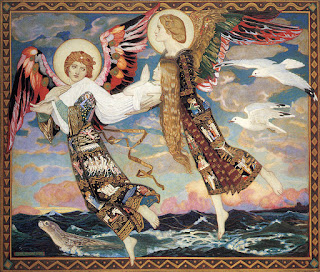

Saint Bride by John Duncan 1913
Saint Brigid is said to have died on February 1st, somewhere between the year  521-525.  February 1st is St. Brigid's feast day in the Catholic church, and it is also the Celtic Pagan holy day of Imbolcas I mentioned earlier.  How curious that the Goddess and the Saint are celebrated on the same day...I am convinced it is not a coincidence.   I also believe that St. Brigid was a powerful Druid High Priestess as well as Catholic Bishop and her specific brand of Christianity allowed many Pagans to convert to the new religion and still maintain their beliefs in the Goddess Brighid.
In the year 1993, an order of Brigidine nuns re-lit Brigid's eternal flame in Kildare, and you can see it today if you visit the Solas Bhride Centre and Hermitages. You can also see the original stone foundation of the fire temple at the Kildare cathedral and a round tower that you can actually climb to the top!  Nearby is St. Brigid's holy well, located in a park-like setting, where you can feel the healing & peaceful presence of both Brighid and St. Brigid. 

As far as I can tell, the radiant energy of Brighid's holy wells, pilgrim sites and churches in Ireland are the same, even if the story of Brigid may be different.  I hope you have the chance to experience this energy yourself soon...


Follow me on FACEBOOKINSTAGRAM  and  BLOGLOVIN'  for daily photos and updates! #slowtravel🐌 


Friday, April 12, 2019

Ireland's Boyne Valley- A Perfect Day Trip From Dublin

Round tower of monasterboice with celtic cross in Boyne Valley Ireland


North of Dublin, lies a world of mysterious burial mounds, ruined abbeys, round towers, haunting high crosses and Ireland's biggest castle.  The Valley of the Boyne is a peaceful day trip through history... 


Stone Passage Tomb at Newgrange UNESCO world heritage site, Boyne valley Ireland
Tomb At Newgrange

The tranquil Boyne River valley lies just 48 km North of Dublin, yet it is worlds away from Ireland's busy capital city.  The Boyne River was where the first settlements in Ireland were established over 5,000 years ago.  These pre-Celtic or indigenous Irish people settled along the Boyne River (or An Bhóinn or Bóinne in Irish) and worshipped the Goddess Boann who according to myth, created the river and also who the river is named after.  This relatively short 112 km river passes through some of Ireland's most beautiful scenery and historical monuments, many of which are FREE to explore.

Getting around this rural area without a car may be a bit difficult. You can book day tours from Dublin that go to some of these sites that I list below.  Try www.boynevalleytours.com they can custom tailor a tour of the places you wish to see. 


Brú Na Bóinne

Neoliticcarvings on kerbstone at enterance to Newgrange burial Tomb, Bru na Boinne, Boyne Valley Ireland
Entrance To Newgrange


Brú Na Bóinne means "dwelling place of the Boyne" in Irish.  Located on a bend in the Boyne River, Brú Na Bóinne is a complex of about 90 megalithic monuments plus 3 enormous passage tombs:  Dowth (rhymes with South), Knowth and the famous Newgrange.  This unique archeological landscape has been designated a UNESCO world heritage site, and an excellent museum and visitor centre* has been built to educate visitors on the various passage graves, henges, standing stones and Neolithic art.  The people who created these structures pre-date the Celts and showed such a strong knowledge of astronomy and architecture that these structures still align with the path of the sun 5,000  years after they were built!  You can tour inside one of these passage tombs and witness the Winter Solstice sunlight creeping into the ritual chamber...an experience you will never forget.  Check out my full blog post on Brú Na Bóinne

*THE VISITOR CENTRE IS CLOSED FOR RENOVATIONS STARTING END OF MARCH 2019


Hill of Tara


Stone Celtic cross atop The Hill of Tara, Boyne Valley, Ireland


Another ancient site nearby is the Hill of Tara.  This was the place where the High King of all of Ireland was crowned at the standing stone "Lia Fáil" or "The Stone of Destiny." The King followed the Pagan ritual called the ban-feis, where the High King marries the Goddess Maeve in order to be crowned.  From Neolithic times up to the last Pagan High King of Tara Diarmait mac Cerbaill, who died in 565 CE; this hill was Ireland's seat of power.  This where Saint Patrick came in the year 432 to challenge the High King of Tara to be able to spread the new religion of Christianity.  At the Hill of Tara, it's not all about what you SEE; it's about what you FEEL, and the earth vibrates with energy in this place!  

There is a visitor center in an old church of St. Patrick where you can buy tickets for  €5  to watch a 20-minute instructional video and join a guided walk that explains the various sites atop the Hill of Tara.  The visitor centre open from 10:00am to 6:00pm,  mid-May to mid-September but the Hill of Tara is open year round and FREE!


Monasterboice


Round tower rising above the Celtic crosses at Monasterboice Monastery, Boyne River Valley, Ireland
Round Tower
Early Christian Celtic cross at Monasterboice monastery, Boyne River Vally, Ireland
Murdocks Cross

Monasterboice is a ruined early Christian monastic settlement like Glendalough in the Wicklow Mountains south of Dublin.  This monastery was settled by Saint Buithe in the late 5th century but was in it's prime in the mid 900's when an Abbot named Muiredach (Murdock) was in charge.  This is when the round tower of Monasterboice was built, and now it stands with it's top blown off.  One of my favourite Celtic High Crosses in all of Ireland is Murdock's Cross which is sort of a picture book carved in stone of Bible stories that the Abbots used to teach Christianity to the Pagans.  This cross is 5.8 meters high (19 feet) and is made of sandstone that is weathering away in the Irish elements.  There are other beautiful High Crosses in this graveyard, and also an intriguing sundial from around 1,000 CE.  The lines on the sundial mark the 5 times per day the monks are required to pray.  This site is FREE and always open!

Eventually, in 1142 Monasterboice fell out of favour when a more significant abbey was built 2 miles away in a new style "popular" on the continent... 


Mellifont Abbey


Lavabo ruins at Mellifont Abbey, Boyne River Valley, Ireland
Ruins of Mellifont Abbey
Called Mhainistir Mhór in Irish meaning "The Big Monastery," Mellifont Abbey was the first Cistercian Abbey built in all of Ireland. The monastery was built in 1142, and by the 1170s there were already 400 monks living at this site!  The name Mellifont comes from an Anglicised version of the Latin name for the Abbey; Mellis-fons meaning "Font of Honey."  This could be because the Cistercian monks were known for their beekeeping to make mead here, or it could be referring to the opulent octagon Lavabo that remains as part of the ruins today.  The Lavabo is where the monks used to wash their hands before eating and praying. Cistercian monks were widely known for two things: hard agricultural labour and the most beautiful style of Medieval architecture.  It is a shame there are only ruins to explore here at Mellifont Abbey, and they are worth a peek, especially if you are at nearby Monasterboice.  The site is open for the 2019 tourist season from 30 May- 04 September from 10:00 am to 6:00 pm.  The entrance fee is €5 for adults and includes a guided tour upon request.


Trim Castle


Trim castle, Trim, Ireland
Trim Castle
The little town of Trim is also situated along the Boyne River.  The enormous well-preserved castle along the grassy shores of the Boyne is the largest Norman castle in all of Ireland.  The castle was built over 30 years and completed in 1172.  The entrance fee to Trim castle includes an informative 45-minute guided tour that takes you through the grounds and into the castle keep.  Trim castle is open from mid-March to mid-October from 10am to 6pm and is €5 for adults (which includes the tour).  The tours leave two times an hour, but in the summer months these fill up FAST!  Arrive early so you won't be disappointed.  For more information see Heritage Ireland's site for Trim Castle

Tower ruins of Trim castle in Trim Ireland
Trim Castle From The Boyne River


After your castle tour, how about a stroll?  There are some lovely walking trails along the Boyne River that cross over into Newton (which was actually the "new town" in 1200) and meander through the fields to the old church ruins of Clonbun. FREE to explore this dark and brooding churchyard! Not far past the churchyard along the walking trail is one of the oldest pubs in Ireland; the Marcie Regan Pub.  This place is ancient, and the beams and low ceilings are all original!  Grab a pint at this super atmospheric pub and soak in the history.  NOTE: The Marcie Regan Pub does not serve food; just beer and great craic!  


The Boyne Valley offers so much more rich history to explore such as the Battle of the Boyne (www.battleoftheboyne.ie), Hill of Slane/Slane Castle in the ancient town of Slane and also the village of Kells known for its early monastery founded by Saint Columba. This old Christian monastery has an excellent round tower, an oratory and four of the most beautiful high crosses in Ireland.  


It's easy to get off the beaten path in the Boyne River Valley.  If you have spent time in this region what was your favourite place to explore?  Comment down below, I would love to hear from you!


Follow me on FACEBOOKINSTAGRAM  and  BLOGLOVIN'  for daily photos and updates! #slowtravel🐌 

Saturday, March 30, 2019

Dublin Day Trip To Newgrange

Large Henge stone at Newgrange, Bru Na Boinne, Boyne Valley, Couny Meath, Ireland


North of Dublin, lies a group of mysterious burial mounds, some of which are 500 years older than the pyramids of Giza. Thought to be entrances to the Fairy realm, a visit to Brú na Bóinne IS entering an enchanting world...of the past.


Burial mound in neighbouring farmers field Newgrange, Bru Na Boinne, County Meath, Ireland
More Burial Mounds In Farmer's Fields
In a lush and tranquil green valley 48 km (30 miles) north of Ireland's bustling capital city Dublin, lies one of Irelands two UNESCO World Heritage Sites:  Brú na Bóinne.  Ireland's other incredible UNESCO World Heritage Site that I visit is Skellig Michael on the rugged West Coast.  The name Brú na Bóinne means "dwelling place of the Boyne" in Irish, after the first people that settled here along the Boyne River over 5,000 years ago.  Brú na Bóinne consists of a modern state-of-the-art museum/visitor centre and two massive passage tombs: Newgrange, Knowth and Dowth.  These passage tombs were built in the Neolithic age by the pre-Celtic indigenous people that the Celtic people called the Tuatha Dé Danaan or "The People of The Goddess Danu." The Celts believed the Tuatha Dé Danaan were a supernatural race of people that simply disappeared into the "Fairy Mounds" and live in another realm.  There is so much mystery surrounding these ancient pre-Celtic people!


Covered walkway to the Bru Na Boinne Visitor Centre, County Meath, Ireland
Entrance To Visitor Centre

If you are heading to this historic site, there are a few things to note.  1. It gets hectic during July and August so try to arrive at the visitor centre before 10:00 am to avoid long lines.  2. You can not visit the tombs on your own, you must be a part of the formal tour group from the Visitor Centre.  3. Newgrange is open year-round, and Knowth is only open May-October.  So if you want to see both passage tombs, you must go during the warmer months.  Dowth is known as "The Fairy Mound of Darkness" and is aligned to the Winter Solstice sunset.  You can see the mound of Dowth by going directly to the site, but there is no public access to the tomb.  There has been an active areological dig there in the past year when in July 2018 a passage tomb was discovered in nearby Dowth Hall possibly connecting it to Dowth mound.


We arrived first thing in the morning before the Visitor Centre opened-and yes, there was already a line-up!  Once we got inside and purchased our tickets we had to wait a half hour for our shuttle bus, so we headed downstairs to the reasonably priced cafeteria for coffee and breakfast. Perfect.


THE VISITOR CENTRE IS TEMPORARILY CLOSED FROM MARCH 28TH 2019, FOR APPROXIMATELY 6 MONTHS FOR RENOVATIONS.  THE TOMBS TOURS ARE STILL RUNNING FROM THE PARKING LOT.


Newgrange Paassage mound, Bru Na Boinne, County Meath, Ireland
Newgrange


Giant kerbstone at the entrance to Newgrange passage tomb, Bru Na Boinne, County Meath, Ireland
Entrance To Newgrange


The Brú na Bóinne visitor centre is open 9am to 7pm in the summer months.  When you arrive at the visitor centre purchase your ticket for the tomb site of your choice; either Newgrange or Knowth (rhymes with South).  Newgrange is €7, Knowth is 6, both are 13, and just the visitor centre is 4.  When you purchase your ticket, you are assigned a time to board a shuttle bus that takes you to your selected passage tomb.  The shuttle bus takes about 15 minutes to drive out to the site, where an archeologist will then meet you and give you a 30-minute guided tour explaining the significance of the ancient burial mound.  For up to date information on the prices and times of tours visit the government website:  http://www.heritageireland.ie/en/midlands-eastcoast/brunaboinnevisitorcentre/

So, you may be asking what is the difference between the two tombs; Newgrange and Knowth? 


One of the many stone structures at the Newgrange UNESCO world heritage site, Bru Na Boinne, County Meath, Ireland
More Structures at Newgrange
Newgrange is older than Knowth and is aligned to the sunrise on Winter Solstice (December 21).  It dates from 3200 BCE, and you are allowed inside the central chamber with your tour guide. WARNING:  If you are at all claustrophobic you do NOT want to enter the burial mound!!    It's a tight squeeze down an 18 meter (60 foot) passageway into the central chamber.  Once everyone is inside the main womb-like cavity, there is a demonstration of how the Winter Solstice sunlight enters the sacred room through the roofbox above the entrance door.  The guide warns you that the lights will go out, and then you are in absolute darkness with 200,000 tons of dirt and stone above you!  Watching the sunlight slowly crawl towards the central ritual chamber to where the ancestral bones were kept was such a visceral experience that it actually moved me to tears!  The thought of experiencing this ritual like people did 5,000 years ago gave me a feeling of connection to the people and the land of the Boyne Valley.  

The OPW holds a yearly Winter Solstice Tour Lottery into Newgrange from December 18- 23, where a few lucky participants can witness the Winter Solstice sunrise at 8:58 am from inside the ritual chamber.  for more information on how to enter the Lottery see the OPW website here: http://www.worldheritageireland.ie/en/bru-na-boinne/winter-solstice/


Neolithic art on massive kerbstone Newgrange and Knowth, Bru Na Boinne, Couty Meath, Ireland
Kerbstone With Geometric Patterns

Knowth is also a very impressive necropolis with it's superior geometrically carved kerbstones and passage tomb.  There are two entrances, one East and one West that are is aligned to the sunrise on the Spring and Autumn Equinoxes.  Unfortunately, you can not enter the actual burial mound, but there is a room built into the tomb where there is a cutaway so you can see into the passageway. You can also see how the mound was constructed with layers of rock and dirt that withstood 5000 years of the Irish elements.  

Reviving the art of willow fencing at Bru Na Boinne, County Meath, Ireland
Willow Fencing


If you only have time (or patience) to see one of the Neolithic sites of Brú na Bóinne, then I would recommend NEWGRANGE.  Even if the line up to Newgrange is longer, the visit inside the passage chamber was phenomenal. But, if you are not interested in going inside a passage tomb, then Knowth would be a better choice to visit.

For more history on Brú na Bóinne visit the government website: http://www.worldheritageireland.ie/bru-na-boinne/ 
or check out this fantastic website for everything you need need to know to explore this area: https://www.knowth.com/

There is a concentration of rich history to explore in the Boyne Valley beyond Newgrange such as The Hill of Tara, Monasterboice and Trim Castle just to name a few.  Having your own vehicle to discover the area would be ideal.  Otherwise, there are many tours of the Boyne Valley including Newgrange, that depart from Dublin each morning.  Check out boynevalleytours.com   they come highly recommended.


Have you visited Brú na Bóinne?  What passage tomb did you prefer; Newgrange, Dowth or Knowth?  Let me know in the comments below.


Follow me on FACEBOOKINSTAGRAM  and  BLOGLOVIN'  for daily photos and updates! #slowtravel🐌