Translate

Showing posts with label Umbria. Show all posts

Friday, June 13, 2025

Hidden Umbria: Civita di Bagnoregio


Civita di Bagnoregio, Lazio, Italy


Somewhere between Ghost Town and Fairy Tale Village floats Civita di Bagnoregio.  Referred to as "the Dying Town," Civita di Bagnoregio is a medieval wonderland lost in time...


Civita di Bagnoregio over the Valle dei Calanchi, Lazio, Italy
Central Italy has no shortage of off-the-beaten-path hill towns to discover.  The Provinces of Tuscany, Umbria and Lazio meet at the Valle dei Calanchi or Valley Of The Badlands and is home to one of Italy's most beautiful villages, Civita di Bagnoregio.  Civita is situated about 24 km to Orvieto in Umbria, making it a perfect day trip.  Full of Medieval architecture, smack in the middle of a stunning canyon and Civita di Bagnoregio is completely car-free. 

Italian Poet Fillipo Paparazzi once wrote that Civita di Bagnoregio was "an island bravely poised in the middle of the air, on the top of a truncated cone, above the immense abyss..."

Maria's Garden, Civita di Bagnoregio, Lazio, Italy
Maria's Garden

Built upon a foundation of tufa upon clay that is slowly eroding with every passing year, Civita di Bagnoregio was founded by The Etruscans over 2,500 years ago. Like the town of Pitigliano, the Romans took over in 265 BCE and renamed the settlement Bagnoregium.  Much of the town has already slid into the canyon below after a massive earthquake, and the residents moved across the ravine to the modern city of Bagnoregio.  There are less than 20 permanent residents living in Civita di Bagnoregio today. Most of the well-cared-for homes in the village are weekend escapes for city folks.  There are more cats than inhabitants lounging in the shady gardens.  

Map of parking lot for Civita di Bagnoregio, Lazio, Italy

Getting to Civita di Bagnoregio which lies two hours north of Rome, is simple.  The closest large town to Civita is Orvieto in Umbria.  There are busses leaving from Orvieto to the Bagnoregio bus station several times a day, and then it's a 20-minute walk to the bridge that crosses the canyon to Civita.  Alternately, there is a shuttle bus during tourist season that leaves the Bagnoregio bus station and drops you at the bridge crossing.  If you arrive by car, drive through Bagnoregio's main street following the yellow street signs to Civita di Banoregio's metered parking lot.  There is a booth where you can pay to cross the footbridge (in 2026, it is €5),


Pedestrian footbridge to Civita di Bagnoregio, Lazio, Italy

Porta Santa Maria the entrance to Civita di Bagnoregio, Lazio, Italy


A pedestrian footbridge stretches across the vast canyon, leading upward to the Roman archway, which is the village's entrance.  Stepping through the Porta Santa Maria arch, you walk along the Etruscan road that was carved 2,500 years ago.  These ancient cobbled roads had led to Rome before Rome WAS Rome!


Civita di Bagnoregio is a delightful place to spend an afternoon-WITH NO AGENDA.  

Remains of Etruscan carvings on the side of a building in Civita di Bagnoregio, Lazio, Italy

There are no main sights to see in Civita di Bagnorgio. The delight is to stroll the hamlet, take a million pictures, have lunch & a coffee and perhaps stop to pet the many, many cats here.  The village is tiny, so it doesn't take long to wander around it.  Enjoy the Etruscan carvings, the medieval layout of the town, the remains of the renaissance palace. Find the outdoor laundry sinks, where the locals have been meeting for decades.

Church of San Donato on the main piazza of Civita di Bagnoregio, Lazio, Italy


On the main piazza, check out th
e church of San Donato.  You will notice round columns in front of the church. These were once the foundation of an Etruscan temple, then a Roman temple and finally a Christian cathedral.  Take a moment to peek inside the church to admire the beautiful and haunting 15th-century crucifix carved out of pear wood.  


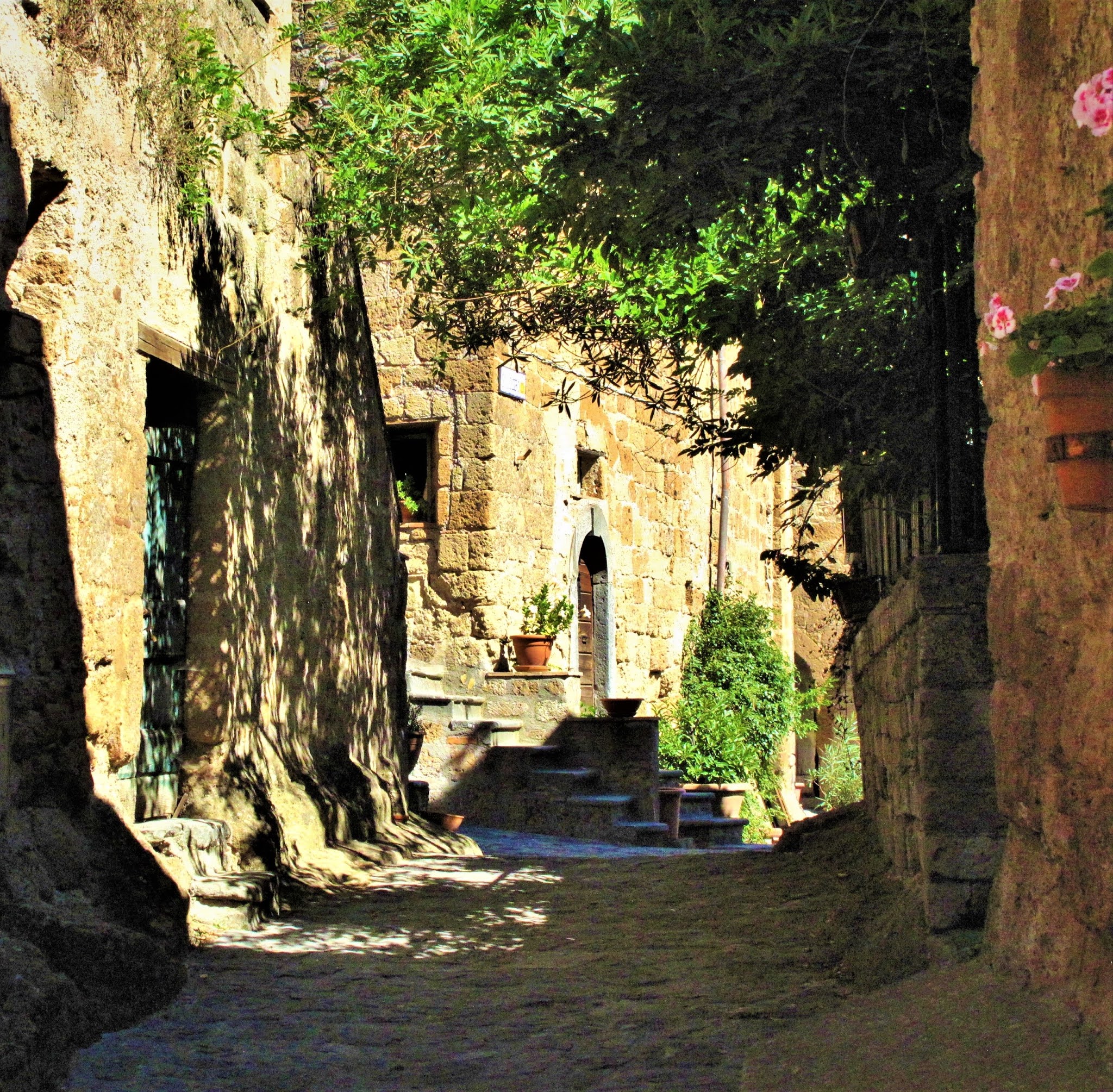
Ancient alleyways of Civita di Bagnoregio, Lazio, Italy


As you stroll the village and take in the views, wander the small alleyways, admire the display of flowers that explode from every window box and staircase.


Etruscan caves in Civita di Bagnoregio, Lazio, Italy


At the end of the town, the main street begins to slowly wind downhill. The road eventually turns into a trail that villagers used to travel to attend their farms on the valley floor.  If you descend along the pathway, you begin to see caves carved out by the Etruscans 2,500 years ago!  These caves were used as wine cellars and storage for farm equipment until just a few decades ago. 


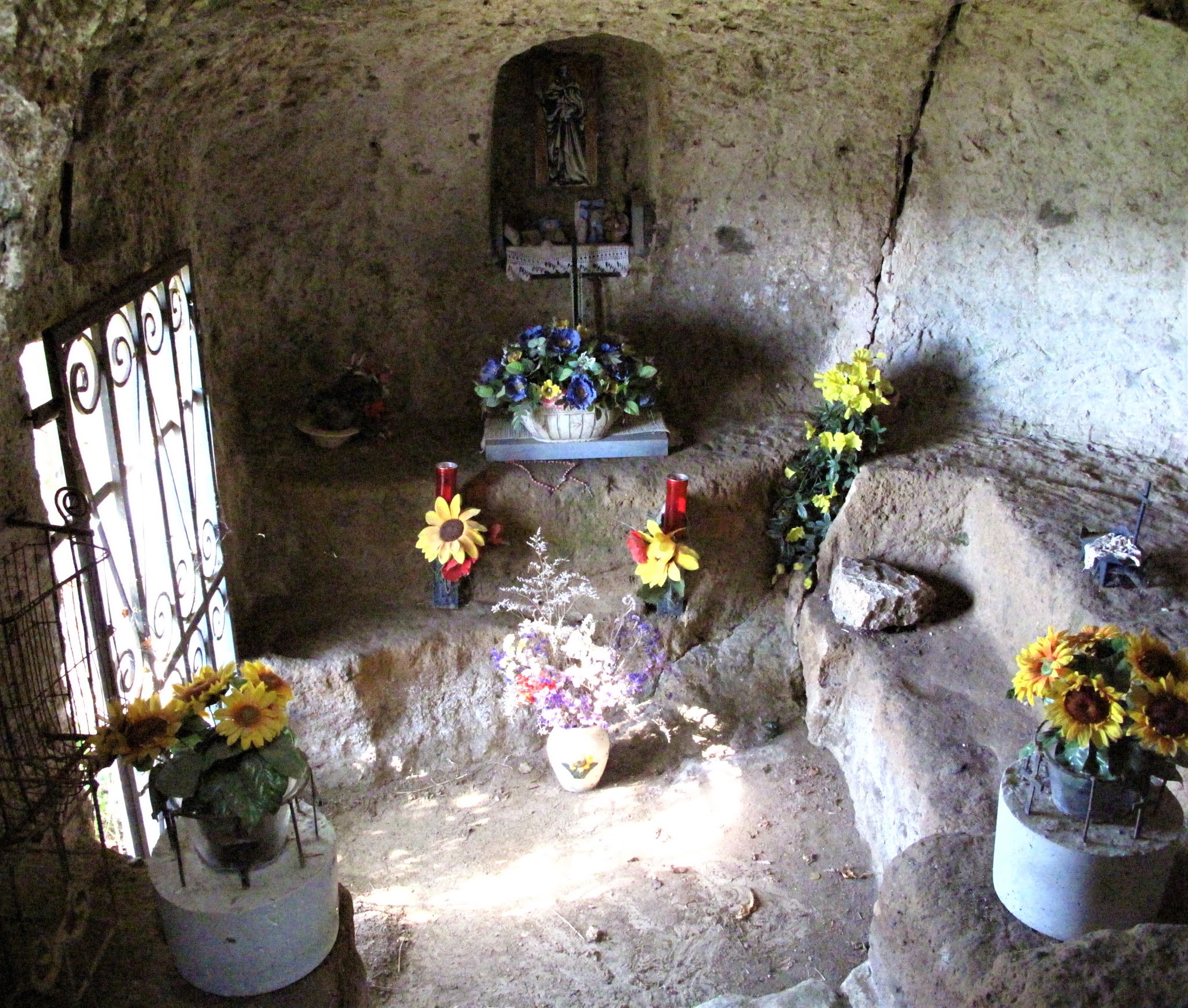
Cappella del Carcere, Chapel of the Incarcerated, Civita di Bagnoregio, Lazio, Italy

One cave has a gate in front of it, sealing it off, but you can peer inside.  This is the Cappella del 
Carcere or The Chapel of The Incarcerated.  This was most likely an Etruscan tomb, but in Medieval times it was used as the city's jail.  This humble "chapel" is a special place of worship for the few remaining Civita residents and is the town's starting point for religious processions.  Now that you have worked up an appetite exploring Civita, it's time for a meal!


Having lunch outdoors with street cats in Civita di Bagnoregio, Lazio, Italy

There are many choices for food in Civita.  I decided to stop for a delicious lunch at a small Osteria off the main piazza called La Cantina di Arianna. Delicious "bruschetta" (toasted bread with local olive oil) and homemade salumi, and of course, the local Orvieto Classico white wine is the best!  Check out my blog post for more information on Wines to Try in Umbria.  My son had so much fun feeding the cats and their little kittens that gathered under our table during lunch.  It seems like outdoor dining in hill towns often means you will have little furry guests joining you for your meal.


Potted plants at a home in Civita di Bagnoregio, Lazio, Italy


Civita di Bagnoregio had soared in popularity since I first visited it in 2013 when it was just a sleepy little ghost town on the Tuscan-Umbrian border.  I recommend planning your visit to Civita earlier in the day or later in the evening, catching the sunset, to avoid the mass tour-bus crowds.  Just remember to slow down your pace and enjoy sauntering around this unique place on earth.

Have you been to Civita?  What was your impression; a tourist trap or a slice of heaven?  Let me know in the comments below!


Follow me on FACEBOOKINSTAGRAM  and  BLOGLOVIN'  for daily photos and updates! #slowtravel🐌

Wednesday, March 12, 2025

ORVIETO~Classic Umbrian Hilltown


Orvieto Umbria; Classic Umbrian Hill Town

Set amidst a rolling landscape and surrounded by vineyards, Orvieto perches regally atop a rock outcrop 1000 feet above the valley floor...


Orvieto fortifications
Founded by the Etruscans around 500 BCE, Orvieto is thought by many archeologists to be the mysterious city of Velzna, a huge Etruscan city destroyed by the Romans. Later, when the Romans annexed the Etruscans, Orvieto became a major Roman stronghold because of its virtually impenetrable verticle cliffs. Orvieto became a refuge for the Pope and a castle during the Middle Ages. Many grand palaces and churches were built.

Today Orvieto, with its close proximity to the A1 Autostrada connecting Rome with Florence, has become quite the weekend destination for those escaping the big cities and a day-trip destination for foreign tourists.   While this gorgeously preserved Medieval hilltop town can be explored in one day, the real magic of Orvieto occurs at sunset when the crowds disperse, and the residents unwind.


Piazza in Orvieto
To reach Orvietos Historical Center at the top of the cliffs, you can park at the funicular (near the train station) at the east end of town. There is also public parking on the west side of the cliffs, and you can take the elevator or escalator up to the top. Unless you have accommodation in the Centro Storico with complimentary parking, it is best to leave your car below, avoiding expensive parking fees and driving the very narrow one-way streets. If you decide to drive up to the centro storico, the most convenient parking lots are in the Piazza Cahen and Piazza del Duomo.

Green Umbrian Hills
If you ride the funicular up to the old center, you are deposited at Piazza Cahen. There is an info centre here at the funicular station where you can get an Orvieto map and find information on various tours of the Orvieto Underground. T
he ruins of Rocca Albornoziana, a fortress from the mid-12th century, are to the left of Piazza Cahen. The view from here of the Umbrian countryside is outstanding. To your right are a public park, and beyond it, the remains of an ancient Etruscan Temple on the edge of the bluffs with more breathtaking views.  


St. Patricks Well

St. Patricks Well
Towards the belvedere of the Etruscan temple remains is one of the most impressive feats of engineering in 16th century Italy; St. Patricks well. The Pozo di San Patrizio was built in 1527 by pope Clement while he stayed in Orvieto during the sack of Rome. The Pope knew the cliff walls of Orvieto would keep invaders at bay, but if they wanted to outlast an extended siege, the city would need an ample water supply. The well took only ten years to build and has a central shaft reaching down 53 metres (175 feet), and two separate paths spiral around the well. One path leads downwards, and the other spiral upwards so that mules carrying water only had one-way traffic to deal with. It's a fun workout to descend the 250 steps down, and the 70 windows offer those with slight claustrophobia some relief. The cost is €5, and the well is open 9-8. The audio guide is worth the €2 rental; bring a sweater-it's cold at the bottom!

Orvieto Cathedral

Orvieto Cathedral

Orvieto is the perfect size town to manage by walking. The streets are flat and easy to stroll with the car-free Via Cavour or "the
Corso" being the main route. Follow the Corso and listen for the Renaissance-era bells of Orvieto's Duomo or Cathedral. Glistening in gold and brightly coloured mosaics, the Duomo's facade is a feast for the eyes! Resembling Siena's Cathedral with its black & white striped marble, Orvieto's Duomo is also magnificent on the inside. Featuring frescoed ceilings started by Fra'Angelico and finished fifty years later by Luca Signorelli from the nearby Tuscan hill town of Cortona. Signorelli's masterpiece and not to be missed piece of art in Orvieto is the Chapel of San Brizio, featuring beautifully lit frescoed scenes of the Apocalypse. The entrance price for seeing the Cathedral, including the San
 Brizio Chapel, is €5.


Orvieto Underground

The Well of The Cave in Orvieto
If you want more subterranean tours, The Well of The Cave (Pozzo della Cava) is a vast network of underground caverns, tunnels and wells dating back to the Roman and Etruscan civilizations of Orvieto. The tunnels provide an excellent exploring adventure for kids but are not for the claustrophobic! Self-guided tours are €4/€2.50 for children. For more information, visit pozzodellacava.it


Etruscan Tombs

Orvietos Necropolis
There are two Etruscan burial sites at the base of Orvieto's cliff. Called a Necropolis, these are literally cities of the dead where the burial tombs look like miniature stone houses laid out in a city grid plan.  On the Southside of Orvieto is the Necropolis of Cannicella, and to the North of  the town is the Necropoli Etrusca del Crocifisso del Tufo.  This is the one I chose to visit because it had a large free parking lot and a small museum holding some of the archeological findings from the area. You can wander freely amongst the tombs that date back to the 5th century BCE and even go inside some of them. You can even see the Etruscan family name carved in stone above the tomb entrance. Tickets 
€3; closed Mondays & Tuesdays.


Orvieto Wine & Wine Tasting

Orvieto Wines
Orvieto is known for its delicious white wines, appropriately named Orvieto Classico. A blend of 40% Grechetto, 20-40% Trebbiano (locally called Procanico) and up to 40% of other white grape blends such as Verdello and Malvasia Bianco. Orvieto Classico is a DOC wine is a pale straw colour that is light and crisp, with a delicate floral taste. There are many enoteca 0r wine bars to try different local wine varieties, including Orvieto "secco" or dry white. Another fun thing to do is tour a local vineyard and have a wine tasting. You can arrange this with the local Tourist Information Centre near the funicular station in Piazza Cahen or visit the tourist office online at orvietoviva.com to plan your tour. For more on discovering wines of Umbria, don't miss my popular blog post 7 Wines To Try In Umbria


Civita di Bagnoregio

Civita di Bagnoregio
A short 20km from Orvieto is the well-preserved Medieval village of Civita di Bagnoregio.  Considered a ghost town, Civita di Bagnoregio is nicknamed "The Dying Town" because of the gradual slide of its' perch atop a clay pillar into the steep valley below. Civita is connected by a 1 km pedestrian toll bridge crossing the canyon. It costs €5 to cross the bridge to Civita, which pays for the shoring up of the village's hillside. Stepping through the city gates is like stepping back through the mists of time; Renaissance, Medieval, Roman and Etruscan architecture blend together, becoming a fun scavenger hunt. The leisurely pace of life in Civita de Bagnoregio reminds one to slow down and enjoy the moment. Busses from Orvieto to Civita de Bagnoregio leave several times a day; check the orvietoviva.com site for the seasonal schedule. Also, check out my blog post on Civita di Bagnoregio for more information on what to see and do.


Palazzo in Orvieto

Orvieto becomes even more enchanting at night with all the day tourists from Rome gone and the historic buildings, palaces and churches delicately lit up. Stroll the Medieval city ramparts or sip a glass of wine and marvel at the Duomo. My favourite place to stay in Orvieto is
La Casa di Tufo B&B right in the historic centre. I feel like I am staying with family at this charming B&B!

Orvieto Charm


Orvieto is a place I stop to visit again and again. What is your favourite memory of Orvieto? The food, the wine, the architecture?


Follow me on FACEBOOKINSTAGRAM  and  BLOGLOVIN'  for daily photos and updates! #slowtravel🐌

Saturday, February 13, 2021

Castiglione Del Lago~Perfect Family Destination In Umbria

Lake Trasimeno from the ramparts of the castle in Castiglione Del Lago, Umbria, Italy

Looking for a hidden family-friendly gem in Tuscany?  This peaceful lakeside town on the Tuscan border with Umbria has all the charms of a big resort, without any tourist crowds.


As a lover of "Slow Travel," I like to stay in one location for at least 3 days and explore the surrounding area.  On my visit to Tuscany, my small family rented part of a farmhouse in Cortona and made day trips to many destinations in Tuscany.  For great tips and Italy road-trip planning advice, read my blog post on: Tuscany Road Trip

View of Lake Trasimeno and farmlands from Cortona, Tuscany, Italy
Castiglione Del Lago Viewed From Cortona

It was a sweltry mid-September day in Tuscany, and it also happened to be my birthday, so nothing was planned on my travel itinerary.  I decided to be spontaneous, go on an adventure and find somewhere not listed in the guidebooks.  Looking at the map book, I decided to head for Lago Trasimeno to beat the heat.  
Castiglione del Lago looked interesting and only 20 km from Cortona, featuring an ancient castle jutting out into a lake.  So I set our rental car's GPS, pressed go, and we were there less than half an hour later.


Medieval city gate in Castiglione Del Lago, Umbria, Italy
Gate in Medieval Wall


Castiglione del Lago is on the West side of Lago Trasimeno just across the Tuscan border in Umbria; Lake Trasimeno being the dividing line between Tuscany and Umbria.  The village of about 15,000 people today started as a castle on an island.  Over time as the city grew, the flat area between the castle and the shore was reclaimed and filled in with buildings and piazzas.  The town's well-preserved historical centre or centro storico is surrounded by a Medieval wall.  Castiglione del Lago's old town centre is known for its threes, meaning there are three city gates, three parallel streets (which is a Roman-era city layout), three piazzas and three churches.  The main sights in this charming town are the castle and the palace, but there is also a public park with a beach and free parking just to the north of the castle on Via Lungolago.  


Map of the historical center of Castiglione Del Lago, Umbria, Italy


Baskets of bulk food shopping for local products in Castiglione Del Lago, Umbria, Italy
The Centro Storico of Castiglione del Lago is within the Medieval walls and completely car-free, making it a delight to stroll.  
There are several free and paid parking lots along Via Belvedere, the road that circles the Old Town.  I also found much free street parking just outside the walled city centre.  Most visitors enter Castiglione del Lago through the West Gate, the Porta Senese and wander along the main street, Via Vittorio Emanuele.  Here you will find a gauntlet of stores selling Prodotti Tipici or regional products like local cheeses, kinds of dried pasta, beans, spices, sweets, and olive oil.  
I loaded up on dried pici, a local thick hand-rolled pasta.  For more on local Tuscan products, read my blog post on: 10 Things You Must Eat In Tuscany


Alter inside church of Santa Maria Maddelena in Castiglione Del Lago, Umbria, Italy
photo: Wolfgang Sauber
The main drag heads East towards the Lake, passing by the beautiful Church of Santa Maria Maddelena, with its neo-classic columns out front and Greek cross plan.  It's worth the peek inside to see the painted panels from 1580 and the lofty dome.  This church was once a Roman Temple when the Romans founded the city and was given the name Clusium 
Novum or New Chiusi.  Chiusi is a lovely Tuscan village and was an important Etruscan city located nearby.  To read about Chiusi, see my blog post: Chiusi Tuscany~Under The Etruscan Sun
Corridor connecting the Palace and the Fortress of Castiglione Del Lago, Umbria, Italy
Corridor to the castle
Following Via Vittorio Emanuele, you come to a grand Renaissance palace, the Palazzo della Corgna. This palace was built for the Duke della Corgna and serves as the city hall, civic museum and art gallery.  There are some beautiful frescoes in the palace, but the real fun is taking the long covered corridor to the Medieval star-shaped castle called the Rocca de Leone.  The castle was completed for Frederick II of Swabia in 1247 by the monk/architect Brother Elia.  Elia was a Franciscan monk from Cortona, who happened to be Saint Francis of Assisi's best friend and right-hand man.  For more information on Saint Francis and the shaping of Umbria, check out my blog post: St. Francis the Umbrian Rock Star!   

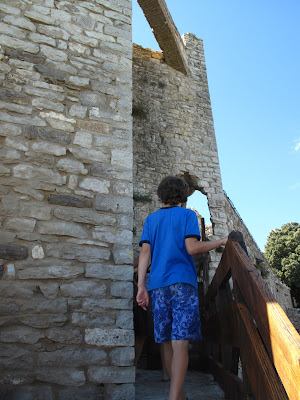
This long walkway leads you to a wonderfully restored stone fortress with sweeping views of Lake Trasimeno, the lake's islands, and Cortona climbing the distant mountainside.  Kids can have fun exploring the ramparts, climbing the tall three-sided bastion tower called "the masio," or take in the shade of the olive trees in the castle's bailey.

View of lake Trasimeno and Rocca de Leone from the "Masio" tower, Castiglione Del Lago, Umbria, Italy
View From The Masio
Climbing the towers and ramparts of Rocca de Leone in Casliglione Del Lago, Umbria,  Italy
Exploring the ramparts of Rocca de Leone castle in Castiglione Del Lago, Umbria, Italy
Strolling under the shade of the ancient olive trees along the ramparts of Rocca de Leone castle of Castiglione Del Lago, Umbria, Italy
If you have worked up an appetite from exploring the fortress, many excellent local Osterias serve local specialties from Lake Trasimeno.  Look for a dish called Brastico, which is fish fire-roasted over reeds from the shore of Lake Trasimeno.  Or perhaps try Tegamaccio, a soup made with several different types of lake fish, baked in terracotta pots for five hours.  Alternately you can grab some take-out food such as panini (sandwiches), arancini (deep-fried rice balls stuffed with meat and or cheese) or pizza sold by the gram and head to the public beach for a picnic.  The beach at Castiglione Del Lago is sandy; the water is warm, clear and shallow, perfect for kids to cool off on a hot day.  The lake water is tested daily from April through September to make sure it is safe for swimmers.

Sandy public beach park of Lake Trasimeno at Castiglione Del Lago,  Umbria, Italy

Family time in Tuscany has never been so much fun!  What is your favourite family activity when visiting Tuscany?  Let me know in the comments below...


Follow me on FACEBOOKINSTAGRAM  and  BLOGLOVIN'  for daily photos and updates! #slowtravel🐌


Sunday, May 17, 2020

Storytime: Saint Margherita of Cortona

Story of Saint Margherita of Cortona, Tuscany Italy


Cortona Tuscany's beloved patron Saint, Santa Margherita, is a life story of devasting loss, repentance and renewed purpose.  How did this simple country girl go from Sinner to Saint?

Nicknamed "poverella"  or "little poor one" she is the protector of all hoboes, tramps, prostitutes, homeless, mentally ill and single mothers. Saint Margherita was the Shero of the 13th century... 
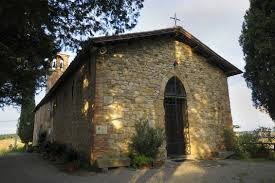

Laviano Church Italy
Laviano Church

Margherita Bartolomeo was born in 1247 in a small village called Laviano halfway between the hilltown fortress of Montepulciano and the lakeside Castle of Castilogne di Lago on Lake Trasimeno. The tiny hamlet consists of a few buildings that are now agriturismos and an 11th Century church called Church of the Saints Vito and Modesto.  It is said that Margherita came to this chapel to pray daily as a child. Across from the ancient church is a small cottage that has room for animals on the ground floor and living quarters above.  Margherita is believed to have been baptized in St. Peters Church in Pozzuolo, a nearby town.  Margharita lived a happy life with her parents and younger brother until her mother died when she was a girl of about seven, and then her life turned upside down.  


Map of Saint Margherita sights, Laviano, Valiano, Val di Chiana, Tuscany, Italy


Margherita's father remarried rather quickly to a woman who was not very kind to her step-daughter.  According to legend, Margherita constantly fought with her step-mother and was described as "willful," "stubborn," "disobedient," and "reckless,"; which is code for Margherita had a mind of her own and can not be tamed!  Soon, Margherita flowered into a stunning young woman, and word of her beauty spread far and wide over the Val di Chiana.  This combination of beauty and fearlessness was a recipe for disaster for a woman who spoke her mind in the Middle Ages. 
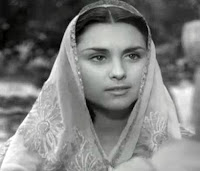


Actress Maria Frau in the 1950s film Margherita da Cortona
Maria Frau in Margherita da Cortona


As word of Margherita's fairness travelled, a son of the nobleman Gugliemo del Pecora heard of the young peasant girl's beauty and wanted to see her for himself.   The del Pecora family were extremely powerful nobles in Montepulciano and had palaces in Montepulciano, Chiusi and Valiano, a small town on the Umbrian border.  The son of Gugiemo del Pecora was Raniero (sometimes called Arsenio in texts, now thought to be an anagram) who had a hunting villa in the hills just outside the village of Valiano.  When he went out hunting, he would seek out the beautiful young Margherita, and a torrid affair began.
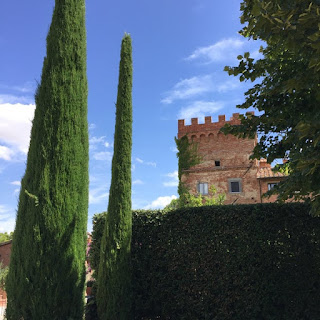


The del Pecora Fortress near Valiano, Tuscany, Italy
The Fortress Like Hunting Lodge

Rumours abounded about the liaison between the peasant girl and the nobleman, and Margherita's family was worried about shame being brought upon them.  Just like Romeo and Juliet, you know that when you try to stop two star-crossed lovers, only tragedy prevails.  Margherita was forbidden to see Raniero, and the fifteen-year-old ran away to live with him.  The legend says that poor Margherita was locked up in a tower in Raniero's castle in Montepulciano and tricked into being his concubine.  There was NO WAY Raniero's family would have been happy with his choice of lover.  Raniero would have to marry a noble, and in fact, was already betrothed to a noblewoman from Siena.  He kept his delicious little Margharita safe from the wagging tongues of the courts of Montepulciano, away from his disapproving father's castle in Valiano and tucked her away just outside the city walls in his fortified tower aka~The Hunting Lodge.


Oil painting by Italian Baroque painter Marco Benefial
Marco Benefial
Here in his hunting lodge, he presented Margherita with fine clothes, jewellery and servants; they hosted hunting parties and dinner parties with his wealthy and noble friends.  The couple was recorded in her biography to have lived for 10 years in "i' more uxorio" a Latin term meaning "together as husband and wife," and they had a son together they named Jacopo.  Life was almost perfect for Margherita; until the unthinkable happened.
One fine Autumn day Raniero was out hunting with his dogs, and he failed to come home by evening.  Margherita knew something was amiss and became anxious since there had been much feuding between the Guelph and Ghibellines in their area along the Tuscan and Umbrian border of Lake Trasimeno.  Suddenly Raniero's favourite hunting dog appeared at the Tower door barking frantically...without his master.  Margherita followed the agitated dog deep into the forest to a grove of Oak trees in the borgo of I Giorgi, where she found Raniero murdered; his body dragged into the woods and half-covered by branches to conceal the corpse.
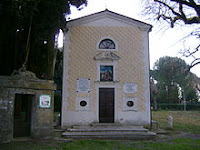
Votive chapel of repentance in the I Giorgi area Tuscany, Italy
Votive Chapel of Saint Margaret

Margherita's word came crashing down on her, and she fell to her knees at the sight of her dead lover.  She believed she was being punished for her happiness and thought God judged her lifestyle to be a sin.  Raniero was caught up in the Guelph-Ghibelline feuds, and his murder was a direct message to the powerful del Pecora family.  Margherita was distraught and repented all her sins to God in that forest grove of Oaks. The faithful have been going to this spot ever since, and a votive chapel was built in there in 1750. In front of the tiny church was a vast 1000-year-old Oaktree called "the Oak of Repentance," the very same Oak Margherita prayed under.    Just in the past year, the Oak Of Repentance has fallen over, and the trunk of the tree has been preserved and erected in front of the votive chapel.  Every year at the beginning of September, the faithful gather here to worship Santa Margherita.
One thousand year old Oak of Repentance in I Giorgi, Tuscany, Italy
Oak Of Repentance


Gathering up her son Jacopo, Margherita fled her home for the past ten years and left everything behind.  She knew Raniero's family disapproved of her and Jacopo, and Margherita may have even suspected his family may have been involved in his murder.  Margherita and her boy returned to her childhood home, only to find her father has disowned her and refused to let them in. Margherita, devastated, then headed to Cortona, some 18 km away.
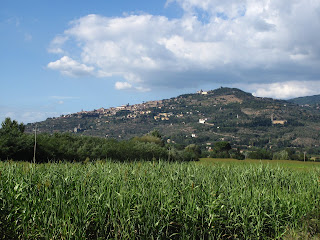

The hill town of Cortona from the valley floor, Cortona, Tuscany, Italy
Cortona From The Valley Floor


      Arriving in Cortona in 1272, Margherita and Jacopo are taken in by Countess Ranieri and her sister Lady Maineria De Moscari in the Palazzo Moscari (now a private home).  These two noblewomen helped the single mother to get back on her feet, and it is thought that perhaps Margherita knew the two them from her life with Raniero.  Maineria and Ranieri arranged to have Jacopo educated in Arezzo so that Margherita could focus on putting her life together again.  Margherita was still a beautiful woman of around 25 years old at this time in her life and decided to devote her life to helping the poor.  Margherita began to spin wool and flaxen, while the noble De Moscari sisters also got Margherita some work as a midwife (which she was very successful at.) They also set Margherita up in a small apartment near the Porta Berada, which is located on Via S. Margherita as it leaves the city to go up to the basilica. 
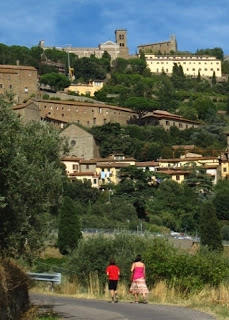

Walking on the road to Cortona, Tuscany, Italy

During the 1200s, Cortona was a mecca for both the Franciscan order and the Benedictine order.  St. Francis himself lived in Cortona briefly in 1211. After he died, the leadership of the Franciscan order went to St.  Francis's best friend, Brother Elias, who lived in Cortona and had already established a church in Cortona.  Saint Francis was A ROCKSTAR in his time, and people flocked to Cortona on pilgrimage and many to devote their lives to the order.  The attraction of the Franciscans was that you didn't have to be in the first order (friars) or second (nuns), but you could devote your life to the third order or tertiaries, which is what Margherita did.  She began to visit the Church of Saint Francis up the street from her dwelling and became more and more involved with the church.  The beautiful Margherita cut her hair off and wore the sackcloth of a Penitant.  She chose a life of poverty living on alms and was even said to have rubbed ashes on her face to hide her beauty.
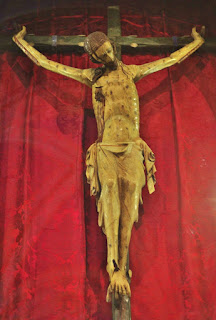
13c Wooden crucifix of Saint Ftancis in the basilica Santa Margherita

Cortona has been ravished by the battles with Arezzo in the late 1250s, and there were many homeless, sick and poor people barely existing.  Margherita prayed fervently every day before the wooden crucifix in St Francis's church, the same one Saint Francis used to pray before.  One day Margherita heard the words, "What is your wish, Poverella?"  Poverella in Italian means "little poor one," and Margherita replied, "I neither seek nor wish for anything but YOU."  This nickname Spirit gave Margherita stuck, and she went to work nursing the sick and feeding the poor. By the year 1278, Margherita's wealthy friends, the De Moscari sisters, opened up their palazzo to establish a hospital, "Our Lady Of Mercy," run solely by her order of tertiary sisters that were nurses called Le Poverelle.  Today the wooden crucifix is housed in Cortona's basilica of St. Margherita.


Street votive shrine along the streets of Cortona, Tuscany Italy
Shrine in Cortona

Margherita's reputation began to grow, and she became known as a woman of devout faith, healing, action and courage, asserting herself in the city of Cortona by taking charge of establishing the hospital.  Twice Margherita's assistance as a peace-maker was needed negotiating disputes between Cortona and the Bishop of Arezzo, Guielmo Ubertini Pazzi.  Margherita's knowledge of noble courtly behaviour and diplomacy came in handy when dealing with the actions of the Bishop, who like to believe he was a warring prince! Jacopo became a Franciscan Friar as well, following in the footsteps of his mother.
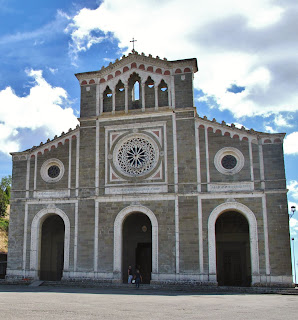


The baroque facade of the basilica of Santa Margherita da Cortona, Italy
St. Margherita Basilica

The deserted oratory of St. Basil at the top of Cortona just below the Medici Fortress was given to Margherita in 1288 by the Catholic Church.  The little chapel only measuring 15 meters long was severely damaged during the 1258 siege of Cortona by Arezzo.  Margherita chose this little chapel because of the adjacent convent that she rebuilt to house her Poverelle which had outgrown the Moscari Palazzo.   Margherita lived in a small room behind the church while she personally oversaw the restoration of the convent and church.
At the age of 50, Margherita began to slow down, and the days of hard labour and poverty diet had taken a toll on her body.  Her confessor, Friar Giunta Bevegnati spent eight days writing down Margherita's Vita and a few years after her death and she was presented as "The New Magdalene." February 22, 1297, Margherita da Cortona died in her small room at the back of her church, and her body was buried in the wall.


Ceiling full of stars in the basilica di Santa Margherita, Cortona, Tuscany, Italy
Interior of baroque era basilica of St. Margherita da Cortona, Italy


        Baroque Interior Of Saint Margherita Basilica
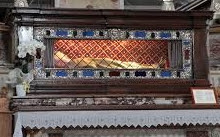


Incorrupt body of Saint Margherita of Cortona, tuscany, Italy
Final Resting Place Of Saint Margherita da Cortona

After Margherita's death, her popularity grew exponentially.  A bigger church was needed, in part to hold her relics and also to house all the pilgrims coming to Cortona.  In 1456 her body was disinterred and was discovered to be incorrupt-her body had not decomposed.  In the Catholic Church, this is considered Supernatural, a miracle and the sign of a Saint!  On May 16, 1728, Margherita da Cortona was canonized, and her body was placed inside a silver and glass casket designed by famous Baroque painter Pietro Berrettini (Pietro da Cortona).  You can view Margherita's body, which is on display behind an iron gate in the marble side-chapel of the basilica.

Painting of Santa Margherita da Cortona


Every year on February 22, the village of Cortona gathers to honour their Patron Saint, Santa Margherita.  It is a festival in front of the basilica with food trucks, candy stalls and mulled wine to keep everyone warm.  Mass is held several times a day, the iron gate is opened, and people line up to get a close look at the body of their beloved Saint.  Saint Margherita's feast day is May 16.  She remains Cortona's original SHERO, protecting all single mothers, falsely accused, homeless, midwives, mentally ill, prostitutes, orphaned, penitents, hoboes & tramps.    Margherita's life is a timeless story that reminds us all that we can be reborn and renewed at any point in our lives and that ...

It doesn't matter who you used to be; what matters is who you decide to be today.


Follow me on FACEBOOKINSTAGRAM  and  BLOGLOVIN'  for daily photos and updates! #slowtravel🐌