Translate

Showing posts with label Saints. Show all posts

Sunday, May 17, 2020

Storytime: Saint Margherita of Cortona

Story of Saint Margherita of Cortona, Tuscany Italy


Cortona Tuscany's beloved patron Saint, Santa Margherita, is a life story of devasting loss, repentance and renewed purpose.  How did this simple country girl go from Sinner to Saint?

Nicknamed "poverella"  or "little poor one" she is the protector of all hoboes, tramps, prostitutes, homeless, mentally ill and single mothers. Saint Margherita was the Shero of the 13th century... 


Laviano Church Italy
Laviano Church

Margherita Bartolomeo was born in 1247 in a small village called Laviano halfway between the hilltown fortress of Montepulciano and the lakeside Castle of Castilogne di Lago on Lake Trasimeno. The tiny hamlet consists of a few buildings that are now agriturismos and an 11th Century church called Church of the Saints Vito and Modesto.  It is said that Margherita came to this chapel to pray daily as a child. Across from the ancient church is a small cottage that has room for animals on the ground floor and living quarters above.  Margherita is believed to have been baptized in St. Peters Church in Pozzuolo, a nearby town.  Margharita lived a happy life with her parents and younger brother until her mother died when she was a girl of about seven, and then her life turned upside down.  


Map of Saint Margherita sights, Laviano, Valiano, Val di Chiana, Tuscany, Italy


Margherita's father remarried rather quickly to a woman who was not very kind to her step-daughter.  According to legend, Margherita constantly fought with her step-mother and was described as "willful," "stubborn," "disobedient," and "reckless,"; which is code for Margherita had a mind of her own and can not be tamed!  Soon, Margherita flowered into a stunning young woman, and word of her beauty spread far and wide over the Val di Chiana.  This combination of beauty and fearlessness was a recipe for disaster for a woman who spoke her mind in the Middle Ages. 


Actress Maria Frau in the 1950s film Margherita da Cortona
Maria Frau in Margherita da Cortona


As word of Margherita's fairness travelled, a son of the nobleman Gugliemo del Pecora heard of the young peasant girl's beauty and wanted to see her for himself.   The del Pecora family were extremely powerful nobles in Montepulciano and had palaces in Montepulciano, Chiusi and Valiano, a small town on the Umbrian border.  The son of Gugiemo del Pecora was Raniero (sometimes called Arsenio in texts, now thought to be an anagram) who had a hunting villa in the hills just outside the village of Valiano.  When he went out hunting, he would seek out the beautiful young Margherita, and a torrid affair began.


The del Pecora Fortress near Valiano, Tuscany, Italy
The Fortress Like Hunting Lodge

Rumours abounded about the liaison between the peasant girl and the nobleman, and Margherita's family was worried about shame being brought upon them.  Just like Romeo and Juliet, you know that when you try to stop two star-crossed lovers, only tragedy prevails.  Margherita was forbidden to see Raniero, and the fifteen-year-old ran away to live with him.  The legend says that poor Margherita was locked up in a tower in Raniero's castle in Montepulciano and tricked into being his concubine.  There was NO WAY Raniero's family would have been happy with his choice of lover.  Raniero would have to marry a noble, and in fact, was already betrothed to a noblewoman from Siena.  He kept his delicious little Margharita safe from the wagging tongues of the courts of Montepulciano, away from his disapproving father's castle in Valiano and tucked her away just outside the city walls in his fortified tower aka~The Hunting Lodge.


Oil painting by Italian Baroque painter Marco Benefial
Marco Benefial
Here in his hunting lodge, he presented Margherita with fine clothes, jewellery and servants; they hosted hunting parties and dinner parties with his wealthy and noble friends.  The couple was recorded in her biography to have lived for 10 years in "i' more uxorio" a Latin term meaning "together as husband and wife," and they had a son together they named Jacopo.  Life was almost perfect for Margherita; until the unthinkable happened.
One fine Autumn day Raniero was out hunting with his dogs, and he failed to come home by evening.  Margherita knew something was amiss and became anxious since there had been much feuding between the Guelph and Ghibellines in their area along the Tuscan and Umbrian border of Lake Trasimeno.  Suddenly Raniero's favourite hunting dog appeared at the Tower door barking frantically...without his master.  Margherita followed the agitated dog deep into the forest to a grove of Oak trees in the borgo of I Giorgi, where she found Raniero murdered; his body dragged into the woods and half-covered by branches to conceal the corpse.
Votive chapel of repentance in the I Giorgi area Tuscany, Italy
Votive Chapel of Saint Margaret

Margherita's word came crashing down on her, and she fell to her knees at the sight of her dead lover.  She believed she was being punished for her happiness and thought God judged her lifestyle to be a sin.  Raniero was caught up in the Guelph-Ghibelline feuds, and his murder was a direct message to the powerful del Pecora family.  Margherita was distraught and repented all her sins to God in that forest grove of Oaks. The faithful have been going to this spot ever since, and a votive chapel was built in there in 1750. In front of the tiny church was a vast 1000-year-old Oaktree called "the Oak of Repentance," the very same Oak Margherita prayed under.    Just in the past year, the Oak Of Repentance has fallen over, and the trunk of the tree has been preserved and erected in front of the votive chapel.  Every year at the beginning of September, the faithful gather here to worship Santa Margherita.
One thousand year old Oak of Repentance in I Giorgi, Tuscany, Italy
Oak Of Repentance


Gathering up her son Jacopo, Margherita fled her home for the past ten years and left everything behind.  She knew Raniero's family disapproved of her and Jacopo, and Margherita may have even suspected his family may have been involved in his murder.  Margherita and her boy returned to her childhood home, only to find her father has disowned her and refused to let them in. Margherita, devastated, then headed to Cortona, some 18 km away.


The hill town of Cortona from the valley floor, Cortona, Tuscany, Italy
Cortona From The Valley Floor


      Arriving in Cortona in 1272, Margherita and Jacopo are taken in by Countess Ranieri and her sister Lady Maineria De Moscari in the Palazzo Moscari (now a private home).  These two noblewomen helped the single mother to get back on her feet, and it is thought that perhaps Margherita knew the two them from her life with Raniero.  Maineria and Ranieri arranged to have Jacopo educated in Arezzo so that Margherita could focus on putting her life together again.  Margherita was still a beautiful woman of around 25 years old at this time in her life and decided to devote her life to helping the poor.  Margherita began to spin wool and flaxen, while the noble De Moscari sisters also got Margherita some work as a midwife (which she was very successful at.) They also set Margherita up in a small apartment near the Porta Berada, which is located on Via S. Margherita as it leaves the city to go up to the basilica. 


Walking on the road to Cortona, Tuscany, Italy

During the 1200s, Cortona was a mecca for both the Franciscan order and the Benedictine order.  St. Francis himself lived in Cortona briefly in 1211. After he died, the leadership of the Franciscan order went to St.  Francis's best friend, Brother Elias, who lived in Cortona and had already established a church in Cortona.  Saint Francis was A ROCKSTAR in his time, and people flocked to Cortona on pilgrimage and many to devote their lives to the order.  The attraction of the Franciscans was that you didn't have to be in the first order (friars) or second (nuns), but you could devote your life to the third order or tertiaries, which is what Margherita did.  She began to visit the Church of Saint Francis up the street from her dwelling and became more and more involved with the church.  The beautiful Margherita cut her hair off and wore the sackcloth of a Penitant.  She chose a life of poverty living on alms and was even said to have rubbed ashes on her face to hide her beauty.
13c Wooden crucifix of Saint Ftancis in the basilica Santa Margherita

Cortona has been ravished by the battles with Arezzo in the late 1250s, and there were many homeless, sick and poor people barely existing.  Margherita prayed fervently every day before the wooden crucifix in St Francis's church, the same one Saint Francis used to pray before.  One day Margherita heard the words, "What is your wish, Poverella?"  Poverella in Italian means "little poor one," and Margherita replied, "I neither seek nor wish for anything but YOU."  This nickname Spirit gave Margherita stuck, and she went to work nursing the sick and feeding the poor. By the year 1278, Margherita's wealthy friends, the De Moscari sisters, opened up their palazzo to establish a hospital, "Our Lady Of Mercy," run solely by her order of tertiary sisters that were nurses called Le Poverelle.  Today the wooden crucifix is housed in Cortona's basilica of St. Margherita.


Street votive shrine along the streets of Cortona, Tuscany Italy
Shrine in Cortona

Margherita's reputation began to grow, and she became known as a woman of devout faith, healing, action and courage, asserting herself in the city of Cortona by taking charge of establishing the hospital.  Twice Margherita's assistance as a peace-maker was needed negotiating disputes between Cortona and the Bishop of Arezzo, Guielmo Ubertini Pazzi.  Margherita's knowledge of noble courtly behaviour and diplomacy came in handy when dealing with the actions of the Bishop, who like to believe he was a warring prince! Jacopo became a Franciscan Friar as well, following in the footsteps of his mother.


The baroque facade of the basilica of Santa Margherita da Cortona, Italy
St. Margherita Basilica

The deserted oratory of St. Basil at the top of Cortona just below the Medici Fortress was given to Margherita in 1288 by the Catholic Church.  The little chapel only measuring 15 meters long was severely damaged during the 1258 siege of Cortona by Arezzo.  Margherita chose this little chapel because of the adjacent convent that she rebuilt to house her Poverelle which had outgrown the Moscari Palazzo.   Margherita lived in a small room behind the church while she personally oversaw the restoration of the convent and church.
At the age of 50, Margherita began to slow down, and the days of hard labour and poverty diet had taken a toll on her body.  Her confessor, Friar Giunta Bevegnati spent eight days writing down Margherita's Vita and a few years after her death and she was presented as "The New Magdalene." February 22, 1297, Margherita da Cortona died in her small room at the back of her church, and her body was buried in the wall.


Ceiling full of stars in the basilica di Santa Margherita, Cortona, Tuscany, Italy
Interior of baroque era basilica of St. Margherita da Cortona, Italy


        Baroque Interior Of Saint Margherita Basilica
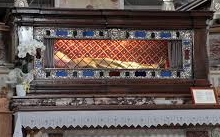


Incorrupt body of Saint Margherita of Cortona, tuscany, Italy
Final Resting Place Of Saint Margherita da Cortona

After Margherita's death, her popularity grew exponentially.  A bigger church was needed, in part to hold her relics and also to house all the pilgrims coming to Cortona.  In 1456 her body was disinterred and was discovered to be incorrupt-her body had not decomposed.  In the Catholic Church, this is considered Supernatural, a miracle and the sign of a Saint!  On May 16, 1728, Margherita da Cortona was canonized, and her body was placed inside a silver and glass casket designed by famous Baroque painter Pietro Berrettini (Pietro da Cortona).  You can view Margherita's body, which is on display behind an iron gate in the marble side-chapel of the basilica.

Painting of Santa Margherita da Cortona


Every year on February 22, the village of Cortona gathers to honour their Patron Saint, Santa Margherita.  It is a festival in front of the basilica with food trucks, candy stalls and mulled wine to keep everyone warm.  Mass is held several times a day, the iron gate is opened, and people line up to get a close look at the body of their beloved Saint.  Saint Margherita's feast day is May 16.  She remains Cortona's original SHERO, protecting all single mothers, falsely accused, homeless, midwives, mentally ill, prostitutes, orphaned, penitents, hoboes & tramps.    Margherita's life is a timeless story that reminds us all that we can be reborn and renewed at any point in our lives and that ...

It doesn't matter who you used to be; what matters is who you decide to be today.


Follow me on FACEBOOKINSTAGRAM  and  BLOGLOVIN'  for daily photos and updates! #slowtravel🐌


Saturday, May 9, 2020

Cortona, Tuscany~A Slice Of Tuscan Sun

Cortona and the Val Di Chiana below, Tuscany Italy


 Cortona is perched upon a 1700 foot hill overlooking a fertile valley, with sweeping views of Lake Trasimeno and the Umbrian countryside.  Cortona has become a pilgrim site for those seeking the Tuscan Sun...


It's been over twenty years since Frances Mayes captured our hearts and imagination (not to mention our stomachs!) with her story of renovating an old villa named Bramasole in the hilltown of Cortona.  The 1997 movie loosely based on Mayes' book Under The Tuscan Sun became a bestseller and one of my favourites, and I knew I needed to make a pilgrimage to this classic village in Southern Tuscany.  But what is it about this rustic Tuscan hilltown that beckons people to fantasize about leaving their life behind and moving to Italy?  Cortona emits a laidback, friendly, community vibe and I would encourage you to explore the town for at least an overnight instead of pulling up in front of Bramasolle to take the "I was here" photo.


Cortona has been popular with foreigners since the Romantics Era in the 1800s.  Its location in the Val di Chiana in southern Tuscany near the Umbrian border makes Cortona close to so many central Italian hill towns such as Siena, Florence, Assisi, Orvietto, Montalcino, Pienza and Montepulciano to name a few. This is why Cortona was my first choice to rent a farmhouse for a week and explore the surrounding countryside.  I found our Tuscan villa on VBRO.com.  


Medieval street underpass in Cortona, Tuscany, Italy


Cortona is also central to Rome (2.5 hrs) Florence (1.5 hrs) Assisi (1 hr).  If you are taking the train to Cortona there are two stations located at the valley floor in the town of Camucia or one about 10 minutes South in Terontola, depending on where you are coming from.  Both train stations have busses that run up the hill to Cortona's main Piazza Garibaldi hourly.  Cars are a bit more difficult to navigate through the narrow and steep streets, but there are several free parking lots outside the city walls including Santo Spirito Church and the Santa Margherita Basilica at the top of the hill.


Most of Cortona's charming restaurants, museums and shops are located on the only flat street in town Via Nationale.  Exploring the streets of Cortona is a treasure hunt but the streets become very steep and turn into steps as you head to the top of town.  We chose to park at the free parking lot at the top of Cortona and check out the Basilica of Santa Margherita.   This graceful neo-gothic style church houses the incorrupt body of Saint Margherita on display in a silver and glass casket in a side chapel designed by Pietro of Cortona.  This was the highlight of the day for my 12-year-old son! 


Margherita of Cortona had an interesting and tragic life. She was born on a nearby farm in 1247 and at 17 ran off with the son of a rich Lord to live as his wealthy mistress in a castle in Montepulciano.  When her lover was murdered, Margherita and her son gave up her life of luxury and became homeless ending up in Cortona and taken in by the monks of Saint Francis.  She followed the order of Franciscans taking a vow of poverty and her nickname became "La Poverella"  or "little poor one."  Margherita established a hospital in Cortona and an order of sister-nurses called le poverelle.                                                                                                                                                                


The basilica interior is painted in blues and gold with a ceiling full of metallic gold stars, like the night sky. A carved wooden crucifix from the 1200s is at the alter and is the same crucifix Margherita prayed to at her time in Cortona.  To check hours of the basilica visit www.santamargheritadacortona.com    


Approaching outer walls of Girifalco Fortress in Cortona, Tuscany, Italy
Girifalco Fortress

Above Santa Margherita is an impressive fortress.  The well preserved Girifalco Fortress was built during Santa Margherita's time in 1258 but was rebuilt to its current appearance in 1500 on the order of Florence's Cosimo De Medici.   The castle foundations date back to the Etruscan era, and extensive renovations completed in 2010 sees the fortress as an art Gallery, culture center and a bistro.  
                                                                                                    You can climb the ramparts and for stunning views of the Val di Chiana, lake Trasimeno and Umbria about a mile beyond.  The entrance to Girifalco Fortress is €5.  For times and events check www.fortezzadelgirifalco.it 


Cortona was one of the largest Umbrian settlements until it was captured by the  Etruscan, who named it Curtun, which means "enclosed place" probably because there was a wall that surrounded the settlement.   Parts of this 2,500-year-old city wall and its gate can be seen today at Porta Bifora on the Westside entrance to Cortona.
                                                                                                                                                                                                                                                                                                                                                                                                                                                                                                                                                                                                                                                                                                                                                                                                                                                                                                                                                                                   

Viiew of the Val Di Chiana from the Girifalso Fortress, Cortona, Italy
View From The Fortezza


The Cortona Etruscan Archeological Museum is a great place to learn about the mysterious indigenous people of Tuscany.  The museum is housed in a 13th-century De Medici palace called Pallazo Casali on Piazza Signorelli.  In this quiet museum, you will find Etruscan artifacts galore, including the Cortona Tablet, a second century BC, 200-word bronze tablet discovered in 1992 that has helped archaeologists learn more about the Etruscan civilization.  There is also an exhibit on the Roman colonization of "Curtun," which the Romans changed to Corito.  
Tickets to the MAEC are €10, and a combo ticket to include the Archeological Park is €13.  Visit the MAEC website for more information: www.cortonamaec.org/it/


The Medieval Clocktower in Piazza Signorelli, Cortona, Italy

Another of Cortona's noteworthy museums is the nearby Diocesan Museum.  Located in the former Church of  Gesú on Piazza del Duomo. The Diocesan Museum houses stunning works by pre and early Renaissance heavyweights like Fra' Angelico, Pietro Lorenzetti, Sassetta. There is a whole room dedicated to Cortona's own Renaissance master, Luca Signorelli, whose memory lives on in the hilltown today.  The cost of the Diocesan Museum is €6, which comes with a free audioguide.  For times and more info, click the link to Cortona Diocesan Museum.                                                                                                                                                                                                                                                                                                                             


Cortona is a DOC wine region with excellent red, white and Vin Santo (dessert wine) offerings.   Cortona boasts about 20 wine bars called Enoteca's offering the region's best wines by the glass or bottle.  The Cortona Syrah is one of the most notable and delicious wines produced in the area. There are winery tours available; check at the Tourist Centre located in the courtyard of the Etruscan Museum for more information.  There is also a craft microbrewery and gastropub called Birrifico Cortonoese, providing delicious snacks with three on tap beers-or take a bottle home as a souvenir.  There is no shortage of excellent restaurants in Cortona, serving fresh, local traditional food.


For an excellent resource of trip planning information, local history or events happing in Cortona go to www.cortonamia.com.                                                                                                     


Cortona has a certain enchantment that many people from around the world have experienced, just as Frances Mayes had those many years ago.  Below is my journal entry from my first trip to Cortona, but you must come to witness the magic for yourself.


Follow me on FACEBOOKINSTAGRAM  and  BLOGLOVIN'  for daily photos and updates! #slowtravel🐌

This post first appeared in 2017 as "Cortona."


Saturday, July 27, 2019

Saint Brigid's Holy Well in Kildare, Ireland

Saint Brigid's slippers at Tobar Bride in Kildare, Ireland


Long before Brigid was the Patron saint of Ireland, there was a Goddess Bríde who was venerated all over the Celtic world.  At St. Brigid's well, you feel Ireland's ancient past wrapped around you like a mantle...


Saint Brigid's ancient well and stone cross in Kildare, Ireland
Holy wells in Ireland are plentiful. Over 3,000 wells and springs dot the countryside; more than any other country in the world.  Always dedicated to an Irish Saint, in ancient times these sacred wells, were places of power devoted to Celtic Gods and Goddesses. In myth and folktale, sacred springs are portals to the Otherworld, the realm of the unseen...the realm of the faeries.  The holy wells were visited at the four significant Pre-Christian holy days February 1 (Imbolc), May 1 (Beltaine), August 1 (Lughnasadh) and November 1 (Samhain).  Other times a well would be visited was when someone needed healing, poetic inspiration, or trying to conceive a child.  These wells and sacred pools often had fish in them which were said to have magical powers, for they lived in the waters that have healing and transformative power.

Stone archway, Saint Brigid's slippers and Station Stones mark Saint Brigid's well in Kildare Ireland
St. Brigid's Slippers

Many of the sacred springs and wells in Ireland have elements of pre-Christian ritual sites.  Accompanying the well or natural spring, there was often a standing stone, a natural or man-made hill, and a very ancient tree; oftentimes a Hazelnut or Ash tree.  There was usually a ritual circuit for each sacred site. Often the ritual included circling the well a certain number of times in a clockwise direction, then drinking or bathing in the spring water. The ceremony concluded with leaving an offering for the God, Goddess or Spirit of the well in gratitude.


Tobar Bride sign at the entrance to Saint Brigid's well in Kildare, Ireland
"Tobar Bride" is Irish for Brigid's Well

When Christianity came to Ireland in the 5th century, Christian churches were often built at the pilgrim site of the holy wells, using the water of the well as a baptismal font.  There are even some churches built directly over pagan wells that still have a subterranean spring in its crypt!  


As the new Christian stone churches were being built, gathering at the holy well sights either fell out of popularity or was forbidden.  After the Dissolution of the Monasteries in the mid-1500s, many Roman-Catholics had nowhere to worship once their Church was disbanded or destroyed.  Catholic parishioners then decided to gather once again at the holy well sights on the Parish's Patron Saint's Feast Day.  The word 'Patron' turned into 'Pattern' and visiting Holy Wells on 'Pattern Day' became very popular in Irish culture in the 1700s.


Saint Brigid's holy well, station stones, stone archway and Saint Brigid's Slippers in Kildare, Ireland
The Spring & The Stones Leading to The Well


Map of Dublin to Kildare in County Kildare, Ireland

I visited Kildare's "Tobar Bríde" or Saint Brigid's wellIn Irish, Tobar means well, and Bríde is one of the spellings for the Celtic Goddess Brigid.  Kildare or Cill Dara is Irish for "Church of the Oak," and it is in Kildare that St. Brigid established her monastery in the 5th century.  Check out my blog post on Saint Brigid for more information on this fascinating woman that helped shape the history of Ireland.
GPS directions to Saint Brigid's holy well in Kildare, Ireland


Kildare is about a 45-minute drive from Dublin on the M7 motorway.  While St. Brigid's Cathedral is located in the heart of Kildare, the well is located on the Southside of the M7 in a park-like setting.  From Dublin heading East on the M7 take the Kildare Centre exit and head South on the R415 following the directions to the Irish National Stud.  Take the second left, and you will see a sign to the well on a small laneway to the right.  There is parking for a few cars at the entrance gate to the park.


Sitting aside Saint Brigid's ancient holy well in Kildare, Ireland
Cloutie Tree To The Left of The Well


I had learned about St. Brigid's well from some women in my spiritual community back home in Vancouver, Canada,  In fact, while I was visiting the well in Kildare, an Irish-Canadian woman was gathering water to bring back to her home in Toronto.  The woman was a Catholic, and she explained that she believed the waters from this well helped to heal her from her cancer.

The well is in a small park maintained by the Brigidine Sisters.  The deep well with a stone cross is fed by an underground spring.  The water then travels in an underground stream and path is marked by "station stones"  where one would say prayers at each stone.  Then the flow pops to the surface again at a stone archway leading to a stepped channel.  The two U-shaped stones under the arch are called St. Brigid's Slippers and are flumes to divert the flow when the water is running high.  Tradition has it that this area was used for early Christian baptisms and healing rituals.   


Bronze statue of Saint Brigid by Annette McCormack at St. Brigid's holy well in Kildare, Ireland
St Brigid by Annette McCormack


Behind the well is a traditional clootie tree.  A "clootie" or "cloutie" is a strip of cloth or leather. The cloutie strip is dipped into the well or spring and then used to wash the affected area of the body.  The cloutie is then tied to a sacred tree next to the well, and as the cloth turns to rags and disintegrates, the illness will disappear.  

Another tradition of sacred wells is the spotting of a tiny fish in the well.  Of course, the symbol of the fish was an early symbol for Christianity before the cross.  If you peer into the well at Tobar Bride, you may spot a little fish frolicking in the spring.  A sighting of the fish is supposed to ensure that St. Brigid has answered your prayers.

  
Looking into Saint Brigid's stone holy well at Kildare, Ireland


I am happy to report there was a goldfish sighting in the dark waters of Tobar Bride in August of 2018. Let me tell you my prayers were answered swiftly and directly!  The transformative energy of Brigid was not a slow burn, but a raging inferno that has changed the course of my life forever.  
I hope you have the opportunity to add one of Ireland's magical holy wells to your Irish itinerary.

For another of my blog posts on Ancient Sacred Sites in Ireland click HERE

In Ireland, this world and the next are only separated by a thin veil. Whisper questions into the sacred wells and your answers will appear...


Follow me on FACEBOOKINSTAGRAM  and  BLOGLOVIN'  for daily photos and updates! #slowtravel🐌