Translate

Showing posts with label storytime. Show all posts

Tuesday, October 8, 2024

Storytime-Haunted B&B In Ontario!

Haunted bed and breakfast in Owen Sound, Ontario, Canada


Ghostly sightings are not usually part of your travel experience, but occasionally, you are bound to run into something that goes bump in the night...


Ruined Church at The Rock Of Cashel, County Tipperary, Ireland
The Creepy Ruined Rock Of Cashel, Ireland


Our travels often take us to ancient places that have been the scene of a bloody battle, a burial site or some other historical tragedy.  From castles to churches, megaliths to burial mounds, we can get a spooky feeling in a dungeon or an early Christian catacomb.  As tourists, we often know the history of the place we are visiting; therefore, we know that many people may have died precisely where we are standing today.  You almost expect to feel the hair stand up on the back of your neck when visiting a 3,000-year-old burial chamber in Ireland, an Etruscan necropolis in Tuscany, or an old ruined castle.


What you don't expect is a romantic getaway to a quaint Inn to turn into a ghostly encounter!  There were no castles, no graveyards, no buildings with a tragic past...or so I thought.  


Snowy country roads at Christmas in South West Ontario, CanadaIt was 2007, and my family was in Ontario for a surprise Christmastime visit to my mother-in-law in the Kitchener area. Between Christmas and New Year's Eve, my husband and I decided to leave our 6-year-old son with Granny overnight and have a much-needed romantic weekend. Searching online, my husband found a Victorian mansion that had become a B&B in Owen Sound, about a three-hour drive north of Kitchener.  


The Highland Manor Inn B&B in Owen Sound, Ontario, Canada
Highland Manor B&B

We packed our overnight bags and took off in our rental car. The drive to Owen Sound from Kitchener was beautiful.  We took country roads that meandered past brick farmhouses and through small Ontario villages.  It was lightly snowing, and we were in the Yuletide spirit, listening to carols on the car radio and stopping for eggnog lattes along the way.  We arrived in Owen Sound just as it was beginning to get dark, and the main street was lit up in Christmas lights and seasonal greenery.  We made our way up to West Hill, which overlooks Owen Sound and pulled up to our bed and breakfast.  The Highland Manor Inn is a stately 1872 Victorian manor house with beautiful arched windows and a wrap-around verandah.
The owners, Paul and Linda, met us upon our arrival, checked us in, and then took us up a sweeping grande curved staircase that ascended 40 feet to the second floor.  Our bedroom room was the "Ross Room," named after the original owners. The room was bright and inviting, with a romantic bedside fireplace that we were enthusiastic to light that evening.  I asked the owners of the B&B to recommend a restaurant to us for our dinner that night, and they kindly called to make reservations at a little steak house down the hill.  The restaurant was nearly booked that evening, but they squeezed us in late for a late meal.  


The Ross Room at Highland Manor Inn B&B Owen Sound, Ontario, Canada
The Ross Room
That gave me plenty of time to freshen up for dinner and explore some of the Highland Manor's grand common rooms, all decorated in exquisite Victorian Christmas decor. My favourite place was the music room, which sat to the right of the curved central staircase. With its 1902 grand piano and open design, I could imagine the Victorian dinner parties that would have taken place here.  
When we returned to the Highland Manor from our dinner, it was nearly 11pm.  Belly full, I decided to go back down to the main floor and enjoy the architecture and decor of the library, which was across from the music room.  Shortly after, my husband came downstairs to join me, and we quietly chatted and thumbed through books and magazines in the library. The lights of the ten foot tall Christmas tree glowed in the dim lighting of the hall, and the house was still, except for the ticking and chiming of a grandfather clock. 


Haunted Inn in Owen Sound, Ontario, Canada
Just after the clock tolled midnight, a strange thing occurred.  What felt like a cold breeze came spilling down the staircase. It was as if someone had opened a door or window at the top of the stairs.  There was also a distinct and overpowering scent of pine oil cleaning products!  When I say "distinct," I mean it smelled of an old fashioned cleaner like Pine-Sol mixed with bleach, the kind my grandma used to clean her bathroom.  My husband looked at me and asked, "Do you smell that?" to which I replied, "Who would be cleaning at this time of night?" 
Immediately, the room's atmosphere changed, becoming only what I can describe as oppressive, and we felt uncomfortable. It was like there was an urgency to leave the room as if some invisible danger had entered the space.  We decided to turn off the reading light and head to our bedroom.   
Our bedroom felt better.  My husband had the firelog in our room's little fireplace burning, and it was so cozy under the blankets, listening to the winter wind blowing against our windows.  Soon, our romantic evening took another strange turn; I kept hearing a baby crying.  I speculated with my husband that maybe one of the guests had a sick baby, explaining the smell of Pine-Sol cleaning product.  The only problem was that my husband could not hear a baby crying.  I even asked him to poke his head into the hallway to see if he could hear the baby's cries from there.  He heard nothing!  I insisted he walk down the hallway to the other guest bedrooms to see if he could hear a baby crying, but he reported nothing but silence.  Feeling uneasy about the night's events, we decided to go to sleep, drifting off on the heavenly Tempur-Pedic memory foam mattress.  

Haunted room at Highland Manor Inn in Owen Sound, Ontario, Canada

I slept restlessly for a few hours until, at about 3 am, a noise woke me up.  I heard a creaking sound coming from the direction of the window.  I slowly opened my eyes, adjusting them to the dim glow of the firelight.  In the corner by the window, I saw the shadow of a woman sitting in the rocking chair!  She had a head covering on like a nun or nurse, but her figure was completely backlit by the light from the window, and I could not see any of its features.  This didn't make any sense because I should have seen her face in the firelight since she was facing the bed and the fireplace. My eyes flew open, I sat up, and I reached to turn on my bedside light.  She was gone!  My blood ran cold, and I shook my husband awake.  I told him what I had just seen, and he believed me entirely. He told me he had a feeling of being 'watched' while going to sleep.  I was SO scared that I kept the light on for the rest of the night. I kept waking up and looking at the rocking chair...but it remained empty for the rest of the night.


The following morning, we went down for a delicious breakfast: homebaked scones served with homemade jam and the main breakfast course we had chosen the previous day upon check-in. I looked around the dining room, surprised I didn't see anyone with a baby I had heard crying at night. As he was pouring the coffee, I asked the owner, Paul, if anyone had been cleaning at a late hour the preceding night. "No," he chuckled nervously and then changed the subject.  


Haunted Inn, The Highland Manor B&B, Owen Sound, Ontario, CanadaAfter breakfast, while we were lingering over our coffee, I asked Paul and Linda about the house's history.  As far as they knew, the house had been built in 1872 by Mr. Ross, who had come to Canada from Scotland.  Mr. Ross also owned a hotel down by the water in Owen Sound that served the passengers and sailors that came into town on the steamships.  Mr. Ross was unmarried, and no one knows how he had made his fortunes in Scotland. Once Mr. Ross built the Highland Manor, he brought his two spinster sisters, Ethel and Amy, over from Scotland to join him.  After some years, Mr. Ross came into financial hardship, owing substantial debt, and he "disappeared," leaving the two unmarried sisters to fend for themselves.  They eventually had to sell their beloved Highland Manor house and move to Vancouver, on the West Coast of Canada.  The house changed hands several times until it was purchased in 1919 by Miss Moore, who converted the mansion into a private maternity hospital called Miss Moore's. That's right; between 1919 and 1940, over 2,000 births were recorded to have taken place in this house! Indeed, there were also some deaths.
  

Haunted Victorian mansion in Owen Sound, Ontario, Canada
Scrooge & Marley by John Leech
When Paul told us about the hospital history at The Highland Manor, a chill ran down my spine.  The cleaning smells, the crying baby, the apparition of the woman in the rocking chair, "watching" me all night long; it made sense now.  The Highland Manor is haunted as F***!!! 👻👻👻 After breakfast, we quickly packed our bags and said our farewells to the owners, who I am pretty sure had an idea of what kind of supernatural occurrences take place in their home.  I guess stating "haunted accommodation in an elegant setting" on their website doesn't sell rooms.
Since I visited The Highland Manor Inn over a decade ago, it has become my Christmas tradition to read Charles Dickens's "A Christmas Carol" between Christmas and New Year's Eve.  Looking back on my haunted romantic weekend, I appreciate the Victorians' connection with ghost stories at Christmas time.  Christmas is a time of reflection, taking stock of our lives and remembering those living and dead who are no longer with us.  

And what is remembered; LIVES.

Have you had a haunted travel experience?  I would love to hear about it in the comments!


Follow me on FACEBOOKINSTAGRAM  and  BLOGLOVIN'  for daily photos and updates! #slowtravel🐌 


Originally published 10/30/19


Friday, July 31, 2020

Tuscany's Mysterious 'Vie Cave'~"Streets Of The Dead"


Shaded canyon of the San Rocco Via Cava near Sorano, Tuscany, Italy


The Etruscan civilization is a mystery to historians and archeologists alike.  Some of the baffling remnants of their culture are the subterranean roads called the Vie Cave, or the 'Sunken Roadways' are 'Streets of The Dead' leading to ancient necropoli...


Decending the switch-backs of the San Rocco Via Cava near Sorano, Tuscany, Italy

There are ancient excavated roadways all across Spain, Italy, Turkey and into the Middle East in as far away places such as Isreal and Jordan.  The "roads"  were constructed by different civilizations and for various purposes. In Jordan, for example, channels were carved into the rock to direct water to ancient cisterns.  In Southern Tuscany, these excavated or "sunken" roads are called Cavoni or also Vie Cave.  These pathways were hand chiselled into the volcanic tufo rock, and are much older than once thought by archeologists.


Local trail map of the San Rocco Via Cava walk near Sorano, Southern Tuscany, Italy
The Vie Cave are called 'Tagliate Etrusche' or 'Etruscan Cuts'  by the locals and is attributed to being carved by the ancient Etruscans.  They are now thought to have been constructed by the Iron-Age Villianovian Civilization, the earliest of the Etruscans. The Villianovians lived in Southern Tuscany and Umbria in about 900-700 BCE. However, the Vie Cave could be much older than that.  Much speculation on what the purpose of the Vie Cave was; for directing rainwater into cisterns, as defensive measures against attack o. perhaps,  for ceremonial purposes.  The Romans later incorporated the Vie Cave into their roads system to form part of the Via Clodia that linked Rome with Manciano in Tuscany, which was a vital farming region for the Empire.


Early Christian carving in a cave of the San Rocco Via Cava near Sorano, Tuscany, Italy


These trails that were hand-carved into the rock are commonly known in Italian as 'Vie Sacre' or 'Sacred Pathways.'  Many of the Vie Cave lead from village centres to Etruscan Necroploi or "cities of the dead." There is a theory that the dead were not transported above ground; instead, they were carried through the subterranean Vie Cave to a Necropolis for cremation and burial.  Through the centuries,  Early Christians left religious symbols on the Vie Cave. Christian symbols were also carved into the Etruscan tombs, and many early churches were built alongside the Vie Cave.


Shaded canyon of the San Rocco Via Cava near Sorano, Tuscany, Italy


Hiking trails in Southern Tuscany are plentiful, with day-long and multi-day journies through every type of terrain.  There are around 15 Vie Cave in the Southern Tuscan area linking the hill-top towns of Pitigliano, Sovana, Sorano, San Quirico, the lost city of Vitozza and San Valentino with its ghost town.  Hiking a shady Via Cava (singular for Vie Cave) is a pleasant and refreshing walk in the heat of the afternoon Tuscan sun.  The Vie Cave canyons can get up to 20 meters deep and up to 3 meters wide, typically following a river bed.  Take great caution when walking the Vie Cave, for they are on the World Heritage Watch List for endangered monuments because of their fragile nature.  The rock is so soft and easily eroded by water and flooding.  Look for the ancient chisel marks of the Etruscan carvers still visible in the Via Cava stone almost three thousand years later!


Viewpoint overlooking Sorano, Southern Tuscany, Italy


I discovered the Vie Cave when exploring the Southern Tuscan village of Sorano.  After spending the night in a Medieval castle high above Sorano, we were driving to the natural hot springs in Saturnia.  Travelling along the SP22 regional road, we saw a roadside viewpoint about 2 km outside of Sorano. Here, you will find a gorgeous view of Sorano across the Lente River canyon.  This was also the trailhead for the San Rocco Via Cava that descends slowly down to the Lente River, winds around the base of Sorano and ends in Vitozza about a 3 hours walk away.


Cave near the San Rocco Via Cava trailhead, Tuscany, Italy

The San Rocco trailhead has plenty of parking, a cliff-side viewpoint with a stunning panorama of Sorano, a few picnic tables and is an enjoyable spot to stop for lunch.  There are also some cave dwellings to explore here.  Follow the signs behind the site of the early church of San Rocco to the trailhead of the San Rocco Via Cava.  Signage and maps explain the history of the Vie Cave in Italian and English at the start of the trail.


Trailhead of the San Rocco Via Cava near Sorano, Tuscany, Italy


Until 1940 the San Rocco Via Cava was the only road leading from Sorano to Sovana!  The Via Cava trail leads gently downwards through a forest full of Oak and Black Walnut trees.  There has been some restoration of the Via Cava walls, and as you descend to the river, the canyon walls grow higher and higher.  A sturdy pair of walking shoes and some bug spray are recommended. However, in late September, when we visited, there were no mosquitos.


Columbariums of the San Rocco Via Cava near Sorano, Tuscany, Italy

Other unique features along the San Rocco Via Cava and around the Sorano area are the Columbarium.  A columbarium or dovecote are caves with rock-cut cells all lined up over top of each other like modern-day cubby holes!  These columbariums were used for housing doves and pigeons in Roman times all the way up to the Middle Ages. Although these dovecotes are much older than that.  I think the dovecotes were Etruscan columbariums used for human ashes. Much like our modern columbariums in cemeteries today, these caves were "cities of the dead" or necropoli. The early Etruscan's funerary practices involved cremation, which later changed as they exchanged cultural information with other advanced societies that moved into their territories, such as the Greeks and Romans.

Shaded canyon of the San Rocco Via Cava near Sorano, Tuscany, Italy


There are surprises to discover at every twist and turn along the San Rocco Via Cava, including many caves, cliffs and necropoli!


Have you walked any Vie Cave; which one?  I would love to hear about your experience in the comments below!


Follow me on FACEBOOKINSTAGRAM  and  BLOGLOVIN'  for daily photos and updates! #slowtravel🐌


Sunday, May 17, 2020

Storytime: Saint Margherita of Cortona

Story of Saint Margherita of Cortona, Tuscany Italy


Cortona Tuscany's beloved patron Saint, Santa Margherita, is a life story of devasting loss, repentance and renewed purpose.  How did this simple country girl go from Sinner to Saint?

Nicknamed "poverella"  or "little poor one" she is the protector of all hoboes, tramps, prostitutes, homeless, mentally ill and single mothers. Saint Margherita was the Shero of the 13th century... 


Laviano Church Italy
Laviano Church

Margherita Bartolomeo was born in 1247 in a small village called Laviano halfway between the hilltown fortress of Montepulciano and the lakeside Castle of Castilogne di Lago on Lake Trasimeno. The tiny hamlet consists of a few buildings that are now agriturismos and an 11th Century church called Church of the Saints Vito and Modesto.  It is said that Margherita came to this chapel to pray daily as a child. Across from the ancient church is a small cottage that has room for animals on the ground floor and living quarters above.  Margherita is believed to have been baptized in St. Peters Church in Pozzuolo, a nearby town.  Margharita lived a happy life with her parents and younger brother until her mother died when she was a girl of about seven, and then her life turned upside down.  


Map of Saint Margherita sights, Laviano, Valiano, Val di Chiana, Tuscany, Italy


Margherita's father remarried rather quickly to a woman who was not very kind to her step-daughter.  According to legend, Margherita constantly fought with her step-mother and was described as "willful," "stubborn," "disobedient," and "reckless,"; which is code for Margherita had a mind of her own and can not be tamed!  Soon, Margherita flowered into a stunning young woman, and word of her beauty spread far and wide over the Val di Chiana.  This combination of beauty and fearlessness was a recipe for disaster for a woman who spoke her mind in the Middle Ages. 


Actress Maria Frau in the 1950s film Margherita da Cortona
Maria Frau in Margherita da Cortona


As word of Margherita's fairness travelled, a son of the nobleman Gugliemo del Pecora heard of the young peasant girl's beauty and wanted to see her for himself.   The del Pecora family were extremely powerful nobles in Montepulciano and had palaces in Montepulciano, Chiusi and Valiano, a small town on the Umbrian border.  The son of Gugiemo del Pecora was Raniero (sometimes called Arsenio in texts, now thought to be an anagram) who had a hunting villa in the hills just outside the village of Valiano.  When he went out hunting, he would seek out the beautiful young Margherita, and a torrid affair began.


The del Pecora Fortress near Valiano, Tuscany, Italy
The Fortress Like Hunting Lodge

Rumours abounded about the liaison between the peasant girl and the nobleman, and Margherita's family was worried about shame being brought upon them.  Just like Romeo and Juliet, you know that when you try to stop two star-crossed lovers, only tragedy prevails.  Margherita was forbidden to see Raniero, and the fifteen-year-old ran away to live with him.  The legend says that poor Margherita was locked up in a tower in Raniero's castle in Montepulciano and tricked into being his concubine.  There was NO WAY Raniero's family would have been happy with his choice of lover.  Raniero would have to marry a noble, and in fact, was already betrothed to a noblewoman from Siena.  He kept his delicious little Margharita safe from the wagging tongues of the courts of Montepulciano, away from his disapproving father's castle in Valiano and tucked her away just outside the city walls in his fortified tower aka~The Hunting Lodge.


Oil painting by Italian Baroque painter Marco Benefial
Marco Benefial
Here in his hunting lodge, he presented Margherita with fine clothes, jewellery and servants; they hosted hunting parties and dinner parties with his wealthy and noble friends.  The couple was recorded in her biography to have lived for 10 years in "i' more uxorio" a Latin term meaning "together as husband and wife," and they had a son together they named Jacopo.  Life was almost perfect for Margherita; until the unthinkable happened.
One fine Autumn day Raniero was out hunting with his dogs, and he failed to come home by evening.  Margherita knew something was amiss and became anxious since there had been much feuding between the Guelph and Ghibellines in their area along the Tuscan and Umbrian border of Lake Trasimeno.  Suddenly Raniero's favourite hunting dog appeared at the Tower door barking frantically...without his master.  Margherita followed the agitated dog deep into the forest to a grove of Oak trees in the borgo of I Giorgi, where she found Raniero murdered; his body dragged into the woods and half-covered by branches to conceal the corpse.
Votive chapel of repentance in the I Giorgi area Tuscany, Italy
Votive Chapel of Saint Margaret

Margherita's word came crashing down on her, and she fell to her knees at the sight of her dead lover.  She believed she was being punished for her happiness and thought God judged her lifestyle to be a sin.  Raniero was caught up in the Guelph-Ghibelline feuds, and his murder was a direct message to the powerful del Pecora family.  Margherita was distraught and repented all her sins to God in that forest grove of Oaks. The faithful have been going to this spot ever since, and a votive chapel was built in there in 1750. In front of the tiny church was a vast 1000-year-old Oaktree called "the Oak of Repentance," the very same Oak Margherita prayed under.    Just in the past year, the Oak Of Repentance has fallen over, and the trunk of the tree has been preserved and erected in front of the votive chapel.  Every year at the beginning of September, the faithful gather here to worship Santa Margherita.
One thousand year old Oak of Repentance in I Giorgi, Tuscany, Italy
Oak Of Repentance


Gathering up her son Jacopo, Margherita fled her home for the past ten years and left everything behind.  She knew Raniero's family disapproved of her and Jacopo, and Margherita may have even suspected his family may have been involved in his murder.  Margherita and her boy returned to her childhood home, only to find her father has disowned her and refused to let them in. Margherita, devastated, then headed to Cortona, some 18 km away.


The hill town of Cortona from the valley floor, Cortona, Tuscany, Italy
Cortona From The Valley Floor


      Arriving in Cortona in 1272, Margherita and Jacopo are taken in by Countess Ranieri and her sister Lady Maineria De Moscari in the Palazzo Moscari (now a private home).  These two noblewomen helped the single mother to get back on her feet, and it is thought that perhaps Margherita knew the two them from her life with Raniero.  Maineria and Ranieri arranged to have Jacopo educated in Arezzo so that Margherita could focus on putting her life together again.  Margherita was still a beautiful woman of around 25 years old at this time in her life and decided to devote her life to helping the poor.  Margherita began to spin wool and flaxen, while the noble De Moscari sisters also got Margherita some work as a midwife (which she was very successful at.) They also set Margherita up in a small apartment near the Porta Berada, which is located on Via S. Margherita as it leaves the city to go up to the basilica. 


Walking on the road to Cortona, Tuscany, Italy

During the 1200s, Cortona was a mecca for both the Franciscan order and the Benedictine order.  St. Francis himself lived in Cortona briefly in 1211. After he died, the leadership of the Franciscan order went to St.  Francis's best friend, Brother Elias, who lived in Cortona and had already established a church in Cortona.  Saint Francis was A ROCKSTAR in his time, and people flocked to Cortona on pilgrimage and many to devote their lives to the order.  The attraction of the Franciscans was that you didn't have to be in the first order (friars) or second (nuns), but you could devote your life to the third order or tertiaries, which is what Margherita did.  She began to visit the Church of Saint Francis up the street from her dwelling and became more and more involved with the church.  The beautiful Margherita cut her hair off and wore the sackcloth of a Penitant.  She chose a life of poverty living on alms and was even said to have rubbed ashes on her face to hide her beauty.
13c Wooden crucifix of Saint Ftancis in the basilica Santa Margherita

Cortona has been ravished by the battles with Arezzo in the late 1250s, and there were many homeless, sick and poor people barely existing.  Margherita prayed fervently every day before the wooden crucifix in St Francis's church, the same one Saint Francis used to pray before.  One day Margherita heard the words, "What is your wish, Poverella?"  Poverella in Italian means "little poor one," and Margherita replied, "I neither seek nor wish for anything but YOU."  This nickname Spirit gave Margherita stuck, and she went to work nursing the sick and feeding the poor. By the year 1278, Margherita's wealthy friends, the De Moscari sisters, opened up their palazzo to establish a hospital, "Our Lady Of Mercy," run solely by her order of tertiary sisters that were nurses called Le Poverelle.  Today the wooden crucifix is housed in Cortona's basilica of St. Margherita.


Street votive shrine along the streets of Cortona, Tuscany Italy
Shrine in Cortona

Margherita's reputation began to grow, and she became known as a woman of devout faith, healing, action and courage, asserting herself in the city of Cortona by taking charge of establishing the hospital.  Twice Margherita's assistance as a peace-maker was needed negotiating disputes between Cortona and the Bishop of Arezzo, Guielmo Ubertini Pazzi.  Margherita's knowledge of noble courtly behaviour and diplomacy came in handy when dealing with the actions of the Bishop, who like to believe he was a warring prince! Jacopo became a Franciscan Friar as well, following in the footsteps of his mother.


The baroque facade of the basilica of Santa Margherita da Cortona, Italy
St. Margherita Basilica

The deserted oratory of St. Basil at the top of Cortona just below the Medici Fortress was given to Margherita in 1288 by the Catholic Church.  The little chapel only measuring 15 meters long was severely damaged during the 1258 siege of Cortona by Arezzo.  Margherita chose this little chapel because of the adjacent convent that she rebuilt to house her Poverelle which had outgrown the Moscari Palazzo.   Margherita lived in a small room behind the church while she personally oversaw the restoration of the convent and church.
At the age of 50, Margherita began to slow down, and the days of hard labour and poverty diet had taken a toll on her body.  Her confessor, Friar Giunta Bevegnati spent eight days writing down Margherita's Vita and a few years after her death and she was presented as "The New Magdalene." February 22, 1297, Margherita da Cortona died in her small room at the back of her church, and her body was buried in the wall.


Ceiling full of stars in the basilica di Santa Margherita, Cortona, Tuscany, Italy
Interior of baroque era basilica of St. Margherita da Cortona, Italy


        Baroque Interior Of Saint Margherita Basilica


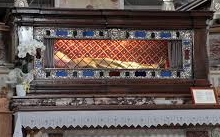
Incorrupt body of Saint Margherita of Cortona, tuscany, Italy
Final Resting Place Of Saint Margherita da Cortona

After Margherita's death, her popularity grew exponentially.  A bigger church was needed, in part to hold her relics and also to house all the pilgrims coming to Cortona.  In 1456 her body was disinterred and was discovered to be incorrupt-her body had not decomposed.  In the Catholic Church, this is considered Supernatural, a miracle and the sign of a Saint!  On May 16, 1728, Margherita da Cortona was canonized, and her body was placed inside a silver and glass casket designed by famous Baroque painter Pietro Berrettini (Pietro da Cortona).  You can view Margherita's body, which is on display behind an iron gate in the marble side-chapel of the basilica.

Painting of Santa Margherita da Cortona


Every year on February 22, the village of Cortona gathers to honour their Patron Saint, Santa Margherita.  It is a festival in front of the basilica with food trucks, candy stalls and mulled wine to keep everyone warm.  Mass is held several times a day, the iron gate is opened, and people line up to get a close look at the body of their beloved Saint.  Saint Margherita's feast day is May 16.  She remains Cortona's original SHERO, protecting all single mothers, falsely accused, homeless, midwives, mentally ill, prostitutes, orphaned, penitents, hoboes & tramps.    Margherita's life is a timeless story that reminds us all that we can be reborn and renewed at any point in our lives and that ...

It doesn't matter who you used to be; what matters is who you decide to be today.


Follow me on FACEBOOKINSTAGRAM  and  BLOGLOVIN'  for daily photos and updates! #slowtravel🐌


Sunday, April 19, 2020

Money Hacks To Save For Travel

Fill your money jar for global travel

Travel is expensive, and it takes time.  Many people say to me: "I wish we could travel, but we just don't have the money."  Or   "I wish I could travel, but I only get one week for vacation each year-it's not worth going overseas."  My answer to that is: "Then you don't really want to travel."   The conversation usually ends there.


Occasionally the conversation continues "But I really do want to travel, how do you manage it?" Here are a few of my hacks for fitting travel into your life.  This first post is about saving up money for a trip, and soon I will have a post on saving money while travelling.

Do not save what is left after spending but spend what is left after saving
Why save for a trip when you can pay by credit card and worry about it later?  Well, if you end up broke a few months after your trip you will blame the travel not yourself because that's what we do as humans.  I recommend saving up for at least your plane tickets, accommodations and some spending money before you depart.  My mother used to say: "If there is a will, then there is a way" and it's true. I was raised by German immigrants who escaped the iron curtain after WWII, so discipline is in my D.N.A, and mental discipline is what it takes to save for a trip.  So before I even start to budget for a trip I go into what my family and I call "austerity measures"  where we cut out all the things deemed unnecessary.


Child playing with a button on string
Hours Of Entertainment!

Tip #1  ENTERTAINMENT is the first item to be cut. You can wait for a few months for that new movie that just came out in theatres to appear on Netflix.  I actually haven't had cable TV for over 13 years now. Between Netflix and YouTube, there is more to watch in one lifetime than humanly possible.  I also use the public library for books (and e-books), magazines and movies.  The library also helps save money on costly guidebooks when you are doing research on your travel destinations.  Look, I'm not suggesting playing with a button on a string for entertainment, but there are so many ways we can cut back in this department.  There is always work to be done in our homes and sometimes my chores mix into my entertainment.  Like when I have a food canning session or ironing mountains of clothes; I set up the laptop and binge-watch the latest Netflix series. I can have fun while doing monotonous work.


Affordable, kid friendly pasta meal in Rome, Italy
Spaghetti Is Always Cheap & Fun!
Tip #2 FOOD.  Many people go out to eat as entertainment.  We don't go out to eat in restaurants unless it is someone's birthday.  I pack our family lunches from home (gasp!-I know, like the peasantry). I cook simple nutritious meals at home that don't involve a lot of expensive ingredients and we don't eat much meat.  If you are a gardener, grow your own veggies and preserve them by canning or freezing.  Eat with the seasons-I would roll over and die first before I buy a pint of strawberries in January for $10!  We make our own beer and wine, which saves on our entertaining.  Look, I would rather be having a meal on a piazza in Italy or a pub in Ireland than at the East Side Mario's at the strip mall-just keep reminding yourself of that.


Window shopping in Cortona, Tuscany
In France, This Is Called "Window Licking"
Tip #3  DO NOT GO TO THE MALL!  Don't do it; just don't.  The only time I go into a mall is when I have to do my Christmas shopping or when I need my shoes repaired (my cobbler is in the mall and yes, I pay to repair a pair of expensive shoes rather than toss them and buy a new pair).  Malls are designed to make you want to spend your vacation dollars by buying that latest "Made In China" gadget, or crappy "Made In Bangladesh" fast fashion item or even gulp down an overpriced coffee. If you knew the real price of some of these things you would choke on your $5 latte (that cost 75¢ to make).
OK, I know we do need clothes and some stuff like pots and pans.  I avoid department stores where you have to walk by what I call the "Glamour Gauntlet" (the cosmetic department, jewellery, fashion)  to get downstairs to the basement where the pots and pans are kept.  Seriously, it's like running the gauntlet of lux and the temptation is too strong for me!  Here's another alternative, go to Kijiji or Craigslist and I love going to the thrift store. I find designer brands that are practically brand new!  Cashmere sweaters, velvet dresses, designer jeans, leather boots, jewellery, purses-I could go on and on.  It doesn't hurt that I know how to sew to make a few repairs or alterations on the clothes, but really I don't bother buying things I need to alter anymore unless the item is really special.  For all other things like intimates, I just shop online to avoid the mall.  I have a note on my phone with all my family's measurements & shoe sizes so if there is an online sale somewhere I can pick up what we need.  It's good for the environment too; reduce, RE-USE, recycle, baby!

Earn extra money or just carry onTip #4  EARN MORE CASH!  This applies to everyone. I don't care if you have three letters behind your name; if you can't afford your travel dreams, then you need more cash in your travel fund.  Our family of three lives off of one income and my business income of sewing belly dance costuming pays for our travel.  In the past, I have also taken on part-time retail jobs, babysitting jobs, custodial jobs, cleaning jobs and now our farm income trickles into our travel fund as well.   I am not above hard work of any kind to get me out travelling in this world.  This quote by Jerry Rice sums it up so well for me: "Today I will do what others won't, so tomorrow I can do what others can't".   On a trip abroad I have often thought, WOW I am sitting on this lovely square having a glass of wine all because someone else was too lazy to scrub their toilet or wash their windows.  CHEERS!


Flow chart of where to put your money you earnedTip #5 EMERGENCIES! It happens once in a while, that we need to dump a bunch of cash down on not so fun stuff.  Car repairs, hot water tank, etc.  Well, I have several bank accounts with purposes for each.  One is called:  "Travel Fund", the other is "Working Account" and one is called "Boring S**t".  Boring S**t is the emergency fund where I would use the money to buy a sump pump because the basement flooded (true story).  I keep a set amount of money in there that makes me feel secure in case of a household emergency.  This is a different fund than say if one gets sick or injured and we have no income for 6 months, then that would be the "Holy F**k!" account.  Toronto Dominion Bank I apologize for my profane account names, but I'm sure you're ok with it, knowing how much money in service fees you make off me.

Now here's one thing that was life-altering for me: DYI  YouTube videos.  Washing machine repairs, sump pump instalments, how to build a chicken run-whatever.  You can save hundreds of dollars a year from going into the "Boring S**t" account and instead, put the money into your "Travel Fund" account.  I try to do things myself rather than hire someone to do the work for me.  I also don't own fancy things.  For example, our furniture is mostly Ikea, or used, or even used Ikea.  Until 18 months ago I drove a 20-year-old Volvo station wagon.  Yes, I put repairs into her, but we do not spend 30+ thousand every few years to get a new car.  Do you know how many trips you could go on for that kind of cash!?!  If you live in a city, take public transit, ride a bike or walk; you will save hundreds of dollars!

Beach scene in Cayo Santa Maria, Cuba
I Would Rather Be

I almost make a sport of saving:  I just saved $50 by colouring my own hair!    I just saved $40 by doing my own oil change on the car!  As long as that cash you save ends up in the Travel Fund; you're golden!
This last tip sums it up.  Ask yourself this: do you know how many ______ you can get for ______?  For example: Do you know how many espressos you can get in Florence for your Grande Chai Tea Latte at the mall?  Do you know many pints of Guinness you could buy in an Irish Pub for your two-four of Bud Light at the Liquor BarnEVERY DOLLAR COUNTS.  This thinking process is what helps to motivate me to stick with my goals.


See you on the piazza! 


Follow me on FACEBOOKINSTAGRAM  and  BLOGLOVIN'  for daily photos and updates! #slowtravel🐌

This post first appeared in 2017 as: How do we afford to travel? Part 1: Saving