Translate

Showing posts with label Beach. Show all posts

Friday, May 1, 2026

Spring Road Trip Through Portugal

 red tiled roof tops of Lisbon, Portugal with the castle of st. George in background


Lisbon has captivated me since the 2020 pandemic, when my world of travel was confined to books, Instagram posts and my laptop. The more I uncovered about Portugal's abundance of history, vibrant culture and breathtaking natural beauty beyond Lisbon, the stronger the call to explore this wonderful country became.  2026 was the time to finally answer that call.

Since this was my first visit to Portugal, I wanted to experience as many regions of this beautiful country as possible. I aimed to strike a balance between the excitement of big cities, inspiring historical sites, quaint country villages, and seaside relaxation, all of which would give me a taste of authentic Portugal. However, my dilemma was that I wanted to see it all!

I invested a lot of time into planning my itinerary, leaving little room for flexibility or spontaneous adventures, which is not typical of my "Slow Travel" style. I wanted to explore more of Portugal beyond the popular destinations of Lisbon, Porto, and the Algarve. As I researched my options, I felt overwhelmed by the choices between historical sites like castles, monasteries, and palaces.  Not to mention so many charming villages and natural parks. Ultimately, I decided to create one large circular route that would start and end in Lisbon, heading northward to explore the diverse regions.

Lisboa landmark sign in Praca do Comercio

The adventure begins in Lisbon, where I spend four days exploring the city and take a side day-trip to romantic Sintra.  Then I pick up a car at the airport and head to the Central Coast surf mecca of Nazaré for some chill time, stopping in the medieval village of Óbidos.  From Nazaré, there are some awe-inspiring historical sights to visit all within a thirty-minute drive: Tomar, Batalha and Alcobaca.

A train going across Dom Luis I bridge over the Duro RIVER

Heading North again, I made a stop in the historic University town of Coimbra for one night before arriving in Portugal's second largest city, Porto.


After spending two nights in the vibrant city of Porto, I headed inland along the Douro River to explore Portugal's most famous wine region.  Pinhão was my base for exploring the Douro River region by boat and a nearby village, Vila Nova de Foz Côa, for an archeological safari.


This is where I started to head south from the Duoro valley, to the Beira Baixa district, into the Serra da Estrella mountain range.  Perched on top of a granite mountain, my next stop is the magical village of Monsanto.


Columns of the Roman Temple of Evora Portugal

Continuing my journey South into the Alentejo region, I spend a night wandering the whitewashed streets of Évora, taking in the magnificent Roman sights. Nearby, an ancient stone circle on the outskirts of the city begs to be explored.


For the last portion of my trip to Portugal, I head to the country's southern coast, spending four days in the Algarve region. Based out of the charming small town of Carvoeiro, I explore the Seven Valley Hiking Trail and the famous Benagil sea caves.  

A trip to the Algarve's South Coast wouldn't be complete without a visit to what was once considered the "End of the World" of Cape Sagres, now a modern surfer haven.  


The journey concludes with returning the rental car to the Lisbon airport and spending my last night in the Olivais district of Lisbon.

Have you experienced the wonders of Portugal? I’d love to hear all about your adventures! Share in the comments what captivated you the most during your trip and your top “must-see” spots for our epic Portuguese road trip! Let's uncover the gems of this beautiful country together!

Follow me on FACEBOOKINSTAGRAM  and  BLOGLOVIN'  for daily photos and updates! #slowtravel🐌

Saturday, February 13, 2021

Castiglione Del Lago~Perfect Family Destination In Umbria

Lake Trasimeno from the ramparts of the castle in Castiglione Del Lago, Umbria, Italy

Looking for a hidden family-friendly gem in Tuscany?  This peaceful lakeside town on the Tuscan border with Umbria has all the charms of a big resort, without any tourist crowds.


As a lover of "Slow Travel," I like to stay in one location for at least 3 days and explore the surrounding area.  On my visit to Tuscany, my small family rented part of a farmhouse in Cortona and made day trips to many destinations in Tuscany.  For great tips and Italy road-trip planning advice, read my blog post on: Tuscany Road Trip

View of Lake Trasimeno and farmlands from Cortona, Tuscany, Italy
Castiglione Del Lago Viewed From Cortona

It was a sweltry mid-September day in Tuscany, and it also happened to be my birthday, so nothing was planned on my travel itinerary.  I decided to be spontaneous, go on an adventure and find somewhere not listed in the guidebooks.  Looking at the map book, I decided to head for Lago Trasimeno to beat the heat.  
Castiglione del Lago looked interesting and only 20 km from Cortona, featuring an ancient castle jutting out into a lake.  So I set our rental car's GPS, pressed go, and we were there less than half an hour later.


Medieval city gate in Castiglione Del Lago, Umbria, Italy
Gate in Medieval Wall


Castiglione del Lago is on the West side of Lago Trasimeno just across the Tuscan border in Umbria; Lake Trasimeno being the dividing line between Tuscany and Umbria.  The village of about 15,000 people today started as a castle on an island.  Over time as the city grew, the flat area between the castle and the shore was reclaimed and filled in with buildings and piazzas.  The town's well-preserved historical centre or centro storico is surrounded by a Medieval wall.  Castiglione del Lago's old town centre is known for its threes, meaning there are three city gates, three parallel streets (which is a Roman-era city layout), three piazzas and three churches.  The main sights in this charming town are the castle and the palace, but there is also a public park with a beach and free parking just to the north of the castle on Via Lungolago.  


Map of the historical center of Castiglione Del Lago, Umbria, Italy


Baskets of bulk food shopping for local products in Castiglione Del Lago, Umbria, Italy
The Centro Storico of Castiglione del Lago is within the Medieval walls and completely car-free, making it a delight to stroll.  
There are several free and paid parking lots along Via Belvedere, the road that circles the Old Town.  I also found much free street parking just outside the walled city centre.  Most visitors enter Castiglione del Lago through the West Gate, the Porta Senese and wander along the main street, Via Vittorio Emanuele.  Here you will find a gauntlet of stores selling Prodotti Tipici or regional products like local cheeses, kinds of dried pasta, beans, spices, sweets, and olive oil.  
I loaded up on dried pici, a local thick hand-rolled pasta.  For more on local Tuscan products, read my blog post on: 10 Things You Must Eat In Tuscany


Alter inside church of Santa Maria Maddelena in Castiglione Del Lago, Umbria, Italy
photo: Wolfgang Sauber
The main drag heads East towards the Lake, passing by the beautiful Church of Santa Maria Maddelena, with its neo-classic columns out front and Greek cross plan.  It's worth the peek inside to see the painted panels from 1580 and the lofty dome.  This church was once a Roman Temple when the Romans founded the city and was given the name Clusium 
Novum or New Chiusi.  Chiusi is a lovely Tuscan village and was an important Etruscan city located nearby.  To read about Chiusi, see my blog post: Chiusi Tuscany~Under The Etruscan Sun
Corridor connecting the Palace and the Fortress of Castiglione Del Lago, Umbria, Italy
Corridor to the castle
Following Via Vittorio Emanuele, you come to a grand Renaissance palace, the Palazzo della Corgna. This palace was built for the Duke della Corgna and serves as the city hall, civic museum and art gallery.  There are some beautiful frescoes in the palace, but the real fun is taking the long covered corridor to the Medieval star-shaped castle called the Rocca de Leone.  The castle was completed for Frederick II of Swabia in 1247 by the monk/architect Brother Elia.  Elia was a Franciscan monk from Cortona, who happened to be Saint Francis of Assisi's best friend and right-hand man.  For more information on Saint Francis and the shaping of Umbria, check out my blog post: St. Francis the Umbrian Rock Star!   

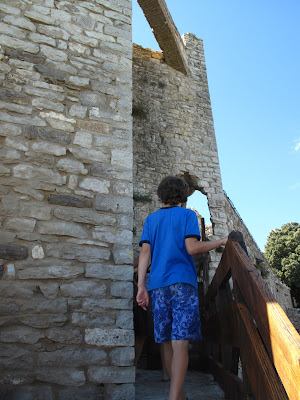
This long walkway leads you to a wonderfully restored stone fortress with sweeping views of Lake Trasimeno, the lake's islands, and Cortona climbing the distant mountainside.  Kids can have fun exploring the ramparts, climbing the tall three-sided bastion tower called "the masio," or take in the shade of the olive trees in the castle's bailey.

View of lake Trasimeno and Rocca de Leone from the "Masio" tower, Castiglione Del Lago, Umbria, Italy
View From The Masio
Climbing the towers and ramparts of Rocca de Leone in Casliglione Del Lago, Umbria,  Italy
Exploring the ramparts of Rocca de Leone castle in Castiglione Del Lago, Umbria, Italy
Strolling under the shade of the ancient olive trees along the ramparts of Rocca de Leone castle of Castiglione Del Lago, Umbria, Italy
If you have worked up an appetite from exploring the fortress, many excellent local Osterias serve local specialties from Lake Trasimeno.  Look for a dish called Brastico, which is fish fire-roasted over reeds from the shore of Lake Trasimeno.  Or perhaps try Tegamaccio, a soup made with several different types of lake fish, baked in terracotta pots for five hours.  Alternately you can grab some take-out food such as panini (sandwiches), arancini (deep-fried rice balls stuffed with meat and or cheese) or pizza sold by the gram and head to the public beach for a picnic.  The beach at Castiglione Del Lago is sandy; the water is warm, clear and shallow, perfect for kids to cool off on a hot day.  The lake water is tested daily from April through September to make sure it is safe for swimmers.

Sandy public beach park of Lake Trasimeno at Castiglione Del Lago,  Umbria, Italy

Family time in Tuscany has never been so much fun!  What is your favourite family activity when visiting Tuscany?  Let me know in the comments below...


Follow me on FACEBOOKINSTAGRAM  and  BLOGLOVIN'  for daily photos and updates! #slowtravel🐌



Sunday, August 23, 2020

Saturnia Hot Springs, Tuscany

Old mill at Gorello Fall, Saturnia, Southern Tuscany, Italy


Tuscany is blessed with numerous thermal baths, known as "terme" in Italian.  Hot water springs from deep within the Earth, holding healing properties that make this area of Italy a paradise for spa lovers.

Warm water cascade of Gorello Falls, Saturnia, Grosetto Province, Tuscany
The Maremma region in Southern Tuscany is dotted with delightful thermal waters, resulting in both natural outdoor pools and spa resorts.  Southern Tuscany's sulfuric Terme waters also boast some of the most healing properties in all of Italy.  One of the best places to experience Terme in Tuscany is the quiet village of Saturnia, located in the deep south of Grosseto Province, near the border with Lazio.  

The settlement at Saturnia was called Aurinia by the Etruscans. A settlement has existed here since pre-Etruscan times and is thought to be one of the oldest cities in Italy, most likely due to the abundance of thermal springs.  There are Pre-Etruscan tombs in the area, like the Necropoli del Puntone (1 KM North of Saturnia on the road to Poggio Murello) that establish Saturnia as a Pelasgi settlement which was the region's indigenous people.


Roman gate on the Via Clodia, Saturnia, Grosetto Province, Tuscany

Etruscan and Roman structures around the village of Saturnia include the Etruscan walls, dating back to the 3rd and 4th centuries BCE, which incorporate the "Porta Romana," a Roman-era city gate.  The Via Clodia, a Roman road that leads to the Porta Romana, was built on an existing Etruscan Route linking Pitigliano, Sovana and Sorano, incorporating some of the mysterious Via Cave.  Check out my blog posts on these nearby attractions.  There are also remains of the ancient Roman baths at the far end of town on Via Italia.  There is also a picturesque castle in Saturnia called the Rocca di Saturna or Castello Ciacci by locals.  This was an Aldobrandesca Fortress built in the 1100s along the fortifying city walls by the original rulers, the famous Aldobrandeschi family of Sovana.  While in Saturnia, be sure to visit the small but interesting archaeological museum. 

The name Saturnia came from the Romans, who settled this area in 183 BCE.  Legend has it that the Roman God Saturnus (Saturn) was tired of the constant warring among humans in the area.  In a rage, Saturnus threw a thunderbolt from the heavens down to Earth, and where the thunderbolt stuck, a magical spring of warm water was created to pacify humankind.  This is the main attraction of Saturnia today.


Cascade of thermal waters at Cascatelle del Mulino, Saturnia, Grosetto Province, Tuscany, ItalyThere are two terme areas in Saturnia, a posh hotel spa and a natural thermal waterfall;  both of these originate from the same source.  The Terme di Saturnia Natural Spa and Golf Resort is a 124-room Five-Star hotel resort for those who want to pamper themselves.  You can book a full-day (€29) or half-day package (€25) at the resort without having to stay overnight in the hotel, which is an excellent alternative to the busy free hot springs.  Check out the resort website at termedisaturnia.it and navigate to the "Reservations & Gift Vouchers" section at the top right of the homepage to book a day package.

The more popular destination attracting locals and tourists alike is Gorello Falls.  An ancient stone mill sits atop Gorello Falls, also known as "Cascatelle del Mulino," or Miller's Falls, to the locals.  This is where one can sit outside in a cascade of warm water...  FOR FREE!!! 

Crowded Sunday afternoon at Gorello Falls, Saturnia, Grosetto Province,Tuscany, Italy
Gorello Falls can be a hectic place, even in the offseason.  Follow the Strada Provinciale SP10 south from Saturnia towards Montemerano for about 2km, and you will see signs for the falls.  There are two parking lots for the springs, both are free.  The first and closest option is a large dirt parking lot at the end of Via della Follonata, which can be quite rough in spots where there have been seasonal washouts.  The overflow parking lot is also located on the SP10, just past the falls, and is a slightly farther walk to the springs. 

I visited Gorello Falls on a Sunday afternoon in late September, and the place was absolutely packed! Robust Russians were padding around in bathrobes, sexy Italian couples on their Vespas, German families camping out in Westfalias, and even locals with horses tied up in the shade of the treed parking lots!  It was a smorgasbord of people watching, and everyone was having a wonderful time.


Saturnia natural hot springs, Grosetto Province, Tuscany, Italy

You can smell the water before you see it; the slightly sulfuric scent emanates from the healing waters, which are at a perfect temperature of between 37 °C and 38 °C.  Cobalt blue calcium-rich water cascades down layered basins of smooth, white limestone at a rate of 800 litres per second.  Each of the little pools can hold about 3-5 adults quite comfortably.  Sitting in one of these stacked pools gives you the feeling that you are a giant pigeon in a warm Italian fountain!  The healing properties of the water are said to help cure vascular diseases and ease muscle tension and pain.  The mineral-rich black mud found at the bottom of the falls is known to alleviate skin disorders such as eczema and psoriasis, so it's common to see people smearing the dark clay all over their faces and bodies.  Remember, there are no storage facilities available at Gorello Falls, so please lock all your valuables in the trunk of your car and bring only your towel to the falls.


Cascate del Mulino, Saturnia, Grosetto Province, Tuscany, Italy
Gorello Falls In The Evening
Further upstream behind the old mill, the hot water runs in a swift-moving channel.  Older kids can ride the stream like a waterslide, but keep your eye on smaller children who can easily be swept up in the swift-moving current.  Even further upstream, there are spots where ropes are tied across the narrow river channel just below the water surface, which are not visible to the eye; be cautious not to get hung up on them!  

The best times to visit Cascate del Mulino during the busy tourist season, from April to October, are early in the morning, before 10:00 a.m., or in the evening, after 5:00 p.m.   There is a cafe/bar located near the falls that serves hot and cold snacks, sandwiches, gelato, and desserts, as well as beer and cold beverages. The cafe also provides shower and washroom facilities.  The Bar Cascate di Saturnia opens daily at 8 am and closes late. 

UPDATE: MARCH 2025- The restaurant Bar Cascate di Saturnia was closed for renovations, but the toilets/changerooms attached to the bar remained open.  You can access these from outside the bar.


Saturnia's hot springs have something for everyone, from elegant spas to free family fun, to romantic midnight dips under the moon and a blanket of stars❣

Have you visited Saturnia, Tuscany?  Which Terme did you prefer: the Spa or the free natural springs?  Let me know in the comments below.


Follow me on FACEBOOKINSTAGRAM  and  BLOGLOVIN'  for daily photos and updates! #slowtravel🐌


This post first appeared in September 2013 as Saturnia Tuscany; Saturn's Bathtub 

Thursday, March 23, 2017

Marina Grande-Sorrento's Best Kept Secret


Sorrento's Marina Grande is a special place, just off the tourists' radar.  Yet this charming community peeks through the curtains of mass tourism every Spring,  puts on a sweet smile, and then goes back to its regular business once the late Autumn cold sets in again.  We were fortunate enough to stay in Marina Grande for 8 days in March, make some friends and start to feel like locals.


The locals call Marina Grande an "Antico Borgo Marinaro" or Ancient Maritime Village.  It has been said by a travel guru that I admire; a Mr. Rick Steves (yup, I AM a total Rick-nic) that "even the cats look different in Marina Grande."  I don't know about that, but there sure are a lot of cute cats in Marina Grande, and unless you have a fish in your hand you are dead to them.  We did have one friendly black cat that walked into the house a few times, but he quickly discovered the cooking at the restaurant next door was MUCH better food than what I had to offer.  But this post is not about the cats.


The reason people think the cats, and the people of Marina Grande look different is that Marina Grande is technically a separate village from Sorrento.  As you can see from this old painting pictured above of Sorrento; Marina Grande is on the beach to the right of the city. Sorrento sits high above Marina Grande on a cliff and is surrounded by medieval city walls.  This left poor Marina Grande residents outside the walls of protection from an attack of invading armies or Turkish pirates called Saracens that used to rape, pillage and plunder along this coast.  Only small sections of Sorrento's original wall remains to be seen today, but this ancient greek gate that marks the entry into Marina Grande has been here since the third century BCE.  This gate is HUGE and serves as a reminder that it was a matter of life and death depending on what side of the gate you were on.  TIP #1:  IF YOU WALK DOWN TO MARINA GRANDE FROM SORRENTO YOU CAN CATCH THE BUS BACK UP.  Busses to Piazza Tasso leave every hour from the little bus shelter by the beach.  The last bus up to Sorrento is about 8:00 pm.


The people of Marina Grande seem very traditional.  Not only in the type of work they do; like all the fishermen that unload their nets here every morning, but also the cultural traditions that have endured for centuries.  Such as every afternoon in the little square in front of the church of Sant'Anna, the older folk would gather on the benches.  Men sit on one side of the Piazzetta and women on the other; watching the village kids playing a game of football in between them.  Many of the older women dress in black as a show of mourning for the loss of a loved one.  There are many "madonelle"  or street side alters of the Virgin Mary that you pass by or are visible on buildings here in Marina Grande.

Madonelle of Marina Grande


Of course, other strong traditions in Marina Grande involve the sea.  This is still an active dock where fishing boats come to unload their catch.  Each morning the boats pull up, and the freshly caught fish are unloaded for the local restaurants to pick up.  One morning we saw some sardines being unloaded and carried into the local restaurant that our friend Simone recommended to us.  We were eating those sardines at Taverna Azzurra that very night; prepared in the local Sorrentine method.  Of course, the meal was completed with the traditional complimentary glass of homemade limoncello (my favourite tradition of all).


Another local tradition related to fisherman and the sea is, of course, the boat.  In Sorrento, there is a type of traditional boat called the "gozzi Sorrentini."  These are handmade light-weight wooden boats with triangular sails that were specially made for fishing.  The gozzo is a generic term for a wooden ship found all over southern Italy, but here in Sorrento, they are still crafted by hand.  This shop was in our small piazzelle, and the owner was in his shop day and night working hard on his beautiful boats.


Fresh Bread Delivery


This next place is the heart of modern Marina Grande.  This unassuming little shop on Via Mariana Grande is the Deco Market, where locals go shopping for their groceries.  We discovered 'The Deco' on our first night in Marina Grande when we were hunting for dinner supplies.  This place has everything you need; a small selection of local produce, dried goods, local wine and beer selection. In the back of the store, here is a meat and cheese counter that has a great local selection.  Twice a  day freshly baked bread is delivered to the store for their customers, and it was delicious!  The store is run by the Russo family and keeping with the family traditions; their son and daughter help out in the evenings.  Simone, their son, was a real joy to get to know; he is so helpful, kind and his English was excellent!  Simone recommended great local beers and wines to us, as well as giving us some sightseeing and restaurant tips.  During tourist season Simone's mother makes up fresh sandwiches every morning, they are called "panini" in Italian.  You can take them away with you for lunch during a sightseeing trip or sit on the beach and have a lovely picnic.


Of course, the real magic of Marina Grande happens in the evening.  Our evening ritual was to grab a glass of wine or limoncello from our cottage and wander across the street, sit on a bench or on the beach itself and watch the lights come on in the Bay of Naples as the sun sinks into the waves. With making Sorrento our home base for exploring Naples and the Amalfi Coast, our days were jam-packed with busses, ferries, and long days walking for hours.  We could have stayed up in busy Sorrento with the bustle of life, but it was SO lovely to return to our Marinara Sea Cottage on Via Marina Grande and just relax and listen to the waves.
  
This is "la dolce far niente" or the "sweetness of doing nothing," and it is an acquired skill. In Marina Grande, you can hone this skill to your heart's content! 

Wednesday, January 20, 2016

Delray Beach, Florida & The Blue Bottle of DOOM!!!

The Blue Bottle also known as the Portugese Man Of War Jellyfish washed up on the shore in Delray Beach Florida


Delray Beach on Florida's West Coast is a mix of fun shops and fabulous restaurants and bars that line the main street.  The beach itself is a paradise of soft white sand that stretches on for miles or as far as the eye can see.  But there is danger lurking at the high tide mark; danger in a squishy blue bottle...  


Sand sculpture of a shark on Delray Beach, Florida, USA

On the way back to our home base in Jupiter, Florida from our alligator safari in the Sawgrass Recreation Area, we decided to stop somewhere and grab dinner.  Some relaxing beach time and perhaps catching a sunset would be a nice way to end our day of gator watching.  Delray Beach looked like a nice place to explore so I entered it into GPSangeeta and we were there in a flash.  Situated between Boca Raton and Boynton Beach and a bit off-the-beaten-path, Delray Beach has a young and artsy vibe to it. There are many art shops and galleries to explore in the Pineapple Grove district of Delray Beach as well as funky murals to check out. 

Dipping your feet in the ocean in Delray Beach, Florida, USA

The main street of Delray Beach is called Atlantic Avenue and leads from Interstate 95 all the way down to the shoreline.  Atlantic Ave is very vibrant; filled with upscale restaurants and Caribbean themed bars.  I thought we would hit up a nice Italian pizzeria for some wood-fired oven pizza Margherita after we play on the beach.  

We found a parking lot that wasn't an outrageous amount to park in near Atlantic Dunes Park, right behind the lifeguard station.  Parking near the beach is very pricey and can be hard to find during peak season.


Beautiful soft brown sand of Delray Beach, Florida

The beach was gorgeous and deliciously empty in January!  Miles of soft light brown sand and gentle surf.  It wasn't long before my son's shoes were off and he was dipping his feet in the water.  Then his pants were rolled up, and he was wading into the water up to his knees.  Of course, soon his pants ended up being rolled up so high, they looked like short-shorts and he was frolicking in the surf, getting soaking wet.
I took it all in;  the sea air whipping my hair around, the smell of the saltwater all the little shorebirds running around where the eatin' is good along the tide line.  In an instant, I was homesick for Vancouver where I grew up.

Beautiful and uncrowded Delray Beach, Florida, USA
The Beach to Ourselves!


We decided to walk north along the beach for a while and do some beachcombing for treasures like beach glass and shells.  I still could not believe there was absolutely no one on this beach except the odd dog walking its human.  It was not that cold out-at least by Canadian standards; maybe the Floridians were still donning their snowsuits!  


Portugese Man Of War jellyfish washed up on Delray Beach, Florida, USA
NOT a Florida Sea Cucumber!


Wandering down the beach, we found some interesting shells at the high tide line. But then we found something strange, and beautiful...and ultimately horrible.  A strange bright blue creature that had helplessly washed up on the sand.  My son thought this must be some kind of sea cucumber because of its shape, and I didn't think anything much of it either.  My poor child went to "rescue" the defenseless sea cucumber (because that's the kind of gentle soul he is) and took it back to the Ocean and put it in.  "Mr. Sea Cucumber" immediately washed back up on the beach, so my son repeated the rescue attempt.😱


Welts on the hand caused by a Portugese Man Of War jellyfish in Delray Beach, Florida, USAThat's when my poor son started to feel the stings.  His hand went red and swollen, and it burned like crazy. Oh, NO-that was a jellyfish!  Well, that is no fun.  But being raised as a West Coast boy, he had been stung in Vancouver by jellyfish loads of times, no big deal.  Then the pain started to worsen; my son went pale and started to complain that his armpits hurt.  I figured this meant lymph nodes and perhaps an allergic reaction of some sort.  MOM panic ensued, and I stayed outwardly calm, but inside I was freaking the F**K out!  We walked briskly back towards the car, and my son was nauseous at this point.  I cheerfully suggested we stop in at the lifeguard station to see if they could help.


Sting Zapper relief gel for Portugese Man Of War jellyfish

The station looked closed, but I knocked on the door anyway and a staff member came to open the door.  We recounted our tale to him and the lifeguard explained that the "sea cucumber" was a Portuguese Man O War jellyfish and is very dangerous-especially if you were swimming and a group of them sting you!  The lifeguard gave us a few packages of this green goo called "sting zapper" and I put it all over my son's hands.  It smelled nice, like tea tree oil and perhaps peppermint.  The lifeguard told us he gets stung almost daily when he is at work and it hurts A LOT.  He also told us that some folks can have an allergic reaction to the venom; so just as a precaution we should be on the watch for signs of difficulty breathing in the next hour or so.


Playing in the surf or Delray Beach Florida, USA

It took a long while before the jellyfish venom to stop stinging, and we decided to head back to our home base near Jupiter for dinner in.  My son slept the whole way back in the car and immediately crawled into bed exhausted.  
We must go back someday to explore Delray Beach and all that Atlantic Avenue has to offer.

The next day the welts on my son's hands were mostly gone, and he felt good as new. Of course, now we ALL know not to touch the blue bottles on the beach.  So this was our tale of harrowing deeds of peril with wild alligators and deadly jellyfish! 
Gotta keep your wits about you in the exotic wilds of Florida!

Follow me on FACEBOOKINSTAGRAM  and  BLOGLOVIN'  for daily photos and updates! #slowtravel🐌


And Now To Lighten The Mood; A Cute Beach Bird Video: