Translate

Showing posts with label Amalfi Coast. Show all posts

Thursday, March 23, 2017

Marina Grande-Sorrento's Best Kept Secret


Sorrento's Marina Grande is a special place, just off the tourists' radar.  Yet this charming community peeks through the curtains of mass tourism every Spring,  puts on a sweet smile, and then goes back to its regular business once the late Autumn cold sets in again.  We were fortunate enough to stay in Marina Grande for 8 days in March, make some friends and start to feel like locals.


The locals call Marina Grande an "Antico Borgo Marinaro" or Ancient Maritime Village.  It has been said by a travel guru that I admire; a Mr. Rick Steves (yup, I AM a total Rick-nic) that "even the cats look different in Marina Grande."  I don't know about that, but there sure are a lot of cute cats in Marina Grande, and unless you have a fish in your hand you are dead to them.  We did have one friendly black cat that walked into the house a few times, but he quickly discovered the cooking at the restaurant next door was MUCH better food than what I had to offer.  But this post is not about the cats.


The reason people think the cats, and the people of Marina Grande look different is that Marina Grande is technically a separate village from Sorrento.  As you can see from this old painting pictured above of Sorrento; Marina Grande is on the beach to the right of the city. Sorrento sits high above Marina Grande on a cliff and is surrounded by medieval city walls.  This left poor Marina Grande residents outside the walls of protection from an attack of invading armies or Turkish pirates called Saracens that used to rape, pillage and plunder along this coast.  Only small sections of Sorrento's original wall remains to be seen today, but this ancient greek gate that marks the entry into Marina Grande has been here since the third century BCE.  This gate is HUGE and serves as a reminder that it was a matter of life and death depending on what side of the gate you were on.  TIP #1:  IF YOU WALK DOWN TO MARINA GRANDE FROM SORRENTO YOU CAN CATCH THE BUS BACK UP.  Busses to Piazza Tasso leave every hour from the little bus shelter by the beach.  The last bus up to Sorrento is about 8:00 pm.


The people of Marina Grande seem very traditional.  Not only in the type of work they do; like all the fishermen that unload their nets here every morning, but also the cultural traditions that have endured for centuries.  Such as every afternoon in the little square in front of the church of Sant'Anna, the older folk would gather on the benches.  Men sit on one side of the Piazzetta and women on the other; watching the village kids playing a game of football in between them.  Many of the older women dress in black as a show of mourning for the loss of a loved one.  There are many "madonelle"  or street side alters of the Virgin Mary that you pass by or are visible on buildings here in Marina Grande.

Madonelle of Marina Grande


Of course, other strong traditions in Marina Grande involve the sea.  This is still an active dock where fishing boats come to unload their catch.  Each morning the boats pull up, and the freshly caught fish are unloaded for the local restaurants to pick up.  One morning we saw some sardines being unloaded and carried into the local restaurant that our friend Simone recommended to us.  We were eating those sardines at Taverna Azzurra that very night; prepared in the local Sorrentine method.  Of course, the meal was completed with the traditional complimentary glass of homemade limoncello (my favourite tradition of all).


Another local tradition related to fisherman and the sea is, of course, the boat.  In Sorrento, there is a type of traditional boat called the "gozzi Sorrentini."  These are handmade light-weight wooden boats with triangular sails that were specially made for fishing.  The gozzo is a generic term for a wooden ship found all over southern Italy, but here in Sorrento, they are still crafted by hand.  This shop was in our small piazzelle, and the owner was in his shop day and night working hard on his beautiful boats.


Fresh Bread Delivery


This next place is the heart of modern Marina Grande.  This unassuming little shop on Via Mariana Grande is the Deco Market, where locals go shopping for their groceries.  We discovered 'The Deco' on our first night in Marina Grande when we were hunting for dinner supplies.  This place has everything you need; a small selection of local produce, dried goods, local wine and beer selection. In the back of the store, here is a meat and cheese counter that has a great local selection.  Twice a  day freshly baked bread is delivered to the store for their customers, and it was delicious!  The store is run by the Russo family and keeping with the family traditions; their son and daughter help out in the evenings.  Simone, their son, was a real joy to get to know; he is so helpful, kind and his English was excellent!  Simone recommended great local beers and wines to us, as well as giving us some sightseeing and restaurant tips.  During tourist season Simone's mother makes up fresh sandwiches every morning, they are called "panini" in Italian.  You can take them away with you for lunch during a sightseeing trip or sit on the beach and have a lovely picnic.


Of course, the real magic of Marina Grande happens in the evening.  Our evening ritual was to grab a glass of wine or limoncello from our cottage and wander across the street, sit on a bench or on the beach itself and watch the lights come on in the Bay of Naples as the sun sinks into the waves. With making Sorrento our home base for exploring Naples and the Amalfi Coast, our days were jam-packed with busses, ferries, and long days walking for hours.  We could have stayed up in busy Sorrento with the bustle of life, but it was SO lovely to return to our Marinara Sea Cottage on Via Marina Grande and just relax and listen to the waves.
  
This is "la dolce far niente" or the "sweetness of doing nothing," and it is an acquired skill. In Marina Grande, you can hone this skill to your heart's content! 

Tuesday, March 21, 2017

Ravello; Amalfi's Floating Garden Above The Sea

Statues on the Terrace of Infinity, Ravello; Amalfi Coast

Dreamy Ravello.  Perching precariously to the mountainside high above the Mediterranean.  Ravello seems a world away from the hustle and bustle of the seaside Amalfi coast towns.  There is an elegance and old-world charm to this distinguished Italian Hamlet, as it's decadent villas can attest to. It was the ideal place to celebrate the first day of Spring; for "beatitudine da favola" or "fairy tale bliss" is made in Ravello.


View of the church in Ravellos main piazza, Amalfi CoastGetting to Ravello is a bit tricky and is part of the adventure.  It sits 1,000 feet above the sea and the 30 minutes drive up from Amalfi made me bite off every last fingernail (and possibly a few of my toenails as well)!  We had rented a little convertible Fiat in Sorrento and zoomed our way South past the towns of Positano and Amalfi with the soft top-down, not a care in the world.  Now, this is where it gets real, my friends.  I actually closed my eyes while Luke drove up the narrow (and I'm talking down to almost one lane) road that had the most amount of switchbacks I have ever experienced.  Although coming back down was worse; it was kind of like riding a tricycle down a spiral staircase.

Arched gate in ancient city walls of Ravello, Amalfi Coast


Finding parking was easy at this time of year.  We just followed the main road into town and there were signs for a public parking lot.  This lot was the only flat place in town to park, and it was quite reasonable.
Ravello has no huge tourist attractions, yet the whole of the town is a tourist attraction.  Ravello is known for its great summer classical music festivals called The Ravello Festival. TIP #1: THE WEBSITE Ravello.com HAS ALL THE INFORMATION YOU NEED  TO PLAN YOUR TRIP.  The website above has information on concert events in Ravello, accommodation, food and wine.


Arches in the city walls of Ravello,Amalfi Coast, Italy

There are many ruins in Ravello, old city walls and aqueducts but they are not Roman.  In fact, because of Ravellos location on such a steep slope high above the sea, life was very hard for the early inhabitants.  The town was built in the 5th century by people hiding out from pirate attacks and barbarian invasions.  The walls around the city date from around 1000 when Ravello broke off from its powerful neighbour Amalfi.  Ravello got its own bishop and gained wealth and power through its wool industry and became a thriving town of 25,000 people; ten times more inhabitants than today.  Unfortunately, becoming powerful means that you are subject to attack and Ravello was sacked in 1137 by Pisa and never fully recovered.  Many of the rich inhabitants ended up moving to nearby Amalfi and Naples, and Ravello slipped into the mists of time until it was rediscovered in the Romantic age by nobles, artists and musicians.

Cafe in Piazza del Duomo, Ravello, Amalfi Coast Italy


Ravello's main square is Piazza del Duomo surrounded by cypress trees and huge umbrella pines.  Like the Amalfi Cathedral, Ravello's Duomo has a great Arabic influence in its architecture.  To the right of the Duomo is an old stone watchtower that is the entrance to the Villa Rufolo.  This is a 13th-century palace built by the noble Rufolo family, later restored in the 1850s by a British noble who purchased the villa.
Ancient arched underpass leading to the upper town in Ravello, Amalfi Coast, Italy


We decided to go on a bit of a treasure hunt to see a different villa; Villa Cimbrone.  It's a bit of a trek through Ravello to get to Villa Cimbrone, which is on the opposite end of Ravello but you get to see the less touristic part of the town and enjoy the quiet beauty here.  To get to the villa you must exit the Piazza Del Duomo, walk through a huge stone tunnel and follow signs (that keep pointing up) luring you through tiny lanes and up staircases where you catch glimpses of the terraced lemon groves and vineyards far below.


Entrance gate of Villa Cimbrone in Ravello;Amalfi Coast Italy


Finally, we meet the magnificent fairy tale gates of Villa Cimbrone.  The villa was built in the 11th century on the ruins of a convent of Santa Chiarra.  The villa was passed around to many noble Italian families through the centuries, unfortunately leaving it in a ruined state.  In 1904 an English Lord fell in love with the property and decided to purchase it and re-build the villa and gardens into a romantic English castle high above the Mediterranean.  It costs €7 to enter the villa to tour the gardens.   Villa Cimbrone is now a 5-star hotel so you can not tour the villa buildings unless you are a guest.  For hotel prices and information got to www.hotelvillacimbrone.com


When you purchase your tickets you get a very good map of the gardens with great information on all of the sights.  Keep in mind that all you see here in the villa is only about 100 years old!


A well in the centre of Villa Cimbrone's cloister Ravello; Amalfi's Coast
The Cloister Of Villa Cimbrone
Beautiful vaulted ceilings of Villa Cimbrone
Crypt Of Villa Cimbrone

Window details of Villa Cimbrone, Ravello; Amalfi's Coast
"Ancient" look alike


Ravello; Amalfi's Floating Garden Above The Sea
Avenue of Immensity


To the right of the ticket booth are the cloister and the crypt.  These were built in 1911 by Lord Grimthorpe's design.  The crypt is very popular as a wedding reception dinner venue because of its fantastic views, acoustics and atmosphere.  In fact, we were glad we were not here during the wedding season because the place is crawling with wedding parties or brides to be scouting out wedding locations; we practically had the place to ourselves.  Unfortunately, once again because it was off-season the Terrace Cafe was not open and only the magnolia trees were starting to bloom.  Follow the long main pathway called "The Avenue of Immensity" toward the pavilion at the end.  In the summer this pathway has beautiful wisteria vines whose blossoms cascade over arches along the lane.


Ravello; Amalfi's Floating Garden Above The Sea
Doorway of the Sun

Then you come upon the most astonishing sight of the gardens of Villa Cimbrone; they may look a little familiar to some of you.  Here is "The Doorway of the Sun" a pavilion with a statue of the Goddess Ceres in the centre.  Ceres is the Roman equivalent of the Greek Goddess Demeter, Goddess of harvest, agriculture and fertility.  This is also the portal to the famous "Terrace of Infinity" a natural belvedere that has a 360-degree view of the coast.  This balcony was recently featured in the Wonder Woman movie as Diana's (aka Wonder Woman) home; it truly is fit for a Goddess.

Ravello; Amalfi's Floating Garden Above The Sea
Terrace of Infinity


We probably took a hundred photos of the view, the terrace, the 18th-century marble statues; it was all so jaw-droppingly gorgeous.  There is something bewitching about this terrace and time seems to stand still here.  The blue of the sea and the blue of the sky seem to blend together to become infinity.  TIP #2:  THERE IS A CAFE HERE IN THE TOURIST SEASON.   This would be a great place to grab a coffee or gelato and sit on the marble benches of the terrace and enjoy your view of infinity.  Unfortunately, the cafe was closed at this time of year but to be in this place alone as a family was incredible.
Ravello; Amalfi's Floating Garden Above The Sea
Temple of Bacchus


The pathway gets a little more rugged here and leads to more little garden vignettes with statues, pergolas and stunning views such as  Mercury's Seat, The Temple of Bacchus (where Lord Grimthorpe is buried) and Eve's Grotto.  There is also a formal English rose garden and an outdoor structure called The Tea Room which was an intimate outdoor entertaining area for the Lord of the house.  Now it is a favourite place for wedding vows and other special occasions.


Ravello; Amalfi's Floating Garden Above The Sea
To The "Tea Room"


We left Villa Cimbrone charmed by the romanticism of this special hotel and inspired by the idea that money CAN buy fairy tales.  Giggling as we walked back out the huge wooden entry gates; Luke makes his favourite (bad Dad) joke; in a statement of mock disgust he declares:  "Ugh, what a dump that place was!"
It was time to head back to our rental car and make our way back up the Amalfi Coast to Marina Grande in Sorrento for our last night in Italy.  In a few short hours, it will be time for us to go back to our "vita contadina" or in English, peasant life.  But we will dream of Villa Cimbrone and beatitudine da favola.


Follow me on INSTAGRAM and FACEBOOK for daily photos!


Monday, March 20, 2017

Drive The Amalfi Coast


Everyone had warned us against driving the famous Amalfi Coast.  "It's dangerous" we were told.  "It's congested" we were warned.  Yet, we got up this morning and Luke suggested: "let's rent a car and drive to Amalfi"; so we did. We went to up to Corso Italia in Sorrento to where the public lemon grove garden is.  There are several car rental companies there, and their prices are comparable.  We went to EuropeCar and rented a little Fiat 500c (the C is for a convertible) for the day. TIP#1: RENTING CARS FROM HOME OVER THE INTERNET IS CHEAPER.  We usually book our rental cars through a website to get the best price-this was a complete impulse rent. 


Road Side Fruit Stand

If it we were in Sorrento in the summer months, this last minute car rental would not be possible due to unavailability. This is the beauty of off-season travel though, you can rent cars easily at the last second, find parking spots AND drive the Amalfi Coast without stopping every few minutes for traffic jams.  I actually adore Fiat 500's and would love to have one at home, but perhaps not the most practical vehicle when you live on a farm.


We used our Maps.Me app on our phone to guide us to the Amalfi Coast road. It was not very difficult, the signage is pretty good and we remembered the road from our public bus trip earlier in the week.   TIP #2: IF YOU GET MOTION SICKNESS TAKE YOUR PILLS BEFORE YOU GO AND PULL OVER TO STOP AT THE REST AREAS TO GIVE YOURSELF A BREAK.  Can't stress this one enough; the Amalfi Coast is constantly twisting and turning.  The rest areas often have little stands that sell fresh fruit and vegetables for not much more than you would pay in town.  We bought some strawberries and had a break to take some spectacular photos between Positano and Amalfi.


Amalfi Perched On The Cliffs

We finally arrived in Amalfi and found the parking scene quite chaotic.  There was a big public parking lot on the ocean side of the highway but it seemed to be full.  TIP #3:  LOOK FOR LOCALS CARRYING GROCERY BAGS RETURNING TO THEIR CARS AND FOLLOW THEM.  Yes, become that creepy parking stalker.  We do this often, and sometimes people will even tell us to follow them to their car.  There is more private parking along the waterfront businesses, just follow Via Lungomare to the end.


Along Via Lungomare


Amalfi Or Maltese Cross?

To be honest, many people gave me the advice to skip Amalfi.  It's boring, not many tourist attractions or shopping etc.  Maybe that's why I loved it.  I loved Amalfi way more than Positano because it felt like a real working town, that has a grand and mysterious past.  For instance; did you know that Amalfi was a republic back in the 900's?  Oh ya, it was a huge power up there with Venice, Pisa and Genoa.  Amalfi was right into the crusades and founded a hospital in Jerusalem AND they founded the Knights of Malta order.  The famous Maltese cross is actually an Amalfi Cross. In those days, if you wanted power you had to be on the pilgrim map.  In order to do this, you need bones of Saints; just like Venice got the bones of Saint Mark, Amalfi snatched Saint Andrew's bones.


To get to the bustling town of Amalfi you must enter the ancient gates of Porta della Marina.  Amalfi was built on two sides of a ravine with the Amalfi river running through it.  There are many buildings with arches overhead that lend to its medieval feel.  In fact, you can also see the Byzantine influence in the architecture of the buildings and Duomo of Amalfi.
The river was paved over and became the narrow main street of Amalfi called Via Lorenzo D'Amalfi.  If you follow this street all the way to the top of town you come to an old paper mill that made the famous paper of Amalfi until 1969 when it was turned into a museum. The famous paper called "bambagina" has been produced in Amalfi since medieval times and is still produced there today but in a modern factory.  Many shops sell the beautiful paper of Amalfi.  Other great finds in Amalfi are linen clothing, majolica tiles and porcelain.  TIP #4: SHOPPING IN AMALFI IS CHEAPER THAN POSITANO, CAPRI OR SORRENTO.


Street vibe of Amalfi


Cathedral of Saint Andrew

Picnic Time
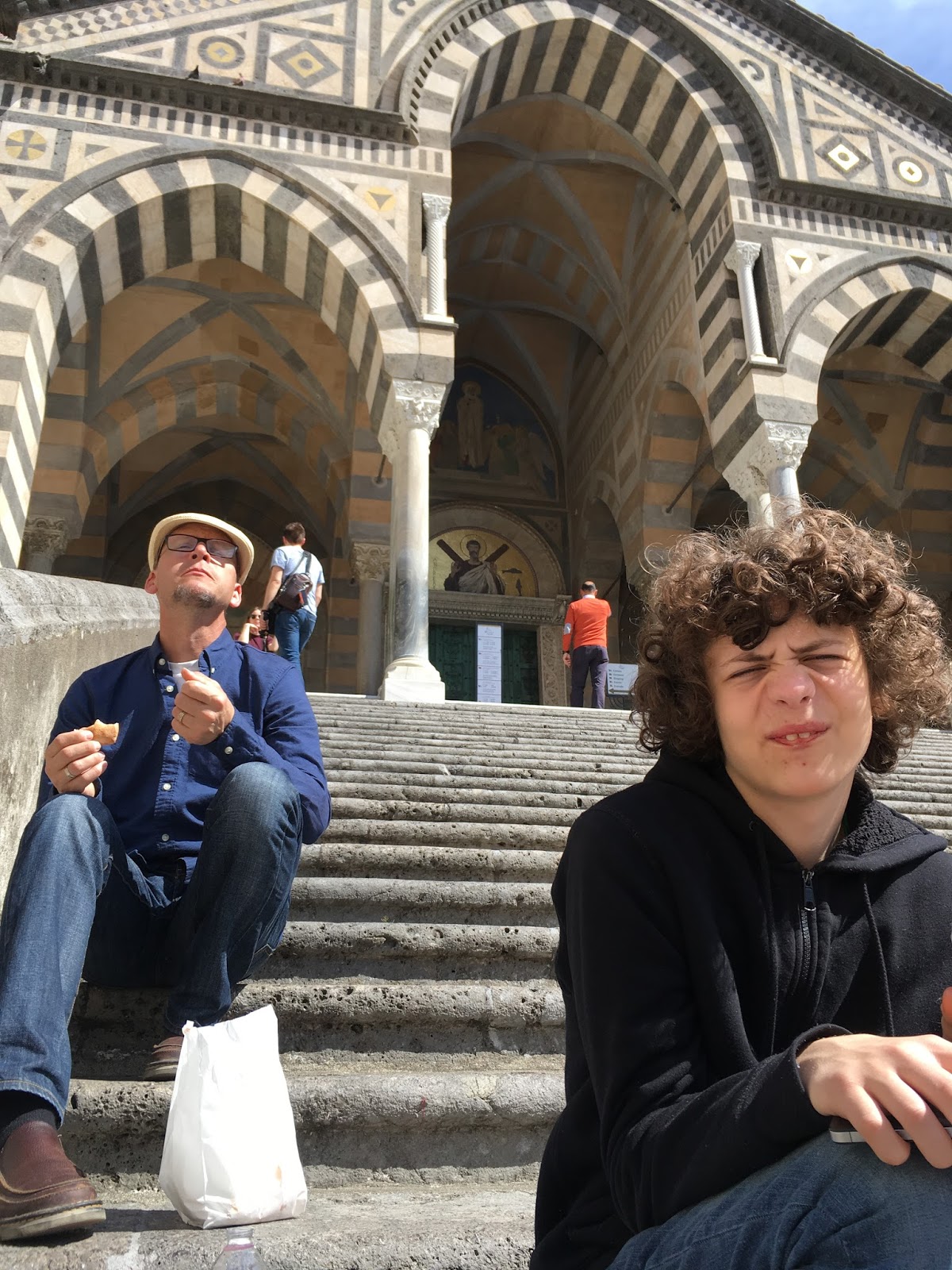
One of the main sights of Amalfi is it's Duomo.  The Duomo di Sant Andrea is up high upon a perch overlooking Piazza del Duomo.  The steps leading up to the Duomo is a local hangout for people to sit and relax in the sun for a bit.  We bought some CalzonesArancini (rice balls with peas and cheese inside) and beer and had a fine picnic on the church steps.  The current Cathedral was built in Amalfi's heyday circa 1,000-1300, but the remains of the older basilica dating to the 800's (housing the museum) were built upon an ancient Greek then Roman temple.  This church was basically built to house the remains of Saint Andrew (the one martyred on an X shaped cross). The remains were brought to Amalfi from Constantinople in1206.  
Campanille


The Duomo is a mix of Moorish, Byzantine and Gothic styles.  The complex consists of the cathedral, the Campanile and the convent of Cappuccini.  It costs €3 to enter the Duomo and tour the museum.  The courtyard inside is a beautiful columned oasis nicknamed the "Cloister of Paradise" is a cemetery for the nobles of Amalfi.  You can get great views of the Campanile or bell tower, with its bright majolica tiles from here.  There are some beautiful marble sarcophagi here to admire and the whole cloister has an Arabic feeling to it.

The best part of this church is the crypt of Saint Andrew.  After exploring the small but very good museum in the former basilica, continue on downstairs through the ornately made wrought iron gates to the resting place of Saint Andrew.


Cloister Of Paradise


Tomb Not A Ballroom
This crypt is like no other I have ever seen.  It is Baroque overload!  The vaulted ceilings were frescoed in the late 1600's with scenes depicting Saint Andrews life and everything in the crypt is gilded and ornate.  With the huge chandeliers hanging in the entryways you would think this a ballroom, not a crypt.  Then you see the big bronze statue of Saint Andrew and his X shaped cross.  This statue from 1606 was a masterpiece of Michelangelo Naccherino, a student of Michelangelo Buonarroti in Florence.  Flanking Saint Andrew are marble statues by Pietro Bernini, father to THE Bernini king of the Baroque era.  In the gold box under the statue sits the remains of the Saint. 


High Altar


Continuing the tour upstairs from the crypt is the Cathedral with its Baroque high altar.  It's almost too much to look at!  Lots of painting and murals depicting the life and miracles of Saint Andrew.  Lots of relics and treasures plundered from Constantinople in 1206.  The crazy thing is that we had this whole place to ourselves practically!  There was only one other family having a private tour of the place and letting their snot nose pre-teen daughter wipe her boogers all over the ancient frescoes in the cloisters  (I think there must be a special place in hell for nose pickers).  
I'm sure the daughter will brag one day:  "I wiped my boogers over every single UNESCO site in Italy"!  Oh, did I forget to mention Amalfi is a UNESCO World Heritage Site?  My Bad.


Exploring The Breakers in Amalfi
We were thoroughly saturated with all this heavy sacred tourism stuff by this point.  We decided to get some fresh air and sunshine and check out Amalfi's beach for another kind of worshipping; the sun!  There is a long breaker that heads out into the water from the parking lot at the highway; it's a great place to look back on Amalfi and take photos.  There is also a large pebble beach here, the Spiaggia Grande where in the summer months you can rent a sun lounger and there are changerooms set up, etc.

The town of Amalfi turned out to be a surprisingly great destination for me.  Amalfi is a real town that depends on tourism, yes; but it is not the resort driven, uber-chic, "look at me in my Prada outfit" kind of place that I find Positano, Capri and to some degree Sorrento to be.


This is what I love about travel; you can read all you want in guidebooks, get all the recommendations from strangers on the internet or even friends and family who have been to the destination.  But until you go visit these sites yourself and experience the energy of the place and distil it through your own unique filters; you can never truly know if it will stir your soul.  And that's the only thing that truly matters.


Follow me on INSTAGRAM and FACEBOOK for daily photos!


Sunday, March 19, 2017

Sorrento's Siren Song

Sorrento is a lemon-kissed jewel on the rugged coastline between Napoli and Salerno; less chaotic then it’s neighbour of Naples to the North and more exciting than the sleepy towns of the Amalfi Coast.  Sorrento was named by the Ancient Greeks for the sirens they believed lived in the waters of the Bay of Salerno.  It must be a Sirens song that lures loads of tourists here each summer.


View From Piazza Della Vittoria
We have spent almost a week between the Amalfi coast and the Bay of Naples, and have not yet explored our home base of Sorrento.  After a lazy morning in, we decided to go up to Sorrento from Marina Grande to visit the public garden that is a lemon and orange grove.  Walking up through the medieval gates of Marina Grande, we pass hotel after hotel that is painting, cleaning and landscaping; making ready for the tourist season that starts in April.  We were lucky to beat the crowds of this lovely town, yet we can only imagine how nice Sorrento would be in the summer with that beautiful breeze constantly blowing off the ocean.  Piazza Della Vittoria is a small public square that sits across from a terrace that overlooks the Bay of Naples.  It's a great spot to rest after coming up from our sea cottage in Marina Grande.


Cloisters of San Francesco

Sorrento's Beach 


Another beautiful spot to stop and take in the view is Villa Communale.  It is just down the street from Piazza Vittoria on Via San Francesco.  Villa Communale is a park that surrounds the monastery of San Francisco.  This 13th-century monastery and its cloisters are a tranquil reprieve during the busy tourist season.  It is beautiful even at night when it is flood-lit and mysterious, with it's Gothic, Norman and Arabic styles.  From Villa Communale you can take stairs that lead to "the beach", which is actually a wooden sundeck (the deck is not yet on for the season) or head to Marina Piccolo. TIP #1: THERE IS A PUBLIC ELEVATOR HERE THAT COSTS €1 TO AVOID THE STAIRS

Antiche Mure-Old Mill


We walked down Via San Cesareo, which we called walking the “lemon gauntlet” for all the yellow souvenirs in the world are here.   This road spits you out at Piazza Tasso, the main square of Sorrento.  If you can cross the busy square here carefully  (I almost became pizza da Strada or road pizza) and walk up a block by the taxi stand to the railings on the side of the road.  If you peer over the bannister you can actually see steps that were carved into the edge of the river gorge by the Greeks in the 5th-century BCE.  The steps lead down to an old abandoned flour mill that was built around 900 and was abandoned in the 1860's when building Piazza Tasso cut it off from the sea.  I would love to turn this place into a super cool restaurant with a cool lit up patio......


Orange Lined Corso Italia


Fresh lemonade
Following along the main drag of Corso Italia, you find all sorts of fashionable clothing stores, grocery stores, the movie theatre and jewellers.  The public lemon garden is on the Corso Italia past the street that heads up to the train station.  Just look for the lemon painted tiles leading into the walled garden.  I Giardini di Cataldo is a family owned citrus grove that is an oasis in downtown Sorrento.  Lemons are big business in the vicinity of Sorrento and Capri. Many different varieties are grown here and therefore are harvested three times a year; the most famous is the "sfusato Sorrentino" that becomes the sweet treats such as limoncello, granita and limonata.  There is a little stand in the garden where you can sample Limoncello, Mandarino (Mandarin Orange liqueur, Liquirizia (a liquorice based liqueur), fennel liqueur, and Liqueur di Noci or walnut liqueur.


Limoncello Factory


This little booze stand was not only a fantastic marketing plan, but it was educational as well.  We decided to exit the lemon garden at the back entrance on Via Correale and head to I Giardini Di Cataldo factory.  The factory is also set in a beautiful garden and you can also have samples of the liqueurs that they produce from ALL LOCAL ingredients.  This family-run business makes THE BEST limoncello I have tasted in my opinion.  I like my limoncello on the sweet side, whereas Luke likes his to taste like lemon furniture polish; more alcohol than lemon.


Limonoro Store

After our purchase of a giant bottle of Limoncello and a bottle of the Liquirizia. We decided to head back to Via San Cesario and hit the lemon souvenir shopping HARD.  We bought lemon soaps in hand-painted dishes, lemon coloured scarves, lemon candies,  tablecloths, and t-shirts.  I just wanted to mention a place called Limonoro.  It is also a limoncello factory with all sorts of free samples; all very delicious.  They have a product that is called Crema di Limone and it is creamy limoncello liqueur.  They also carry it in an orange flavour.  BUY IT!  It is the best version of this creamy liqueur I have tasted in Sorrento (I may have sampled A LOT in the week we were there).  TIP#2: BUY LIQUEURS THAT HAVE A QUALITY OF PRODUCTION SEAL.  This ensures that you are purchasing good liqueurs.


Citra-licious!

We slipped through a little laneway and headed East (our backs towards the water) to Corso Italia again to see the old part of town.  Along this stretch of upscale shops, there is a Carthusia of Capri perfume shop!  YaY!  The shop had JUST opened for the tourist season that day, which was so lucky because I tried to purchase perfume in Capri a few days earlier, but the shop not yet open for the tourist season.  I did end up purchasing a bottle of a unisex fragrance called "Capri: Forget Me Not" that is a mixture of mint, fig, citrus and sunshine in a bottle.  It is a wonderful souvenir that transports me back to Capri in an instant when I sniff it.


 Further along the Corso Italia, you see a great white villa called Villa Fiorentino. This is a villa owned by the city of Sorrento and holds great art exhibits such as the Sophia Loren photography exhibit that was shown here in 2017.  The grounds of the villa is a lovely park with a children's playground.  It's also a nice place to have a little picnic; in fact, there is a great coffee bar called Bar Veneruso next door that has THE most amazing selection of fresh desserts.


One Of Each, Per Favore!


TIP #3: NAPLES AREA SWEETS TO TRY:  Sfogliatella, Baba Au Rhum, Delizia (which is a lemon sponge cake in a bowl covered in lemon chiffon), various Zeppole (a sort of Italian doughnut), or in March look for Zeppole di San Giuseppe Saint Joseph's Day cakes (which have custard and fruit on them).
Sorrento is a charming place to spend the day or very handy place to stay as a jumping off point to see the Amalfi Coast area with lots of train, ferry or even car rental shops.  The food is GREAT in the town and if you are worried about having to speak Italian, there are plenty of American and British ex-pats in this town to help you out.  We even hit St. Patricks Day in a British PUB on Corso Italia.  It seems the only Sirens left in Sorento are the ones selling that delicious, sweet, lemon treat -limoncello!

Someone had too many limoncello samples: