Translate

Friday, July 31, 2020

Tuscany's Mysterious 'Vie Cave'~"Streets Of The Dead"


Shaded canyon of the San Rocco Via Cava near Sorano, Tuscany, Italy


The Etruscan civilization is a mystery to historians and archeologists alike.  Some of the baffling remnants of their culture are the subterranean roads called the Vie Cave, or the 'Sunken Roadways' are 'Streets of The Dead' leading to ancient necropoli...


Decending the switch-backs of the San Rocco Via Cava near Sorano, Tuscany, Italy

There are ancient excavated roadways all across Spain, Italy, Turkey and into the Middle East in as far away places such as Isreal and Jordan.  The "roads"  were constructed by different civilizations and for various purposes. In Jordan, for example, channels were carved into the rock to direct water to ancient cisterns.  In Southern Tuscany, these excavated or "sunken" roads are called Cavoni or also Vie Cave.  These pathways were hand chiselled into the volcanic tufo rock, and are much older than once thought by archeologists.


Local trail map of the San Rocco Via Cava walk near Sorano, Southern Tuscany, Italy
The Vie Cave are called 'Tagliate Etrusche' or 'Etruscan Cuts'  by the locals and is attributed to being carved by the ancient Etruscans.  They are now thought to have been constructed by the Iron-Age Villianovian Civilization, the earliest of the Etruscans. The Villianovians lived in Southern Tuscany and Umbria in about 900-700 BCE. However, the Vie Cave could be much older than that.  Much speculation on what the purpose of the Vie Cave was; for directing rainwater into cisterns, as defensive measures against attack o. perhaps,  for ceremonial purposes.  The Romans later incorporated the Vie Cave into their roads system to form part of the Via Clodia that linked Rome with Manciano in Tuscany, which was a vital farming region for the Empire.


Early Christian carving in a cave of the San Rocco Via Cava near Sorano, Tuscany, Italy


These trails that were hand-carved into the rock are commonly known in Italian as 'Vie Sacre' or 'Sacred Pathways.'  Many of the Vie Cave lead from village centres to Etruscan Necroploi or "cities of the dead." There is a theory that the dead were not transported above ground; instead, they were carried through the subterranean Vie Cave to a Necropolis for cremation and burial.  Through the centuries,  Early Christians left religious symbols on the Vie Cave. Christian symbols were also carved into the Etruscan tombs, and many early churches were built alongside the Vie Cave.


Shaded canyon of the San Rocco Via Cava near Sorano, Tuscany, Italy


Hiking trails in Southern Tuscany are plentiful, with day-long and multi-day journies through every type of terrain.  There are around 15 Vie Cave in the Southern Tuscan area linking the hill-top towns of Pitigliano, Sovana, Sorano, San Quirico, the lost city of Vitozza and San Valentino with its ghost town.  Hiking a shady Via Cava (singular for Vie Cave) is a pleasant and refreshing walk in the heat of the afternoon Tuscan sun.  The Vie Cave canyons can get up to 20 meters deep and up to 3 meters wide, typically following a river bed.  Take great caution when walking the Vie Cave, for they are on the World Heritage Watch List for endangered monuments because of their fragile nature.  The rock is so soft and easily eroded by water and flooding.  Look for the ancient chisel marks of the Etruscan carvers still visible in the Via Cava stone almost three thousand years later!


Viewpoint overlooking Sorano, Southern Tuscany, Italy


I discovered the Vie Cave when exploring the Southern Tuscan village of Sorano.  After spending the night in a Medieval castle high above Sorano, we were driving to the natural hot springs in Saturnia.  Travelling along the SP22 regional road, we saw a roadside viewpoint about 2 km outside of Sorano. Here, you will find a gorgeous view of Sorano across the Lente River canyon.  This was also the trailhead for the San Rocco Via Cava that descends slowly down to the Lente River, winds around the base of Sorano and ends in Vitozza about a 3 hours walk away.


Cave near the San Rocco Via Cava trailhead, Tuscany, Italy

The San Rocco trailhead has plenty of parking, a cliff-side viewpoint with a stunning panorama of Sorano, a few picnic tables and is an enjoyable spot to stop for lunch.  There are also some cave dwellings to explore here.  Follow the signs behind the site of the early church of San Rocco to the trailhead of the San Rocco Via Cava.  Signage and maps explain the history of the Vie Cave in Italian and English at the start of the trail.


Trailhead of the San Rocco Via Cava near Sorano, Tuscany, Italy


Until 1940 the San Rocco Via Cava was the only road leading from Sorano to Sovana!  The Via Cava trail leads gently downwards through a forest full of Oak and Black Walnut trees.  There has been some restoration of the Via Cava walls, and as you descend to the river, the canyon walls grow higher and higher.  A sturdy pair of walking shoes and some bug spray are recommended. However, in late September, when we visited, there were no mosquitos.


Columbariums of the San Rocco Via Cava near Sorano, Tuscany, Italy

Other unique features along the San Rocco Via Cava and around the Sorano area are the Columbarium.  A columbarium or dovecote are caves with rock-cut cells all lined up over top of each other like modern-day cubby holes!  These columbariums were used for housing doves and pigeons in Roman times all the way up to the Middle Ages. Although these dovecotes are much older than that.  I think the dovecotes were Etruscan columbariums used for human ashes. Much like our modern columbariums in cemeteries today, these caves were "cities of the dead" or necropoli. The early Etruscan's funerary practices involved cremation, which later changed as they exchanged cultural information with other advanced societies that moved into their territories, such as the Greeks and Romans.

Shaded canyon of the San Rocco Via Cava near Sorano, Tuscany, Italy


There are surprises to discover at every twist and turn along the San Rocco Via Cava, including many caves, cliffs and necropoli!


Have you walked any Vie Cave; which one?  I would love to hear about your experience in the comments below!


Follow me on FACEBOOKINSTAGRAM  and  BLOGLOVIN'  for daily photos and updates! #slowtravel🐌


Friday, June 26, 2020

Pitigliano, Tuscany's Little Jerusalem

Sunset on the village of Pitigliano in Southern Tuscany, Italy

Pitigliano in Southern Tuscany is not perched upon the tufa rock, it IS the tufa rock!  Carved from Tufaceous or volcanic rock, the village of Pitigliano is part of the area of towns that make up the "Borghi del Tufo"...

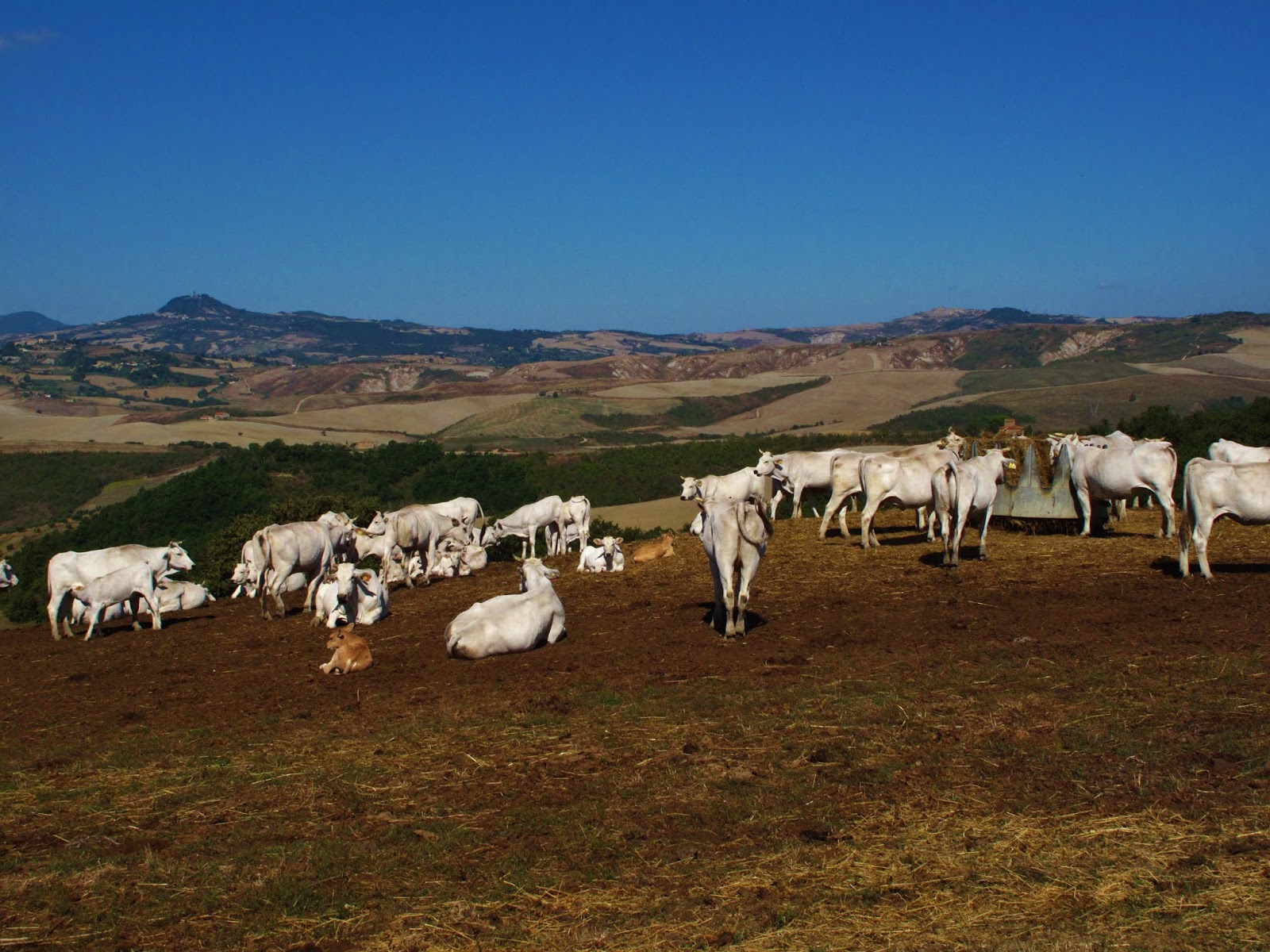
White Chianina cows grazing in the hills of Southern Tuscany, Italy

Heading from out from Cortona, which had been our home base for the past week, we drive further south through Southern Tuscany to the province of Grossetto.  Grosetto is known for its beautiful beaches, Chianina cattle and cowboys.  Grossetto also is home to excellent thermal springs and some off-the-beaten-path hill towns.  Three of these spectacular hill towns are in the Fiora River Valley; Sovana, Sorano and Pitigliano.  
Driving to Pitigliano is half the adventure!  Taking the local roads, we traversed mountains, drove down cypress-lined lanes and through cattle ranches dotted with white Chianina cows.


Pitigliano a village built from Tufa rock in Southern Tuscany, Italy
Pitigliano From The View Point

The countryside of Southern Tuscany in late September was the colour of gold, and the forests were random patches of dark green, creating a patchwork effect.  We drove small roads winding up the rounded mountains and then riding the ridge for a few moments before suddenly plunging down the other side again. Forests of Oak and Maple with little vineyards and pastures cut into the mountainside dotted with castles and church spires off in the distance. 

If you are driving from Rome to Pitigliano, you most likely arrive via the SR74, which cuts through the modern part of Pitigliano.  The road makes a sudden hairpin turn, and there is a scenic viewpoint along Via San Michele that has free public parking. 

Gate in the Pitigliano city wall with the Orsini Crest in Pitigliano, Tuscany, Italy

Pitigliano was founded by the Etruscans in the 7th-6th century BCE, but little is know of its ancient past.  Historians believe the city may have been wiped out by the Etruscan King of Chiusi, Lars Porsenna, in 500 BCE.  The tufa rock outcropping in the middle of a vast canyon is a natural form of defence, which is a typical Etruscan building strategy.  The outcropping that the city sits upon used to be connected by a footbridge.

Nowadays, there is a street that bridges the canyon, and the entrance to the city is through the medieval wall to the 14th century Orsini fortress.  The fortified palace now holds the Civic Archaeological Museum and the Museum of Holy Art.€3 entry fee for each.  

The Medicean Aquaduct of Pitigliano in  Grosetto, Southern Tuscany, Italy


Once past the Palace complex, you are on Via Cavour, and the impressive Medicean Aquaduct appears on your left side.  This was built not by the Romans but in 1639 by the Medici  Family, who ruled Pitigliano after the Orsini.


The Medicean Aquaduct  in front of the Orsini fortress in Pitigliano, Grosseto, Tuscany, Italy


Walking in the shadow of the Medicean aquaduct of Pitigliano, Grosseto, Tuscany, Italy


Following Via Cavour between the aqueduct and the fortress, you arrive at Piazza Republica, an elegant Renaissance square that's fountain frames the forested canyon below.   

Fountain in Piazza Republica, Pitigliano, Grosseto, Tuscany, Italy

The baroque style Cathedral of Saint Peter and Paul with it's contrasting bell tower in Pitigliano, Grosseto, Italy

Once past Piazza Republica Via Cavour turns into Via Roma, the main Corso, which forms an oval-shaped circuit through town.  Pitigliano transforms from an elegant Renaissance hill town into a medieval maze of staircases, underpasses and narrow alleyways.  Following Via Roma, you arrive at Piazza San Giorgio and the Baroque Cathedral of St Peter and Paul.  It was actually built in 1061 but given a facelift in the 18th century by one of the Orsini family.  The 35-foot belltower standing next to the church looks awkwardly underdressed! 

The church of San Rocco is the oldest church in Pitigliano, Grosseto, Tuscany, Italy


Further along the street, the road changes name again to Via Generale Orsini, and we come to San Rocco, Pitigliano's oldest church.  Constructed in the 12th-13th century, the church is worth popping inside. The centuries worth of rulers' coat of arms are on display behind the altar, and beautiful frescos and paintings adorn this romantic church.  There is a little side chapel to Saint Apollonia (the patron Saint of dentistry) complete with a portrait of a bucktooth woman in medieval garb holding a big pair of pliers and a bloody tooth.  My son thought it was the Italian Tooth Fairy!  


Medieval details on the church of San Rocco in Pitigliano, Grosseto, Tuscany, Italy

The Vie Cave are "Cave Roads" built by the Etruscans around Pitigliano, Grosseto, Tuscany
Once past the church of San Rocco, the street changes name again and becomes Via Aldobrandeschi.  This is the oldest part of Pitigliano with many medieval buildings and streets. Follow the road to the end, and you will find a viewpoint with stunning views of the valley below.
  
A little laneway on the right called Via Porta di Sovana takes you down an alleyway to the mysterious Via Cava.  The Vie Cave are hand-cut trenches that became an interconnected road network between Sovana, Sorano and Pitigliano.  Nobody knows for sure what their real function was, but they date back to the early Etruscan era.  If you have time for a leisurely walk, I recommend exploring the Vie Cave.
Pitigliano laneways in the afternoon sun Pitigliano Grosseto, Tuscany, ItalyExploring the delightful streets of Pitigliano, Grosseto, Tuscany, Italy


Trattoria near the jewish ghetto in Pitigliano, Grosseto, Tuscany, Italy


Eating in Pitigliano is a treat!  Of course, just like every Italian hill town, there is a regional specialty.  We ate at the Locanda del Pozzo Antico, which is a family-run trattoria and pizzeria.  Ravioli stuffed with sheep milk cheese is a specialty here, and the Pitigliano white wine Bianco di Pitigliano made from Trebbiano Toscano grapes is a crisp and fruity treat!  Red wine drinkers should be on the lookout for Sovana DOC wines made in the closeby region of the hill town of Sovana.  Just be aware that the pizza ovens do not fire up until the evenings in Pitigliano.  If you are craving a sweet treat after your meal, try the local cookies called sfratti made from walnuts, honey, nutmeg and orange peel all wrapped up in a delicious dough.  A great place to pick up sfratti is at Panifico del Ghetto (167 Via Zuccarelli) near the synagogue.


Local products sold along the main corso in Pitigliano, Grosseto, Tuscany, ItalyPitigliano is known as Tuscany's Little Jerusalem.  From 1555 to 1569, the Pope issued a papal bull that evicted all Jews from the Holy Lands.  Crossing the border from Lazio into Tuscany, many Jewish people made Pitigliano their home when fleeing the State of the Church.  By 1600 Jewish people settled into the Borghi di Tuffo; Sorano, Sovana and Pitigliano being confined to live only in the ghettos provided.  The peaceful coexistence of the Jewish people in Pitigliano resulted in a synagogue being built in the Jewish quarter of Pitigliano.  This synagogue is still the only one in existence in the Grosetto Province of Tuscany.  A walk in the Jewish quarter along Via Zuccarelle is an evocative peek into Jewish life 400 years ago.  For more tourist information on Pitigliano, go to pitigliano.org.


Pitigliano is a romantic town to explore. The history, the culture, the mystery ... and you must see it lit up at night!


Follow me on FACEBOOKINSTAGRAM  and  BLOGLOVIN'  for daily photos and updates! #slowtravel🐌

Wednesday, June 17, 2020

Chiusi, Tuscany~Under The Etruscan Sun

A view of Lake Chiusi from the cathedral of Chiusi's  belltower, Chiusi, Province of Siena, Tuscany, Italy
A small Tuscan hill town built on a massive tufa foundation; Chiusi's attractions are all below ground!  This charming country village holds a secret under its streets...

Chiusi's Piazza Duomo and the Cathedral of Saint Secondiano, Chiusi, Province of Siena, Tuscany, Italy

For Tuscan adventure seekers, this small somewhat off the beaten path hill town, Chiusi (pronounced choosy) is a troglodyte's dream. At one time, this hilltown was an ancient Etruscan hub and one of the most important cities in Etruria.  Building upon a broad tufa rock foundation allowed the Etruscan people to easily dig a network of tunnels used to store wine, collect rainwater or to escape when under attack.   The Etruscan name for Chiusi was Clevsin, and it was constructed and settled by pre-Etruscan people dating back to the 8th century BCE.  Clevsin was built upon an Etruscan trade route to Rome, later becoming the Via Cassia.  The Via Cassia branched off from the Via Flaminia that lead to Umbria, and Clevsin became a Roman town called Clusium.

Separate belltower of Cathedral Saint Secondiano, Chiusi, Province of Siena, Tuscany, Italy


Chiusi is located close to the border of Umbria and Lazio in the south of Tuscany. It is located along the A1 autostrada between Florence and Rome, and many trains stop or change in Chiusi, making it a transportation hub.  If you are driving your own car, parking lots near the historic centre are plentiful, and many are free.  Try the convenient parking lot off of Via della Pietriccia just behind the town's main square.  TIP: If you are planning to see several sights in Chiusi, I would recommend purchasing the Chiusi Museum Card to save on entrance fees.  The pass costs €10 and allows admittance to all 3 Chiusi museums.
There is an excellent archeological National Etruscan Museum just off the piazza.  There is an extensive collection of Etruscan artifacts and funerary urns.  You can also arrange visits to the local Etruscan tombs such as Tomb Of The Pilgram and Tomb Of The Monkey. These tombs are located just outside the town, which requires a guide to tour.  The museum entrance fee is €6, and visiting the tombs is €2 and requires advanced reservations.


Close uo of the underground Etruscan carved well far below the streets of modern Chiusi, Province of Siena, Tuscany, Italy


While this quaint village is pleasant enough to wander around for the day, the real attraction is Chuisi's underground caverns.  The Chiusi Civic Museum "The Underground City" on Via II Ciminia offers tours several times a day of the City UNDER the City.  Knowledgeable guides take you on a one-hour underground Etruscan city tour of the tunnels, subterranean wells and lakes that were the Etruscan water system network for the large city of the time.  Your guide either takes you to the underground lake or the hand-carved well, both were vital water sources to the ancient city with 25,000 residents.
A room full of ancient ossuaries in Chiusi Underground Tour, Chiusi, Province of Siena, Tuscany, Italy
If you don't manage to visit the museum, the Underground City tour has an extensive collection of Etruscan ossuariesAn ossuary is a carved stone box or funerary urn where human remains are placed.   The ossuaries were found in the nearby necropolis located out of town.  A necropolis is literally a city of the dead where all the ornately carved ossuaries are placed.  When someone died, an enormous banquet was held, and many of the ossuaries depicted the dead feasting.  The Etruscans used to cremate their dead, but then as Roman culture became popular, inhumation became the fashion.  

Ancient Etruscan ossuaries or funeral urns underground in Chiusi, Province of Siena, Tuscany, Italy


So fascinating! We were shown how to read the Etruscan names on the ossuaries, from right to left.  It was interesting that the most popular female Etruscan first name was Tania!  Many of the wealthy Etruscans had depictions of themselves carved on top of the ossuary.   The departed loved-one appears propped up on one elbow as if eating during a banquet feast,  a tradition that the Romans later adopted.
The Greeks, who were at war with the Etruscans and settled in this part of Italy, also had a high impact on the Etruscan culture.  The Greek God Dionysus was reflected by the Etruscan wine God named Fuflun, who is depicted on many of the ossuaries.


Children love the underground city tour in Chiusi, Tuscany, Italy
The Cathedral of Chiusi offers another underground tour.  The Cathedral of Saint Secondiano or Chiusi's Duomo was built in 560 CE over a Roman Temple, which was converted from an Etruscan Temple.  The Duomo's bell tower, which stands separately, was built over a Roman swimming pool that was in use in the first century BCE.

To sign up for this tour, you must go with a registered guide.  Buy the tickets at the Duomo museum. The Museum entry fee is €2, the underground tour is 3, a combo ticket is 4.  The tour was in Italian, and our guide didn't speak much English, but he was accommodating.  We followed the guide outside to access the underground labyrinth through a secret door at the back of the cathedral.  Once again we travelled deep underground through a maze of tunnels.  If you are claustrophobic, this tour IS NOT the right choice for you.  Also, some of the passageways are very narrow, and the robust Italian family that was taking the tour with us had to turn back because one person in their party could not fit through the thin tunnel.  

Underground Roman cistern now sits under Chiusi's Duomo, Chiusi, Province of Siena, Tuscany, Italy


The guide expertly leads you through a literal maze of passageways that were carved out of tuff stone over 2000 years ago.  The underground tunnels are dark, cold and eerily quiet.  After about 20 minutes, you arrive
at an enormous cistern located directly under the courtyard of the church.  This was once a Roman swimming pool. I learned one of my favourite Italian words, "pipistrello," which means bat!  There was a colony of bats living in the cistern. A few of them were flying around, disturbed by the flashlights and our voices.  


Staircase from the underground cistern to Chiusi's  belltower, Chiusi, Province of Siena, Tuscany, Italy


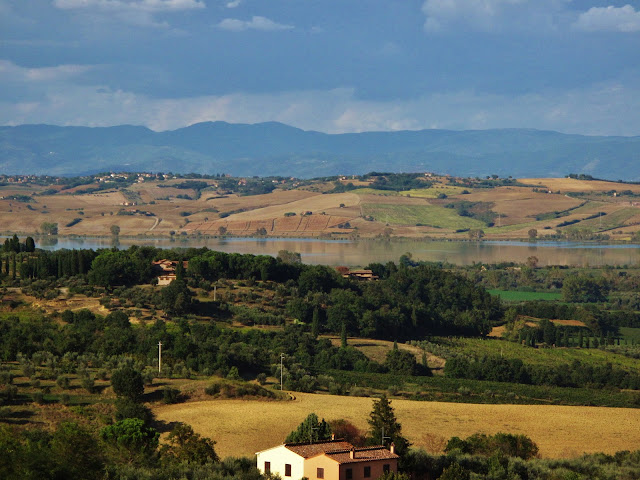
The guided tour ended by having the chance to climb all the way up the bell tower of the church.  It must have been hundreds of stairs!  Climbing the spiral staircase from the still, dark, cold of the cistern into the bright, searing heat of the afternoon felt like a metaphor of some sort.  The views from the belltower are expansive, and one can see all the way to Lake Chiusi nestled amongst the rolling hills.

We definitely earned our gelato today!

I felt the need to find out more about the Etruscan civilization after exploring Chiusi above and under the ground.  Maybe a visit to the Etruscan museum in Cortona is to find out more about these mysterious ancient peoples and their fascinating customs that seemed to have disappeared into the mists of time.  

Chiusi sparks my curiosity about ancient Italian civilizations and beckons me to explore deeper ...underground!

Follow me on FACEBOOKINSTAGRAM  and  BLOGLOVIN'  for daily photos and updates! #slowtravel🐌