Translate

Saturday, March 30, 2019

Dublin Day Trip To Newgrange

Large Henge stone at Newgrange, Bru Na Boinne, Boyne Valley, Couny Meath, Ireland


North of Dublin, lies a group of mysterious burial mounds, some of which are 500 years older than the pyramids of Giza. Thought to be entrances to the Fairy realm, a visit to Brú na Bóinne IS entering an enchanting world...of the past.


Burial mound in neighbouring farmers field Newgrange, Bru Na Boinne, County Meath, Ireland
More Burial Mounds In Farmer's Fields
In a lush and tranquil green valley 48 km (30 miles) north of Ireland's bustling capital city Dublin, lies one of Irelands two UNESCO World Heritage Sites:  Brú na Bóinne.  Ireland's other incredible UNESCO World Heritage Site that I visit is Skellig Michael on the rugged West Coast.  The name Brú na Bóinne means "dwelling place of the Boyne" in Irish, after the first people that settled here along the Boyne River over 5,000 years ago.  Brú na Bóinne consists of a modern state-of-the-art museum/visitor centre and two massive passage tombs: Newgrange, Knowth and Dowth.  These passage tombs were built in the Neolithic age by the pre-Celtic indigenous people that the Celtic people called the Tuatha Dé Danaan or "The People of The Goddess Danu." The Celts believed the Tuatha Dé Danaan were a supernatural race of people that simply disappeared into the "Fairy Mounds" and live in another realm.  There is so much mystery surrounding these ancient pre-Celtic people!


Covered walkway to the Bru Na Boinne Visitor Centre, County Meath, Ireland
Entrance To Visitor Centre

If you are heading to this historic site, there are a few things to note.  1. It gets hectic during July and August so try to arrive at the visitor centre before 10:00 am to avoid long lines.  2. You can not visit the tombs on your own, you must be a part of the formal tour group from the Visitor Centre.  3. Newgrange is open year-round, and Knowth is only open May-October.  So if you want to see both passage tombs, you must go during the warmer months.  Dowth is known as "The Fairy Mound of Darkness" and is aligned to the Winter Solstice sunset.  You can see the mound of Dowth by going directly to the site, but there is no public access to the tomb.  There has been an active areological dig there in the past year when in July 2018 a passage tomb was discovered in nearby Dowth Hall possibly connecting it to Dowth mound.


We arrived first thing in the morning before the Visitor Centre opened-and yes, there was already a line-up!  Once we got inside and purchased our tickets we had to wait a half hour for our shuttle bus, so we headed downstairs to the reasonably priced cafeteria for coffee and breakfast. Perfect.


THE VISITOR CENTRE IS TEMPORARILY CLOSED FROM MARCH 28TH 2019, FOR APPROXIMATELY 6 MONTHS FOR RENOVATIONS.  THE TOMBS TOURS ARE STILL RUNNING FROM THE PARKING LOT.


Newgrange Paassage mound, Bru Na Boinne, County Meath, Ireland
Newgrange


Giant kerbstone at the entrance to Newgrange passage tomb, Bru Na Boinne, County Meath, Ireland
Entrance To Newgrange


The Brú na Bóinne visitor centre is open 9am to 7pm in the summer months.  When you arrive at the visitor centre purchase your ticket for the tomb site of your choice; either Newgrange or Knowth (rhymes with South).  Newgrange is €7, Knowth is 6, both are 13, and just the visitor centre is 4.  When you purchase your ticket, you are assigned a time to board a shuttle bus that takes you to your selected passage tomb.  The shuttle bus takes about 15 minutes to drive out to the site, where an archeologist will then meet you and give you a 30-minute guided tour explaining the significance of the ancient burial mound.  For up to date information on the prices and times of tours visit the government website:  http://www.heritageireland.ie/en/midlands-eastcoast/brunaboinnevisitorcentre/

So, you may be asking what is the difference between the two tombs; Newgrange and Knowth? 


One of the many stone structures at the Newgrange UNESCO world heritage site, Bru Na Boinne, County Meath, Ireland
More Structures at Newgrange
Newgrange is older than Knowth and is aligned to the sunrise on Winter Solstice (December 21).  It dates from 3200 BCE, and you are allowed inside the central chamber with your tour guide. WARNING:  If you are at all claustrophobic you do NOT want to enter the burial mound!!    It's a tight squeeze down an 18 meter (60 foot) passageway into the central chamber.  Once everyone is inside the main womb-like cavity, there is a demonstration of how the Winter Solstice sunlight enters the sacred room through the roofbox above the entrance door.  The guide warns you that the lights will go out, and then you are in absolute darkness with 200,000 tons of dirt and stone above you!  Watching the sunlight slowly crawl towards the central ritual chamber to where the ancestral bones were kept was such a visceral experience that it actually moved me to tears!  The thought of experiencing this ritual like people did 5,000 years ago gave me a feeling of connection to the people and the land of the Boyne Valley.  

The OPW holds a yearly Winter Solstice Tour Lottery into Newgrange from December 18- 23, where a few lucky participants can witness the Winter Solstice sunrise at 8:58 am from inside the ritual chamber.  for more information on how to enter the Lottery see the OPW website here: http://www.worldheritageireland.ie/en/bru-na-boinne/winter-solstice/


Neolithic art on massive kerbstone Newgrange and Knowth, Bru Na Boinne, Couty Meath, Ireland
Kerbstone With Geometric Patterns

Knowth is also a very impressive necropolis with it's superior geometrically carved kerbstones and passage tomb.  There are two entrances, one East and one West that are is aligned to the sunrise on the Spring and Autumn Equinoxes.  Unfortunately, you can not enter the actual burial mound, but there is a room built into the tomb where there is a cutaway so you can see into the passageway. You can also see how the mound was constructed with layers of rock and dirt that withstood 5000 years of the Irish elements.  

Reviving the art of willow fencing at Bru Na Boinne, County Meath, Ireland
Willow Fencing


If you only have time (or patience) to see one of the Neolithic sites of Brú na Bóinne, then I would recommend NEWGRANGE.  Even if the line up to Newgrange is longer, the visit inside the passage chamber was phenomenal. But, if you are not interested in going inside a passage tomb, then Knowth would be a better choice to visit.

For more history on Brú na Bóinne visit the government website: http://www.worldheritageireland.ie/bru-na-boinne/ 
or check out this fantastic website for everything you need need to know to explore this area: https://www.knowth.com/

There is a concentration of rich history to explore in the Boyne Valley beyond Newgrange such as The Hill of Tara, Monasterboice and Trim Castle just to name a few.  Having your own vehicle to discover the area would be ideal.  Otherwise, there are many tours of the Boyne Valley including Newgrange, that depart from Dublin each morning.  Check out boynevalleytours.com   they come highly recommended.


Have you visited Brú na Bóinne?  What passage tomb did you prefer; Newgrange, Dowth or Knowth?  Let me know in the comments below.


Follow me on FACEBOOKINSTAGRAM  and  BLOGLOVIN'  for daily photos and updates! #slowtravel🐌 


Sunday, March 17, 2019

How to Have The Cliffs of Moher All To Yourself!

Walking North from Hag's Head along the Cliffs of Moher, Ireland


Ireland's iconic Cliffs of Moher are on travel book covers, tourist brochures and most visitors to Irelands' "Bucket List"; and for a good reason-they are awe-inspiring!  If you want to have a chance to see the cliffs without the crowds, then read on...


Beautiful arches in the sea at the Cliffs of Moher, County Clare, Ireland
Looking Northward At The Cliffs Of Moher

The Cliffs of Moher are on Ireland's West Coast located in County Clare between Hag's Head (near the town of Liscannor) to the South and Doolin to the North, stretching about 12 kilometres.  These 214 meters (700-foot) tall cliffs are an impressive tourist draw that attracts scores over one million tourists a year to eager to see the sheer drop into the wild Atlantic Ocean.  Most tourists end up at the modern Cliffs of Moher Visitor Centre located around the midpoint of the cliffs.  The parking lot for the Visitor Centre is on the R-478 coastal road, and costs €8 to park your car, but then you can enter the visitor centre for free.  The center is state-of-the-art and equipped with a tourist information centre, ATM, toilets, restaurants and of course, a gift shop.


Detailed map of parking and trail head for Hags Head walk along the Cliffs of Moher, County Clare, Ireland


But... if you want these rugged Atlantic cliffs all to yourself without the crowds even in mid-August at the height of tourist season, there is another route you can take.  There is a coastal walking trail sometimes referred to as the Hag's Head Trail or the Cliffs of Moher Coastal Trail, but it is actually part of The Burren Way.  The Burren Way is a 114 km (71 miles) multi-day hike across county Clare that starts in Lahinch and ends in Corofin, crossing the Burren which is Europe's largest limestone landscapes. 


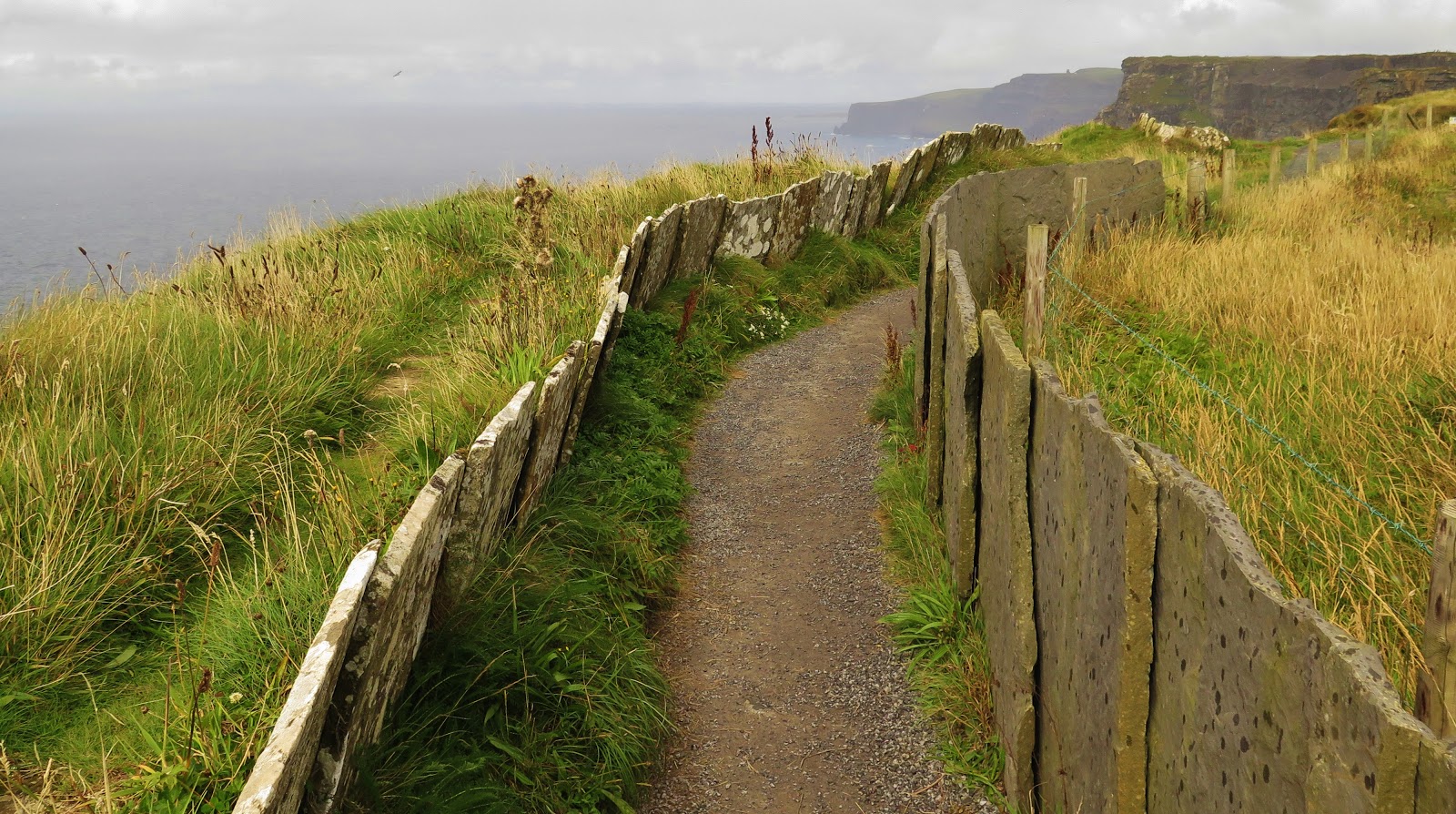
Pathway lined with slate slabs at Hag's Head, Cliffs of Moher, Ireland
Cliffs of Moher Coastal Walk


Detailed map of shuttle bus stops along the Cliffs of Moher hiking trail from Hag's Head to Doolin, County Clare, Ireland


A shuttle bus service operates March 1st through October 31st bringing hikers back and forth to their car or bus connection.  There are four access points to the Coastal Trail; Liscannor, Hags Head, The Cliffs of Moher Visitor Center and Doolin (which has five bus pick-up locations.) For shuttle-bus information and schedules see COASTAL WALK SHUTTLE BUS.  From Hag's Head to the Visitor Center it is approximately 5.6 kilometres and takes about 2 hours to walk and then from the Visitor Centre to Doolin is another 7.7 kilometres which takes about another 3-3.5 hours.  The total walk is about 5-5.5 hours depending on fitness levels and how many times you stop to take photos!  


Walk through farmers fields to the Hag's Head trailhead at the abandoned telegraph tower, Cliffs of Moher walk, Ireland
Walk Towards The Telegraph Tower


For our Cliffs of Moher experience, we parked at the Kilconnel parking lot for  €2.  The parking lot is located on private land off a farm road just past the town of Liscannor.  Heading north from Lisconnor on the R-478, turn towards the coast at the intersection of Saint Brigid's Well (worth the stop to check this Holy Site out) and then follow the signs for parking.   Once you pay the parking attendant who will direct you where to park, you walk uphill through farmers fields for about a kilometre or so to join the coastal hiking trail.   We recommend arriving early to guarantee a parking space is available. 

Please respect the private farm property and take care not to drop litter or feed the animals (no matter how cute they are!) 


Sitting on the edge of the Cliffs of Moher, County Clare, Ireland
Take EXTREME Caution Near The Edge


The hiking trail itself is quite level with only a few sets of stairs near the abandoned telegraph tower.  The path here is lined with large slabs of slate, and if you look closely at the stone, you can see fossilized worm tracks from when this rock was just mere sand on the ocean floor.  

The path does come very close to the edge of cliffs in several places.  There are no fences or safety railings on this part of the coastal cliffs trail.  The cliff's edge is often slippery, and the gusts of strong wind that can slam into the cliffs without warning are enough to bowl you over at times.  Even earlier this year in 2019, a student taking a selfie on the cliff's edge lost his footing, falling to his death.  The recommendation for children is that no child under the age of 10 walks the trail from Hag's Head to the visitor centre.  I think that as long as you are supervising your children carefully, hiking the coastal trail should not be a problem.


The Cliffs of Moher looking northward towards Doolin, Ireland


Petting some of the friendliest horses along the Cliffs of Moher coastal walk from Hag's Head to Doolin, Ireland
Making Friends Along The Hike

The weather can turn abruptly on Ireland's west coast; all the pictures in this blog post were taken within a few hours of each other.  You know what they say about the Irish climate: "If you don't like the weather; just wait five minutes!"  It's so true!  For this hike, I suggest dressing in layers with a good wind/waterproof jacket and sturdy walking shoes.  Bring along a water bottle and perhaps a snack, although the Visitor center is a good place to stop in for food.  You may also want to pack bug repellant because at certain times of year the gnats are terrible along the grassy cliffside!  Sunscreen and sunglasses are also a smart thing to bring.


The coastal walk from Hags Head to Doolin along The Cliffs of Moher, County Clare, IrelandThe walk from the Visitor Centre to Doolin is not as dramatic as the first half of the hike, yet still beautiful.  The path winds past the Centre and slopes gradually down towards the sea at Doolin.  Doolin is a great place to stop in for a pint or a dinner at a pub.  Doolin is also a great place for Irish Trad Music in the pubs.  You can also book a boat cruise to see the cliffs of Moher from a different perspective-the water.  A one hour cruise is €20 (discount for online booking), and two companies offer cruises three times per day weather permitting.  www.doolin2aranferries.com and www.obrienline.com  Doolin is also the place where you catch the ferry to the Aran Islands with the same boat companies. 


Enjoy your visit to the Cliffs of Moher even if the weather is wet; because you know how the old saying goes: 


"you can't have rainbows without the rain!"


Double rainbow on the Cliffs of Moher Walk from Hag's Head to Doolin, Ireland


Follow me on FACEBOOKINSTAGRAM  and  BLOGLOVIN'  for daily photos and updates! #slowtravel🐌 #dulgomall

Thursday, February 28, 2019

Dingle Peninsula VS Ring of Kerry

Cow in the green pastures of county Kerry, Ireland

Are you struggling to decide between driving Ireland's uber-famous Ring of Kerry and the lesser known Dingle Peninsula?  Then this is the blog post for YOU!  I have some pros and cons for each drive, to help you choose what will work better for your perfect Ireland road trip itinerary.


Sunset over the Dingle Peninsula county Kerry, Ireland
Sunset Views of the Dingle Peninsula 
I was fortunate enough to spend a week renting a thatch-roofed cottage on the actual ring of Kerry between Cahairsiveen and Killorglin, allowing me to drive around both the Ring of Kerry on the Iveragh Peninsula and the Slea Head Loop on the Dingle Peninsula.  Many folks have asked me which scenic drive I would recommend to them because they have limited time on the West Coast.  If you are getting around by public transport, then your choices are minimal, especially if you are travelling in the shoulder or off-season.   Tour buses leave from Killarney to drive around the Ring of Kerry making this a much busier road to drive than the Dingle's Slea Head Drive.  So if you want to avoid crowds, head to Dingle. If driving in Ireland makes you nervous, and you don't want to rent a car then the Ring of Kerry would be your choice, because there are very few tours offered for the Dingle Peninsula.  This article is geared towards travels who have access to a vehicle.


Views

Both the Ring of Kerry and the Slea Head drive offer stunning ocean views.  The Slea Head road is closer to the sea, whereas The Ring of Kerry has some beautiful cliff-top vistas overlooking the Atlantic Ocean.  You can also take a side road off of the Ring of Kerry and drive the 32 kilometres Skellig Ring Road to see the beautiful Cliffs of Kerry and Skellig Islands off in the distance.  
My vote for better views goes to the Dingle Peninsula because you are driving next to the ocean more than on the Ring of Kerry.

The green cliffs of Kerry near Portmagee, Ring of Kerry, county Kerry, Ireland
The Cliffs Of Kerry
Road at Slea Head , Dingle Peninsula, County Kerry Ireland
Slea Head


Historical Points of Interest

There are many archaeological points of interest on both scenic drives, yet each loop holds different and unique sites. 


Dingle Peninsula's famous early Christian church Gallarus Oratory
Gallarus Oratory, Dingle Peninsula


Slea Head has beehive huts that were used by early inhabitants and later by Christian Monks.  Gallarus Oratory is a very early Christian church that was made by hand corbeled stone in a stunning setting.  Kilmalkedar Church with its Celtic cross graveyard and ancient Ogham stone is picturesque and evocative. DUNBEG RINGFORT IS CLOSED.   If you want to see a stone ringfort, you will have to see it on the Ring of Kerry. 


Staigue stone ringfort located in the rolling hills along the Ring of Kerry
Staigue Ringfort, Ring of Kerry


Ring of Kerry has three bronze age stone ring forts; two at Cahirsiveen and a huge one at Staigue Ring Fort. The cute town of Kenmare has a  prehistoric pagan stone circle in the middle of the city, and Killarney National Park on the Ring of Kerry has a ruined castle and a few deserted abbeys to explore.

My vote is tied between these two drives; each has completely different types of historical monuments.


Attractions


Jaunting car parked on lawn of Muckross House in Killarney National Park, Ring of Kerry, County Kerry, Ireland
Jaunting Car At Muckross House


With Killarney National Park being situated on the Ring of Kerry, the town of Killarney is much better set up for tourist activities than Dingle.  Killarney Park has Muckross House and Traditional Farms which is a grand Victorian House, and it's working open-air museum farm, Ross Castle and Muckross Abbey.  You can hike many of the gorgeous trails in Killarney park, rent a bike and explore the park, rent a boat, take a boat tour or hire a jaunting car through the Gap of Dunloe. 

Mysterious Beehive shaped huts on the Island of Skellig Michael, Kerry Coast, Ireland
Mysterious Beehive Huts On Skellig Michael


Another famous tourist attraction that is along the Ring of Kerry is the Skellig Islands.  Skellig Michael is a remote island 12 miles off the Kerry coast that is one of two of Ireland's  UNESCO world heritage sites.  The islands have become very popular in the last few years because of the filming of the Star Wars movies, and you must READ THIS BEFORE GOING TO SKELLIG MICHAEL!

Honourable mention for attractions on the Ring of Kerry is Derrynane (rhymes with Mary Ann) House, which was the home of Daniel O'Connell who gained equality for Catholics in Ireland back in the 1800s.


The town of Dingle has an aquarium called Oceanworld that is very popular with children. See www.dingle-oceanworld.ie for more information.  Another favourite activity in Dingle is a boat cruise around the harbour to spot Fungie the dolphin, Dingle's wild "mascot."  Or * NEW FOR 2019* you can take a cruise from Dingle to the Skellig Islands (this is not a landing tour, just a boat trip.  Check out Dingle Bay Charters for their cruise schedule.  If you want a taste of "real Ireland" visit the Blasket Islands just off the coast of Dunquin. Dingle Bay Charters in Dingle harbour has a ferry service daily to the remote Gaelic speaking Islands.  If you don't want to make the trip all the way out to Great Blasket Island, you can stop in at the Blasket Islands Visitor Center in Dunquin.  

My vote: Offering so many more attractions and activities, I would have to say the winner for the best attractions is Ring of Kerry.

Beaches

Both the Ring of Kerry and the Dingle Peninsula have gorgeous sandy beaches, some are popular swimming areas full of frolicking children, and some are a bit more isolated and remote feeling.  For two of the most popular swimming beaches here my picks:


View of Ballinskellig Castle on Ballinskellig Beach, Skellig Ring Road, County Kerry, Ireland
Ballinskellig Beach photo by Patrick Cotter

Ballinskellig Beach (also known as Ladies Beach) along the Skellig Ring Road has a 1-kilometre long sandy strand, lifeguards on duty in July and August, and the ruins of a 16th-century castle to explore.  Most of the beaches along the ring of Kerry are located around the village of Sneem or around Ballinskellig on the Skellig Ring Road.  This is a popular beach with locals and holiday cottage renters in the summer, so finding parking can be a bit difficult.


Sandy beach of Inch Strand near Dingle on Dingle Peninsula, County Kerry, Ireland
Inch Strand Near Dingle

Inch Beach or Ínse (in Irish meaning Sea Meadow) is a sandy spit that juts out four miles into Dingle Bay making it the biggest beach in County Kerry.  This beach is perfect for swimming, beachcombing, horseback riding and surfing.  You can also drive up along the sand at Inch Beach!  There are several surf schools located on Inch Beach that offer lessons from May through September and surfing is great year round.

This was a tough decision!  My vote for the best beach would have to be Inch Strand, on the Dingle Peninsula.  


Towns


Busy shopping street of Kenmare, Ring of Kerry, County Kerry, Ireland
Downtown Kenmare

While Killarney is a large town on the ring of Kerry, for me it lacks charm and authenticity.  It seems like Killarney is all just strip malls and chain hotels with a lot of forgettable pubs and restaurants.  While there are many other charming towns on the Iveragh Peninsula like Killorglin, Waterville, Sneem and Kenmare which is my favourite on the Ring of Kerry.  Kenmare is an ancient market town that is very easy to walk with lots of shops, restaurants and pubs.  There is also a stone "Druid's Circle" in the city that dates back over 3,000 years!

Busy main road lined with colourful shops in Dingle, County Kerry, Ireland
Dingle's Colourful Main Street


The Dingle Peninsula's namesake town of Dingle, however, is one of the most charming places on the West Coast of Ireland.  Nestled on the water's edge, Dingle is a fishing port before a tourist town.  Colourfully painted little shops and restaurants line Dingle's streets and keep tourists happy.  Dingle's real charm comes out at night when locals and tourists alike head into the pubs for a pint and a session.  A "session" you may know is an evening of Irish Traditional Music, and in the evening out of almost every pub spills the sound of drums, fiddles and lots of laughter.  Dingle is rather well known in Ireland for its music scene, and it is worth spending an overnight, other than Dingle there are no other towns that I would say you must stop to visit.

The vote here would be for Dingle on the Dingle Peninsula for quality over quantity. Dingle is a super little town!

There you have it, folks!  If you have limited time on Ireland's West Coast, I would head over to Killarney National Park, then overnight in Dingle and drive the Slea Head Loop trail.  If you do have the luxury of time to do both drives I would highly recommend it, as each peninsula is unique with a unique vibe on each.

Have you been to County Kerry?  What was your favourite drive?

Follow me on FACEBOOKINSTAGRAM  and  BLOGLOVIN'  for daily photos and updates! #slowtravel🐌 #dulgomall